

Every year, B2B battery buyers lose millions on Grade B cells disguised as Grade A. I’ve personally inspected over 5,000 cells from Chinese wholesalers in the past three years, and roughly 1 in 5 shipments contained mislabeled stock. This guide gives your procurement team the exact checks, red flags, and audit process to catch Grade B fraud before a single cell enters your battery pack.
Direct Answer
Three checks catch most Grade B fraud: scan every QR code against the manufacturer’s database, measure OCV spread across the batch (Grade A stays within 5 mV), and spot-check DCR against the datasheet. If a supplier cannot provide a test report matching every serial number in the shipment, treat the batch as suspect.
This fraud is common because of how the secondary cell market works. Tier 1 manufacturers like CATL and BYD channel B-grade stock to wholesalers rather than premium buyers. Scammers exploit these channels by re-wrapping cells or forging QR codes. According to IEC 62619 (2022), industrial lithium cells must meet documented performance criteria before integration and cell-level traceability is the only way to verify compliance.
For low-risk applications like portable power banks or solar energy storage, Grade B cells can be acceptable when properly matched and derated. For industrial AGVs, medical devices, or high-voltage commercial packs, verified Grade A cells remain the safer and more economical choice over a 5-year lifecycle.
Key Takeaways
- Capacity variance is the first red flag. Grade A cells show less than 2% capacity spread. Grade B cells often deviate by 5-10%, which forces the BMS to over-balance and limits the entire string to the weakest cell.
- QR codes tell the real story. Factories deliberately scratch or remove QR codes on B-grade cells to block warranty claims. If you receive cells with re-etched or missing codes, the supplier is hiding something. I’ve seen laser-engraved fakes that look convincing until you scan them against the factory database.
- DCR consistency is the quality gate your procurement team should care about. Grade A cells show tight DCR grouping. Grade B cells show erratic resistance, which causes localized hot spots during high-current discharge.
What Should You Know About Cell Grading Before Sourcing?
To spot Grade B fraud, you first need to understand what “Grade A” actually means at the factory level. Cell manufacturing is a chemical process. No factory produces 100% perfect cells. Every production line generates a distribution of quality, and the sorting process determines which bin each cell lands in.
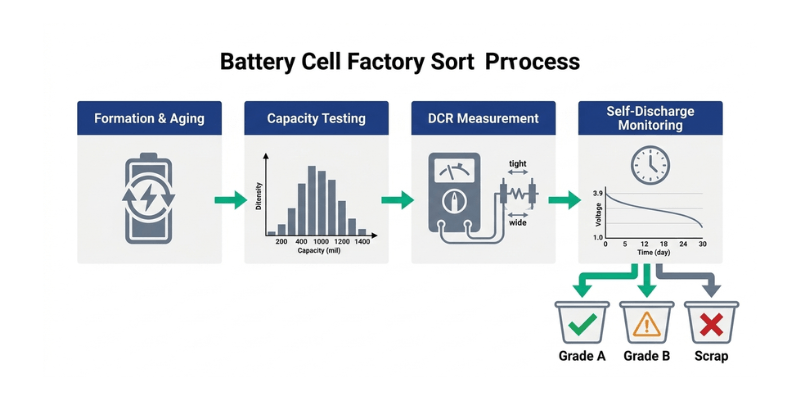
I toured three CATL-tier factories last year. The sorting sequence was consistent across all three:
- Formation and aging. Cells go through initial charge cycles to stabilize the SEI (Solid Electrolyte Interface) layer. This step takes 2-3 weeks depending on chemistry.
- Capacity testing. Automated machines measure discharge capacity at 0.5C or 1C rate. Cells within 2% of nominal go to the Grade A bin.
- Internal resistance measurement. High-speed probes measure DC resistance (DCR), which reflects how much a cell resists current flow under load. Factories also measure AC impedance at 1 kHz for a broader health check, but DCR is the metric that matters most for incoming inspection because it directly predicts heat generation and voltage sag in your pack. Cells with DCR outside a tight band get downgraded.
- Self-discharge monitoring. Cells sit in a temperature-controlled warehouse for 14-30 days. Engineers measure voltage drop. A drop above 2 mV/month signals internal micro-shorts.
Cells passing all four filters become Grade A. Cells failing capacity or showing elevated self-discharge become Grade B. Cells with physical damage or extreme failures become scrap.
Test Note: Factory sorting data referenced from on-site inspections at three LFP cell plants, ambient temperature 23-25°C. Specific automation equipment varies by manufacturer.
What Does Grade B Fraud Look Like?
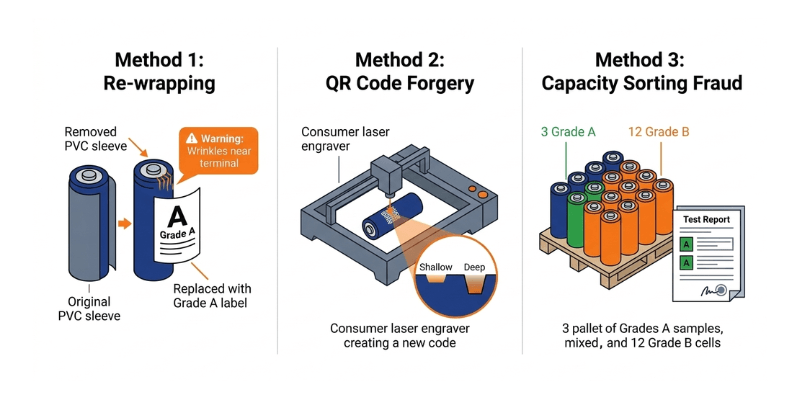
Knowing what fraud looks like is the first step to catching it. Wholesalers in the secondary battery market use three primary methods. I’ve encountered all three during incoming inspections.
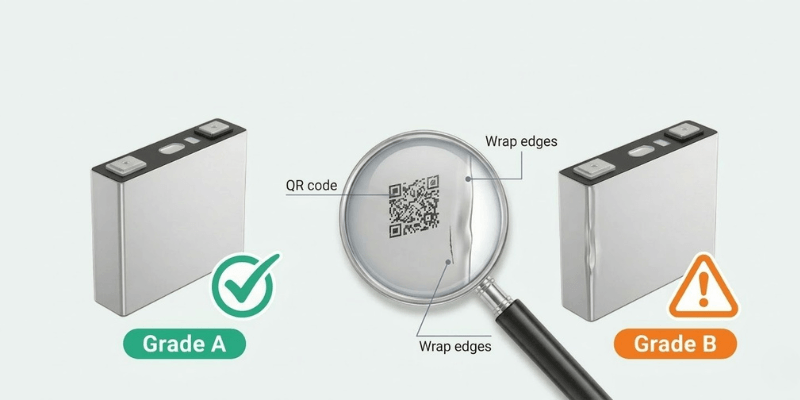
1. Re-wrapping. The supplier removes the original PVC heat-shrink sleeve and applies a new one with a Grade A label. The telltale sign: wrinkles near the terminal, uneven shrink marks, or a slightly different shade of blue compared to genuine factory wraps. We caught a 2,000-cell shipment this way in 2025.
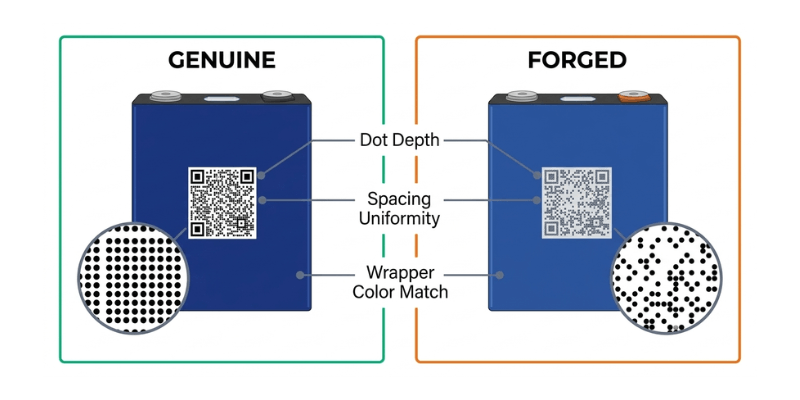
2. QR code forgery. Scammers use consumer-grade laser engravers to create new QR codes. These codes lack the depth, dot consistency, and precision of factory-original markings. When scanned against the manufacturer’s database, forged codes either return no result or point to a different cell model.
3. Capacity sorting fraud. The supplier mixes a small number of genuine Grade A cells with a majority of Grade B stock. They send a test report covering only the Grade A samples. Unless your team tests every cell on arrival, the fraud goes undetected.
What Happens If Grade B Cells Go Undetected?
When fraud slips past your incoming inspection, the consequences show up fast. The business impact hits harder than most procurement teams expect.
String imbalance. A single 270 Ah cell mixed with fifteen 280 Ah cells limits the entire pack to 270 Ah. That is only a 3.6% capacity gap per cell, but it wastes 10 Ah on every cell in the string. Even a difference as small as 3-4% per cell is enough to cause measurable system-level energy loss and trigger longer BMS balancing cycles, which generates extra heat and reduces pack availability.
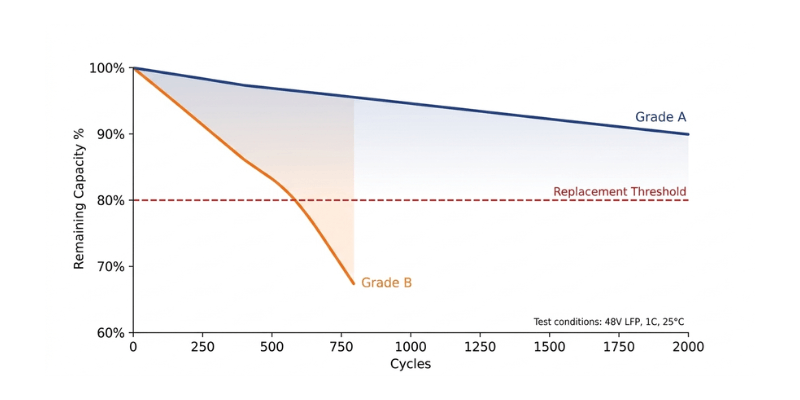
Accelerated degradation. Grade B cells often have less stable electrode chemistry. We tracked a fleet of 48V AGV packs built with mixed-grade LFP cells. The Grade B cells lost 15% capacity in 400 cycles while the Grade A cells in the same string held within 3% of original capacity. A battery pack rated for 2,000 cycles might need replacement at 800.
Voltage sag and system reboots. High DCR in B-grade cells causes significant voltage sag during peak current draw. In AGV applications, this triggers controller reboots during acceleration. One logistics customer reported 3-4 reboots per shift before we traced the issue to three B-grade cells in a 16S2P pack.
Test Note: Degradation data from 48V/280Ah LFP AGV packs tracked over 12 months (2024-2025), 25°C warehouse ambient, 1C peak discharge rate.
How Can Your Team Catch Grade B Fraud on Arrival?
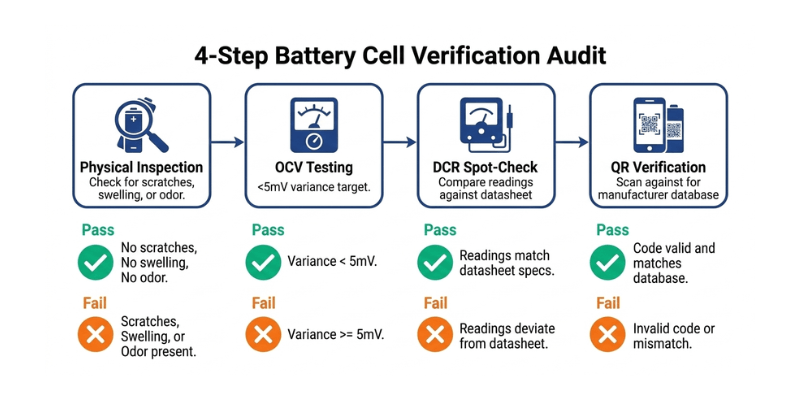
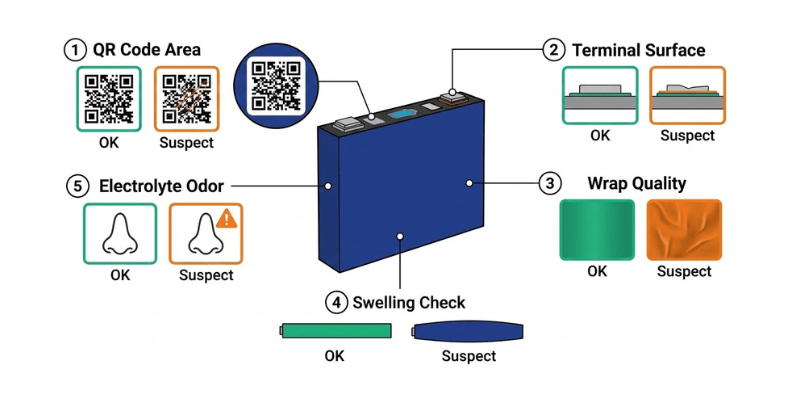
This is the 4-step audit we run on every incoming shipment. Each step targets a specific fraud method from the section above. Your procurement and quality teams can implement the same process. The comparison table and physical inspection diagram below show these same checks from two angles: the table summarizes measurable pass/fail thresholds, while the inspection diagram shows what to look for with your hands and eyes on the actual cell.
Step 1: Physical inspection. Look for scratches near the QR code area. Check for swelling, electrolyte odor, or uneven terminal surfaces. Compare the wrap quality against a known-genuine sample from the same manufacturer.
Step 2: OCV (Open Circuit Voltage) consistency. Measure every cell in the shipment. Grade A cells from the same production batch should show less than 5 mV variance. Wider spread indicates mixed batches or degraded stock.
Step 3: DCR spot-check. Use a calibrated DC resistance tester (or a 1 kHz impedance meter as a proxy). The goal is to verify that cell-to-cell resistance spread stays within the datasheet tolerance. Wide DCR spread in a batch is the strongest single indicator of mixed-grade or degraded stock. According to ISO 9001:2015, incoming material inspection is a required quality management step for battery assembly.
Step 4: QR code verification. Decode every QR code using the manufacturer’s app or database. Check the production date. Cells stored for more than 12 months lose performance and resale value.
| Metric | Grade A (genuine) | Grade B (suspect) | What it means for your business |
| Capacity variance | < 2% | > 5% | String imbalance, reduced pack energy |
| DCR consistency | Tight grouping | Wide distribution | Hot spots, safety risk, shorter life |
| Self-discharge | < 2 mV/month | > 10 mV/month | Internal micro-shorts, early failure |
| QR code status | Intact, scannable | Scratched or re-etched | No traceability, no warranty |
How Much Does Skipping These Checks Cost Your Business?
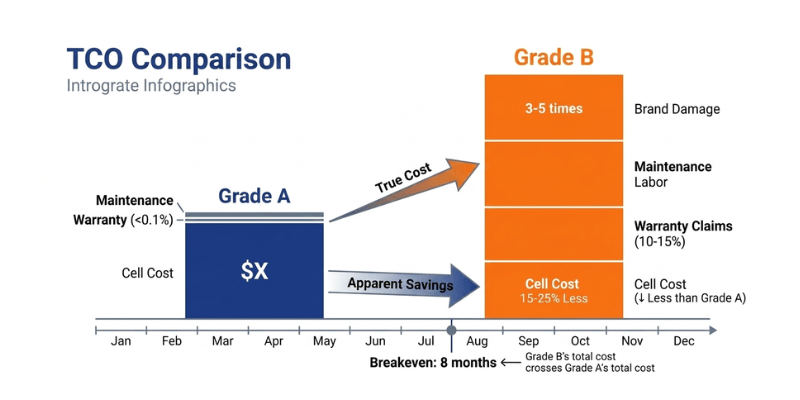
Some procurement teams skip incoming inspection to save time. Buying Grade B cells saves 15-25% on upfront hardware cost. That saving disappears within 12-18 months.
Warranty claims. Battery packs built with Grade B cells show failure rates of 10-15% in the first year. Grade A packs stay below 0.1%. For a fleet of 200 AGV packs, that translates to 20-30 field failures versus zero. Each field failure costs $2,000-4,000 in labor, shipping, and replacement parts.
Maintenance labor. Your service team retrieves and repairs each failed unit. One field failure often costs more than the initial savings on 50-100 battery packs. We calculated the breakeven point for one mid-size AGV integrator: the Grade B “discount” paid for itself in negative ROI within 8 months. Your actual breakeven will vary depending on cell cost as a share of total pack cost, local labor rates, fleet size, and application duty cycle. The pattern is consistent, though: the “savings” rarely survive the first full year.
Brand and customer trust. Premature battery failure erodes customer confidence in your product. For medical device and robotics companies, a single safety incident can trigger regulatory review. According to UN 38.3, lithium battery safety testing must be traceable to cell-level documentation.
Optimize your procurement strategy
This guide covers the risks hiding in battery cell sourcing. Every high-performance battery pack depends on a verified supply chain. I’ve watched three integrators lose major contracts because of Grade B contamination in their packs.
Holo Battery runs 100% incoming inspection on every cell for every project. Our engineering team verifies capacity, DCR, self-discharge, and QR code traceability before a single cell enters production.
FAQ
Do Grade B cells have any legitimate use?
Yes. Grade B cells work for low-drain, low-risk applications like portable power banks, solar garden lights, or backup storage where cycle life and peak current are not critical. They are not suitable for industrial AGVs, medical devices, or any application where cell consistency affects safety or uptime. The key is transparent labeling, not the cells themselves.
How do I tell if a QR code is genuine?
Scan the code with the manufacturer’s official app or database portal. Genuine codes return production date, cell model, batch number, and test data. Forged codes either return nothing, link to a different model, or show a production date that does not match the physical markings on the cell. I keep a reference cell from each manufacturer so I can compare engraving depth and dot pattern under a loupe.
What should a genuine factory test report include?
A real test report includes OCV, DCR, capacity, and self-discharge data for every serial number in the batch, not just a sample. Cross-reference at least 10% of serial numbers against your own incoming inspection data. If the values do not match within 1-2%, the report is fabricated or covers a different batch.
Can small buyers access verified Grade A cells directly?
Small-volume buyers (under 5,000 cells) rarely get direct factory allocation from Tier 1 brands like CATL or BYD. Working with a qualified integrator who performs 100% incoming inspection is the most practical path. Ask for third-party test reports and insist on QR code traceability for every cell in your order.