

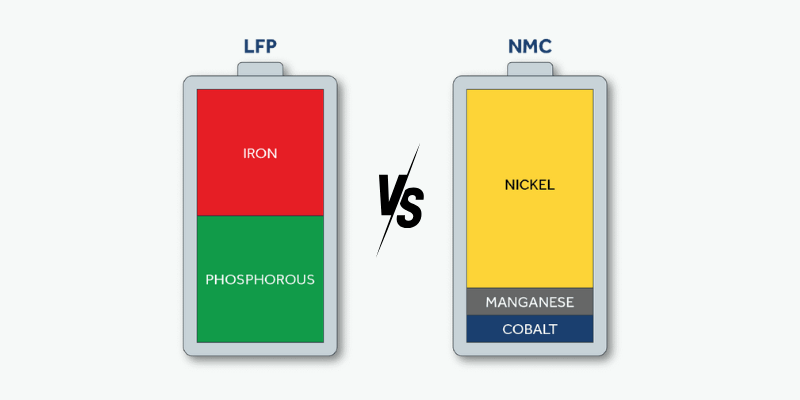
Recomandări cheie
- Energy Density: NMC cells reach 200 to 250 Wh/kg. LFP cells sit around 140 to 170 Wh/kg. CTP designs push LFP battery packs to 130 to 150 Wh/kg at pack level.
- Cycle Life: LFP handles 2,000 to 3,500 cycles. NMC lasts 800 to 1,200 cycles under real conditions.
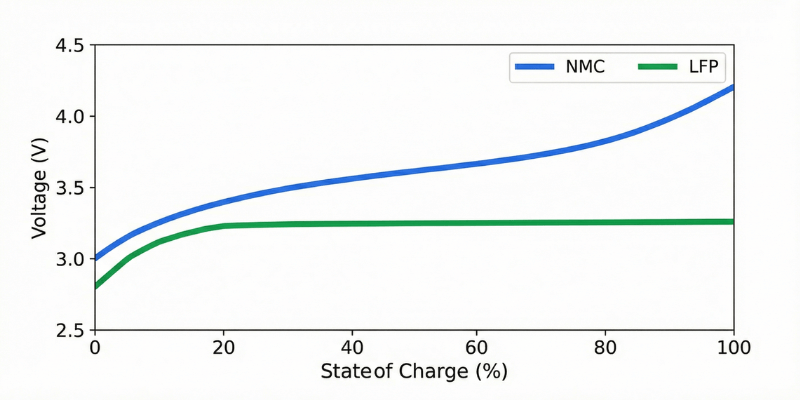
- The SOC Trap: LFP voltage stays flat during discharge. You need Coulomb counting and Kalman filtering in your BMS. NMC voltage drops linearly with charge. Easier to read.
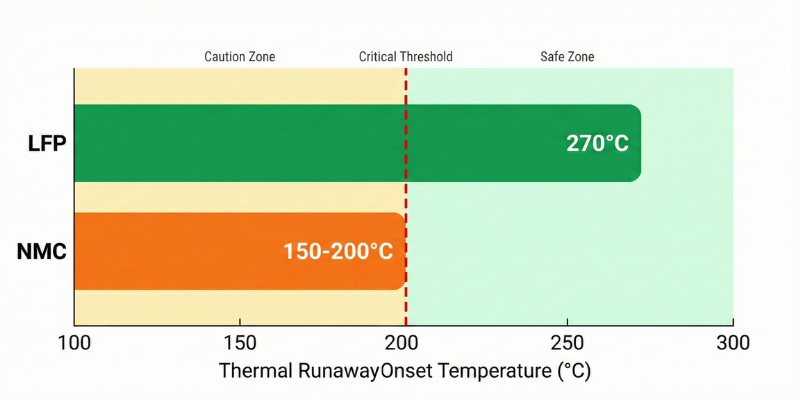
- Safety: LFP thermal runaway starts above 250°C. NMC starts between 150 to 200°C and releases oxygen. Fires spread faster with NMC.
- When to Use What: AGVs, robots, solar storage? LFP. Drones, handheld devices, portable medical gear? NMC.
Why This Guide Exists
You are building a pachet de baterii personalizat.
Marketing says NMC has higher density. Marketing says LFP is safer.
But when you source cells in small batches of 100 to 10,000 units, you do not get headline specs from CATL or BYD press releases. You get what Tier-2 suppliers ship.
This guide uses conservative numbers based on cells you order in small quantities. No lab data. No best-case scenarios. Real specs from real suppliers.
Energy Density (Cell vs. Pack)
Do not look at cell datasheets alone. You buy battery packs. Enclosures, BMS hardware, and thermal materials reduce effective density by 20 to 35 percent. The difference between celula bateriei vs modulul bateriei vs bateriei matters when reading specs.
| Metric | NMC | LFP (Standard) | LFP (CTP Design) |
| Cell Density | 200 to 250 Wh/kg | 140 to 170 Wh/kg | 140 to 170 Wh/kg |
| Battery Pack Density | 140 to 180 Wh/kg | 90 to 120 Wh/kg | 130 to 150 Wh/kg |
| Volume Efficiency | Ridicat | Scăzut | Medium |
The Engineering Reality:
NMC packs weigh 25 to 40 percent less than LFP packs at the same capacity. For drones and handheld tools, every gram counts.
LFP packs are heavier. CTP assembly (no module layer) closes the gap. For AGVs and forklifts, extra weight provides ballast.
The BMS Problem (SOC Estimation)
Firmware engineers often complain when switching from NMC to LFP. The battery gauge jumps around.
The Voltage Curve Problem:
- NMC has a linear discharge curve. Voltage drops steadily from 4.2V to 3.0V. You map voltage to state of charge (SOC) with a simple lookup table.
- LFP has a flat discharge curve. Voltage sits around 3.2V to 3.3V from 80 percent down to 20 percent charge. A 0.1V difference represents 60 percent or 40 percent charge. BMS measurement noise reaches 5mV. The signal remains too close to the noise floor.
The fix:
For LFP, use a fuel gauge IC with Coulomb counting plus Kalman filtering.
Budget for a TI BQ or Analog Devices chip. Add 5 to 8 dollars to your BMS cost.
If you cut corners on the BMS, your users see “50 percent” jump to “20 percent” in five minutes. That creates support problems.
Cycle Life and Total Cost
This is where LFP wins.
Test conditions: 25°C, 1C charge and 1C discharge, 80 percent depth of discharge (DoD), measured to 80 percent state of health (SOH).
| Chimie | Cycle Life (to 80 percent SOH) | Replacement Interval | Cost Trend |
| NMC | 800 to 1,200 cycles | Every 2 to 3 years | Higher operating cost |
| LFP | 2,000 to 3,500 cycles | Every 5 to 8 years | Lower total cost |
NMC makes sense for products with short refresh cycles. Consumer electronics get replaced every 2 to 3 years anyway.
LFP makes sense for capital equipment. AGVs, forklifts, solar storage need to run 5 years or more without battery swaps.
Run the math on replacement labor and downtime. LFP wins on total cost of ownership in most cases.
Safety and Thermal Runaway
No lithium battery is fireproof. But the margins differ.
| Chimie | Runaway Onset Temp | Oxygen Release | Fire Severity |
| NMC | 150 to 200°C | Yes | Harder to extinguish |
| LFP | 250°C or higher | Minim | Limited propagation |
NMC cathodes release oxygen when they decompose. That oxygen feeds the fire from inside the cell.
This is fuga termică.
One cell goes, others follow.
LFP has a stable iron phosphate oxygen bond. A punctured or overcharged LFP cell vents and smokes.
Full thermal runaway is less frequent. Fires spread slower.
For indoor use (warehouses, hospitals, server rooms) LFP simplifies safety paperwork.
Fewer fire suppression requirements. Easier insurance conversations.
Temperature Performance
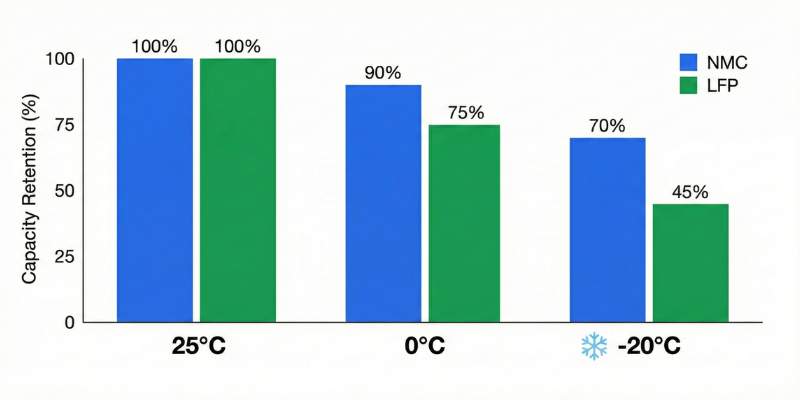
Discharge capacity at low temperatures:
| Temperatură | NMC Capacity | LFP Capacity |
| 25°C | 100 percent | 100 percent |
| 0°C | 88 to 92 percent | 70 to 80 percent |
| Minus 20°C | 65 to 75 percent | 40 to 55 percent |
LFP struggles in cold. Voltage sags. Capacity drops. Internal resistance spikes.
If your product operates in freezers or outdoor winter conditions, NMC handles cold better.
Charging in cold weather:
Cold charging is where LFP gets dangerous.
Below 10°C, lithium ions plate on the anode instead of intercalating. This damages capacity permanently and creates internal short circuit risks.
Rule of thumb: Below 10°C, charge LFP battery at 0.1 to 0.2C max. Or heat the battery pack first. NMC tolerates 0.3 to 0.5C cold. Pre-heating still helps.
If your application needs fast charging in cold environments, add a heating element and temperature-gated charge controller. Budget 5 to 15 dollars extra per battery pack.
Self-Discharge and Shelf Life
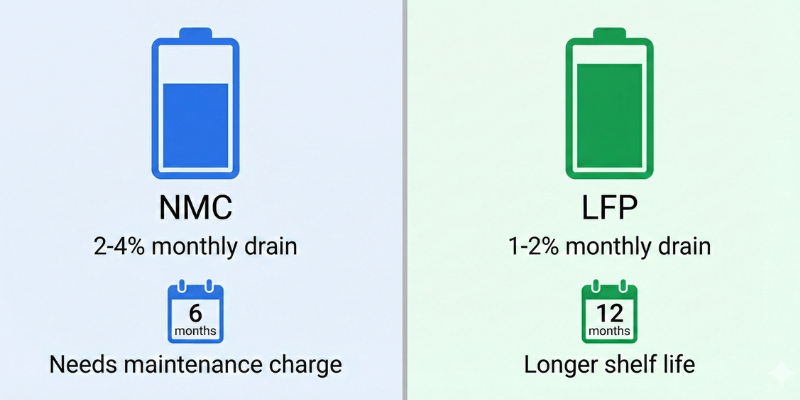
| Chimie | Monthly Self-Discharge | Storage Recommendation |
| NMC | 2 to 4 percent | Store at 40 to 60 percent SOC |
| LFP | 1 to 2 percent | Store at 50 to 60 percent SOC |
LFP holds charge longer on the shelf.
If your products sit in a warehouse for months before shipping, LFP needs less maintenance charging. Lower risk of deep discharge damage.
For best practices, see Cum să depozitați bateriile de litiu în siguranță.
Pricing (Small Batch, 2026)
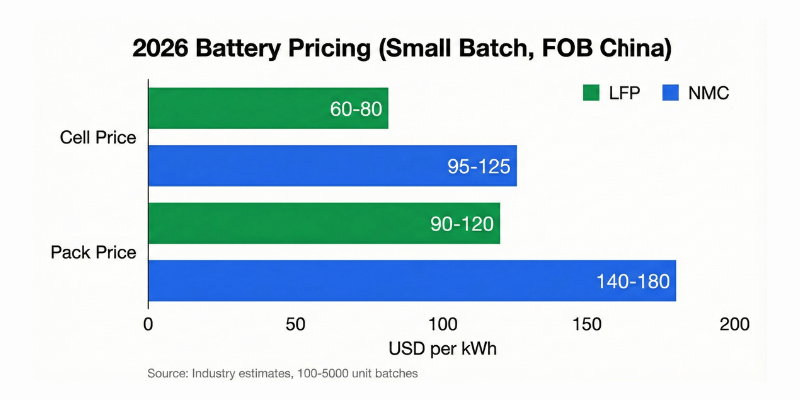
These are realistic prices for small batch custom packs (100 to 5,000 units), FOB China, as of early 2026. Large volume OEM deals get better rates. Cost vs performance trade-offs depend on your volume.
| Level | LFP | NMC |
| Cell Price | 60 to 80 dollars per kWh | 95 to 125 dollars per kWh |
| Battery Pack Price | 90 to 120 dollars per kWh | 140 to 180 dollars per kWh |
Supply chain note: LFP uses iron and phosphate. Cheap. Abundant. Stable pricing. NMC depends on cobalt and nickel. Volatile pricing tied to DRC mining and Indonesian supply. If you plan a product with a 5-year production run, LFP gives you more predictable costs.
Environmental and Compliance
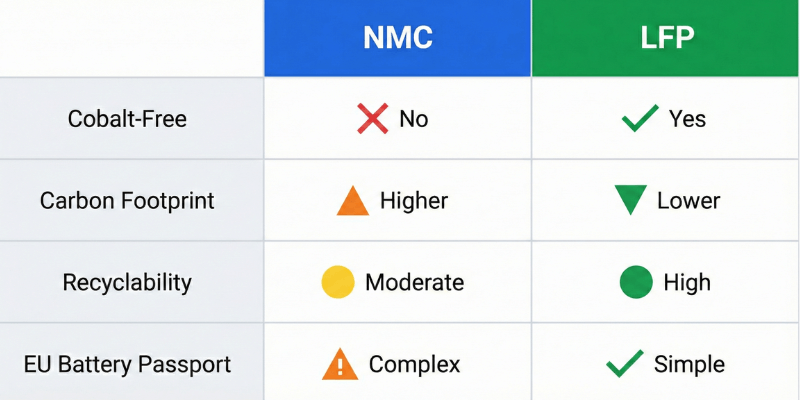
| Factor | NMC | LFP |
| Cobalt-free | Nu | Yes |
| Carbon footprint | Superior | Mai jos |
| Recyclability | Moderat | Superior |
| EU Battery Passport (2027 | More documentation | Simpler |
If your customers care about ESG, or if you sell into the EU market, LFP is easier to document. No conflict mineral reporting for cobalt.
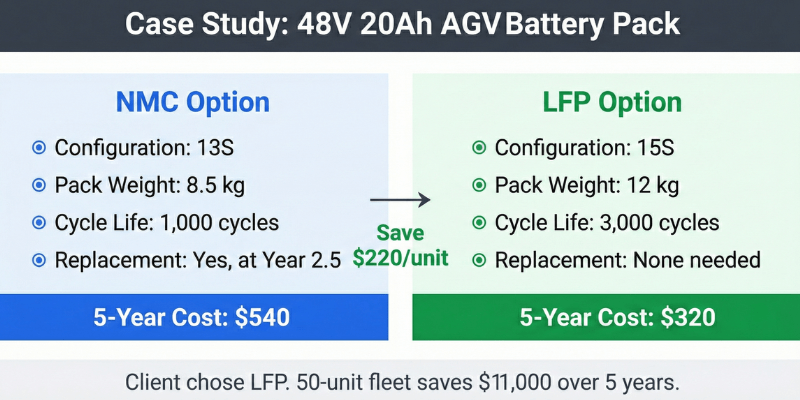
Real Project Example: AGV Battery Selection
Last year we designed a battery pack for a warehouse AGV fleet. Client requirements:
- Target voltage: 48V
- Target capacity: 20Ah
- Minimum cycle life: 3,000 cycles
- Usage environment: Indoor warehouse
- Budget limit: 300 dollars per pack
We compared NMC and LFP options:
NMC option:
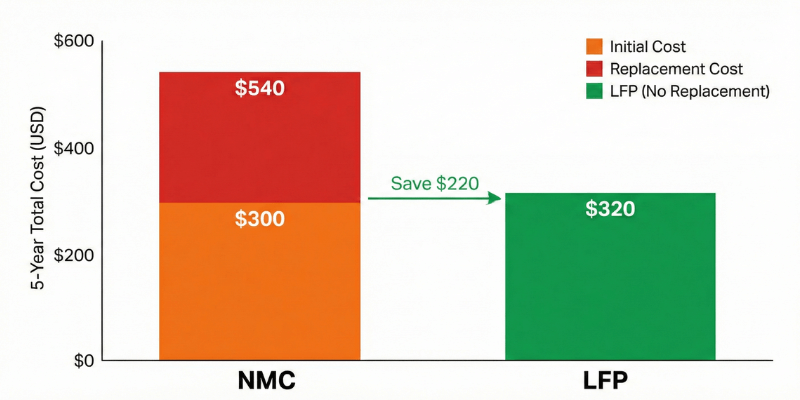
- Configuration: 13S (48.1V nominal)
- Battery pack weight: 8.5kg
- Estimated cycle life: 1,000 cycles
- Replacement needed: Yes, at year 2.5
- 5-year cost including one replacement: 540 dollars
LFP option:
- Configuration: 15S (48V nominal)
- Battery pack weight: 12kg
- Estimated cycle life: 3,000 cycles
- Replacement needed: No
- 5-year cost: 320 dollars
The client chose LFP. The extra 3.5kg was acceptable for a floor-based AGV.
Total cost savings over 5 years: 220 dollars per unit. For a 50-unit fleet, that equals 11,000 dollars saved.
Key lesson: Always calculate total cost over product lifetime. Upfront price is misleading.
Common Mistakes When Choosing Chemistry
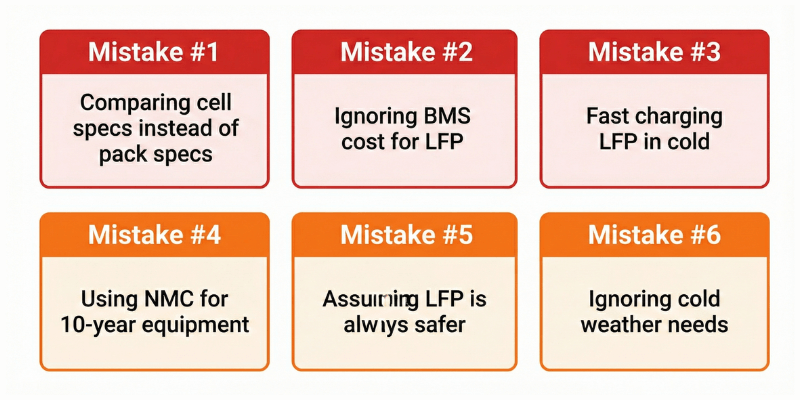
Mistake 1: Comparing cell specs instead of battery pack specs
Cell density of 250 Wh/kg becomes 160 Wh/kg at pack level after you add enclosure, BMS, and thermal management. Always ask suppliers for pack-level data.
Mistake 2: Ignoring BMS cost for LFP
LFP needs smarter SOC estimation. A basic voltage-based BMS fails with LFP. Add 5 to 10 dollars per pack for a proper fuel gauge IC with Coulomb counting.
Mistake 3: Fast charging LFP in cold without heating
Below 10°C, you must add a heating film or PTC heater. Budget 8 to 12 dollars per pack. Allow 15 to 30 minutes pre-heat time before fast charging.
Mistake 4: Using NMC for 10-year equipment
NMC reaches 80 percent SOH in 2 to 3 years under daily cycling. For equipment designed to last 10 years, you pay for 3 to 4 battery replacements over the product life. LFP often costs less in total.
Mistake 5: Assuming LFP is always safer
LFP is safer in thermal runaway scenarios. But a poorly designed BMS allows overcharging, which damages any chemistry. Proper protection circuits are required for both LFP and NMC.
Mistake 6: Ignoring cold weather requirements
If your product ships to regions with winter temperatures below 0°C, test LFP discharge at minus 10°C and minus 20°C. Capacity drops 30 to 50 percent. NMC handles cold better. Or add heating to your LFP design.
LFP vs NMC Selection Checklist
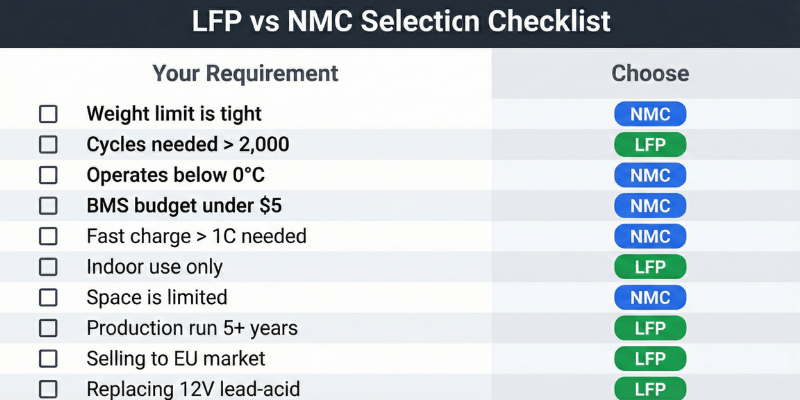
Before you choose, answer these questions:
What is your target battery pack weight limit?
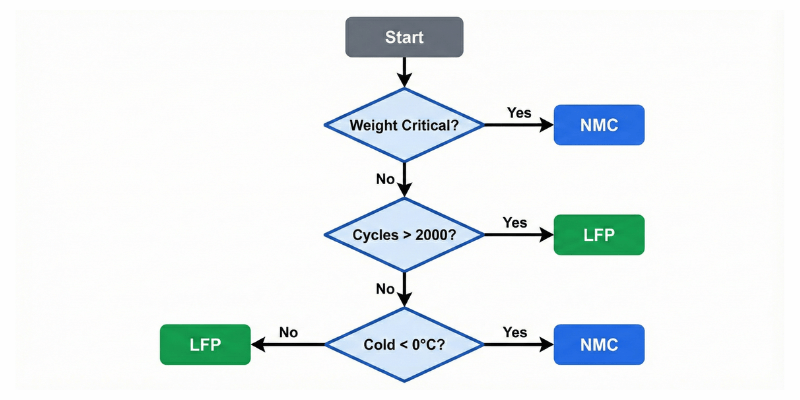
If weight limit is tight: NMC
How many charge cycles do you need over product life?
If more than 2,000 cycles: LFP
Does your product operate below 10°C?
If yes: NMC, or LFP with heating system
What is your BMS budget per unit?
If under 5 dollars: NMC (simpler SOC estimation)
Do you need fast charging above 1C?
If yes: NMC or LMFP
Is the product used indoors or outdoors?
If indoor only: LFP preferred for lower fire risk
What is your acceptable battery pack volume?
If space is limited: NMC
How long is your planned production run?
If 5 years or more: LFP for stable material costs
Do you sell into EU markets?
If yes: LFP simplifies Battery Passport compliance
Are you replacing an existing 12V lead-acid battery?
If yes: LFP (4S equals 12.8V, drop-in compatible)
Decision Matrix
| Your Priority | Pick This | Why |
| Lightest battery pack | NMC | 25 to 40 percent lighter than LFP |
| Longest cycle life | LFP | 2 to 3 times more cycles |
| Lowest fire risk | LFP | Higher runaway threshold. No oxygen release |
| Cold weather operation | NMC | Better low temperature discharge |
| Replacing 12V lead-acid | LFP | 4S equals 12.8V nominal. Drop-in compatible |
| Stable long-term pricing | LFP | No cobalt or nickel exposure |
| Fast charge required | NMC or LMFP | Standard LFP prefers slow charge |
FAQ
Which chemistry replaces lead-acid batteries better?
LFP. A 4S LFP pack runs at 12.8V nominal. That fits the 12V lead-acid window (10.5 to 14.4V) almost perfectly. NMC 3S (11.1V) is too low. NMC 4S (14.8V) is too high for most 12V systems without voltage conversion.
Why does my LFP battery percentage jump around?
Flat voltage curve. Your BMS tries to guess SOC from voltage. But LFP voltage barely changes between 20 and 80 percent charge. Fix: use a BMS with Coulomb counting. Run a full charge and discharge cycle occasionally to recalibrate.
Is LFP safer than NMC?
In most failure scenarios, yes. LFP thermal runaway starts 50 to 100°C higher than NMC. LFP does not release oxygen to fuel a fire. But “safer” does not mean “safe.” A damaged or overcharged LFP pack still vents hot gas. Proper BMS protection is still required.
What is the best BMS chip for LFP SOC estimation?
Texas Instruments BQ34Z100 and BQ40Z50 work well. Analog Devices LTC2944 is another option. These chips support Coulomb counting with drift correction. Budget 3 to 8 dollars per unit depending on features.
How do I calculate LFP battery pack capacity for my application?
Start with your load power in watts. Divide by nominal voltage (3.2V per cell times series count). Add 20 percent margin for capacity fade over life. Add another 10 percent if you operate below 10°C.
Example: 500W load, 48V system (15S LFP), 2-hour runtime needed.
500W divided by 48V equals 10.4A.
10.4A times 2 hours equals 20.8Ah.
Add 20 percent margin: 25Ah minimum capacity.
What is the voltage range of a 48V LFP battery pack?
A 15S LFP pack:
Nominal voltage: 48V (3.2V times 15)
Full charge: 54.75V (3.65V times 15)
Empty (recommend cutoff): 42V (2.8V times 15)
Compare to 13S NMC:
Nominal voltage: 48.1V (3.7V times 13)
Full charge: 54.6V (4.2V times 13)
Empty: 39V (3.0V times 13)
How do I charge LFP below 0°C safely?
Do not charge LFP below 0°C without pre-heating. Lithium plating occurs at low temperatures and damages cells permanently.
Solution: Add a PTC heater or heating film inside the pack. Use a temperature sensor and charge controller that blocks charging until pack temperature reaches 10°C or higher. Budget 8 to 15 dollars extra per pack for heating system.
How long do LFP batteries last in solar storage?
Solar storage typically cycles once per day (charge during sunlight, discharge at night). At 80 percent DoD and 25°C, a quality LFP cell lasts 3,000 cycles or more. That equals 8 years of daily cycling.
NMC in the same application lasts 1,000 cycles or about 2.7 years. You replace NMC 3 times during the period one LFP pack lasts.
Should I wait for LMFP?
LMFP adds manganese to LFP. Raises voltage from 3.2V to 3.65V. That gives 15 to 20 percent more energy density. Safety stays at LFP level. Worth considering if small batch supply improves. Check availability with your supplier before designing around LMFP.