

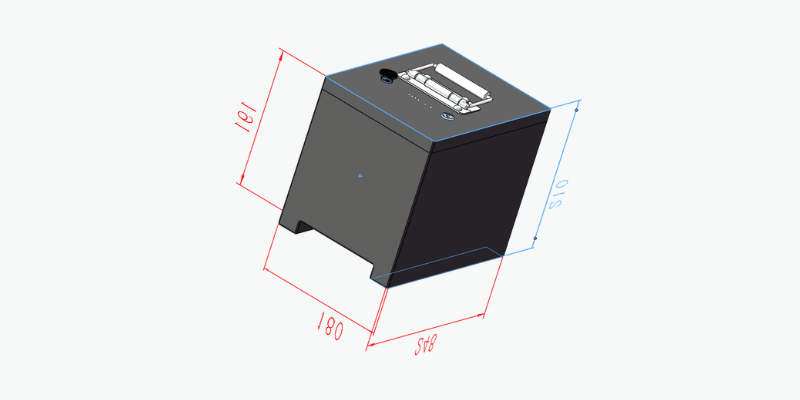
Am meisten AGV-Batterie Ausfälle sind auf fünf vermeidbare Integrationsfehler zurückzuführen. Diese Fehler beschleunigen den chemischen Abbau. Integrationsfehler reduzieren die Nennlebensdauer um 50 bis 70 Prozent. Das Verständnis der Grundursachen ermöglicht es Ingenieuren, Systeme mit mehr als 4.000 LFP-Zyklen zu entwerfen.
Direkte Antwort
AGV-Batterien erreichen nicht die Nennleistung Zyklus Leben aufgrund von Integrationsfehlern. Die Zellqualität ist selten die Hauptursache. Zu den fünf primären Fehlermodi gehören:
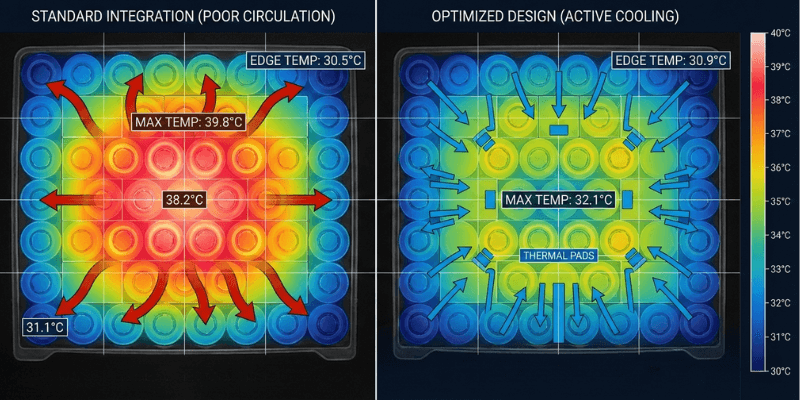
- Interne Temperaturgradienten erzeugen Deltas von 5 bis 8 Grad Celsius. Dies beschleunigt die Alterung der zentralen Zellen um das 1,5-fache.
- Hoher Gleichstromwiderstand durch zu geringes Drehmoment an den Sammelschienen. Dies löst bei 20 Prozent Restladung fälschlicherweise Unterspannungsabschaltungen aus.
- Lithiumbeschichtung durch Kaltladung unter 10 Grad Celsius. Dadurch wird die Kapazität dauerhaft reduziert.
- Tiefentladung auf 2,5 V pro Zelle. Dadurch erhöht sich der Innenwiderstand und die Lebensdauer wird halbiert.
- Mechanische Vibration bei 10 bis 500 Hz. Dies führt zu einer Ermüdung der Laschen und unregelmäßigen Spannungsmesswerten.
Das richtige Wärmemanagement und konservative Spannungsgrenzen verlängern die LFP-Lebensdauer auf über 4.000 Zyklen. Die Standardintegration dient AGVs mit niedrigem Arbeitszyklus in klimatisierten Lagerhäusern mit täglicher Zwischenladung bei über 15 Grad Celsius.
Wärmegradienten verursachen unterschiedliche Alterung
Mittelzellen in dichten 16S-Packungen werden 5 bis 8 Grad Celsius heißer als Randzellen. Schlechter Luftstrom speichert Wärme. Heißere Zellen verlieren 1,5-mal schneller an Kapazität als kältere Zellen. Dieses Ungleichgewicht löst vorzeitig aus BMS Niederspannungsabschaltungen. Die Packung stoppt, während gesunde Zellen noch 20 Prozent Energie enthalten.
Lösung: Entwerfen Sie aktive Luftströmungskanäle zwischen Zellmodulen. Verwenden Sie Wärmeleitpads mit hoher Leitfähigkeit, um die Wärme an das äußere Gehäuse abzuleiten. Halten Sie das interne Temperaturdelta in allen Zellen unter 3 Grad Celsius.
Ein hoher Gleichstromwiderstand führt zu Fehlabschaltungen
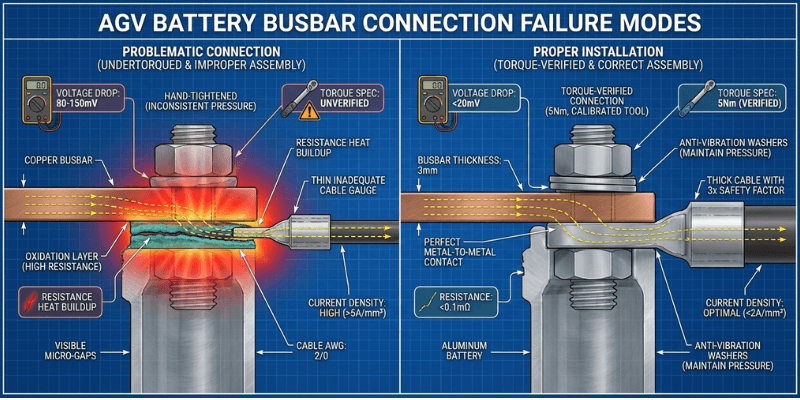
Dünne Stromkabel und von Hand festgezogene Stromschienen erhöhen den Innenwiderstand. AGVs benötigen zum Beschleunigen und Heben einen hohen Spitzenstrom. Ein hoher Widerstand führt zu erheblichen IR-Spannungsabfällen. Anschlüsse mit zu geringem Drehmoment erzeugen einen zusätzlichen Spannungsabfall von 80 bis 150 mV. Das BMS löst Abschaltungen aus, solange noch 30 Prozent Ladung übrig sind.
Lösung: Berechnen Sie die Kabelquerschnitte für den Spitzenstrom. Verwenden Sie einen 3-fachen Sicherheitsfaktor für die Stromdichte. Überprüfen Sie alle Stromschienenverbindungen mit kalibrierten Drehmomentschlüsseln. Drehmoment auf 5 Nm einstellen. Bringen Sie schwingungsdämpfende Unterlegscheiben an, um den Anpressdruck beim Transport auf dem Boden aufrechtzuerhalten.
Kaltes Laden verursacht dauerhafte Schäden
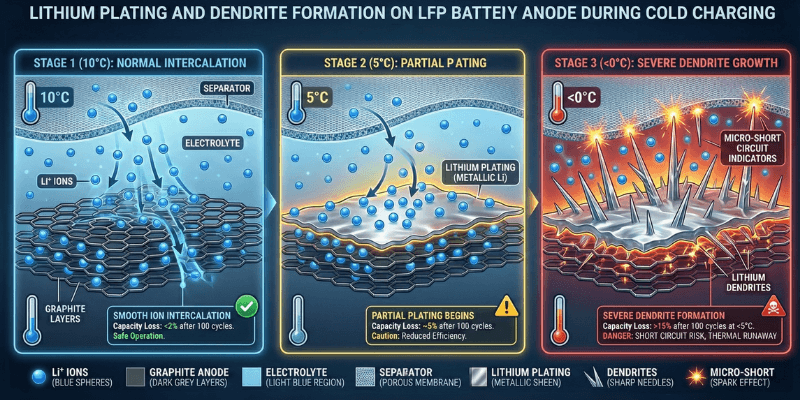
Das Laden von LFP-Akkus bei unter 10 Grad Celsius ohne Vorheizen führt dazu, dass sich Lithiumionen auf dem Akku ablagern Anode Oberfläche. Ionen können sich nicht in Graphitschichten einlagern. Durch die Beschichtung entstehen metallische Dendriten. Dendriten verursachen Mikrokurzschlüsse. Die Kapazität sinkt dauerhaft. Die Brandgefahr steigt. Eine Kaltladung unter 5 Grad Celsius verringert die Gesamtkapazität nach 100 Zyklen um 15 Prozent.
Lösung: PTC-Heizungen oder Polyimid-Heizfolien integrieren. Programmieren Sie das BMS so, dass der Ladevorgang blockiert wird, bis die Zellen eine Temperatur von 15 Grad Celsius erreichen. Verwenden Sie temperaturgesteuerte Laderegler für Tiefkühlumgebungen.
Tiefentladung beschleunigt das Widerstandswachstum
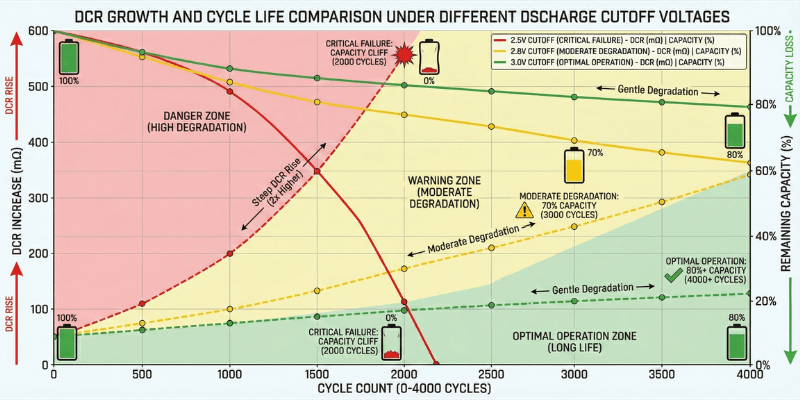
Die werkseitigen BMS-Einstellungen ermöglichen häufig eine Entladung auf 2,5 V pro Zelle. Durch häufige Tiefentladung erhöht sich der Innenwiderstand (DCR) dauerhaft. Ein hoher Widerstand verringert die Leistungsabgabe. AGVs verlieren an Drehmoment und Geschwindigkeit. Entladeunterbrechungen unter 2,8 V pro Zelle verkürzen die Lebensdauer des LFP-Zyklus um 50 Prozent.
Lösung: Stellen Sie die Software-Entladeunterbrechung auf 3,0 V pro Zelle ein. Sorgen Sie für einen Ladezustandspuffer (SOC) von 10 Prozent. Dieser konservative Grenzwert verlängert die Lebensdauer des LFP-Zyklus auf 4.000 Zyklen.
Mechanische Resonanz und Tab-Ermüdung
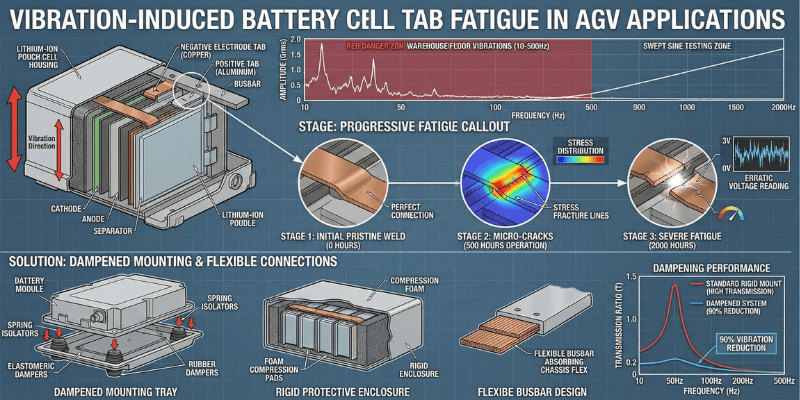
Lagerhallen haben unebene Böden. Ständige Mikrovibrationen bei 10 bis 500 Hz führen zu mechanischer Ermüdung der Zellenlaschen. Lose Laschen erzeugen Funken und unregelmäßige Spannungswerte. Interne Zellschäden durch Schock sind irreversibel. Batteriesysteme in Materialtransportgeräten müssen Sinusschwingungen von 10 bis 2000 Hz standhalten.
Lösung: Dämpfungslager für den Batterieträger verwenden. Sichern Sie die Zellen in einem starren Gehäuse mit Schaumstoffkompression. Stellen Sie sicher, dass die internen Sammelschienen flexibel bleiben, um die Biegung des Gehäuses zu absorbieren, ohne die Zellanschlüsse zu belasten.
Vergleich der technischen Auswirkungen
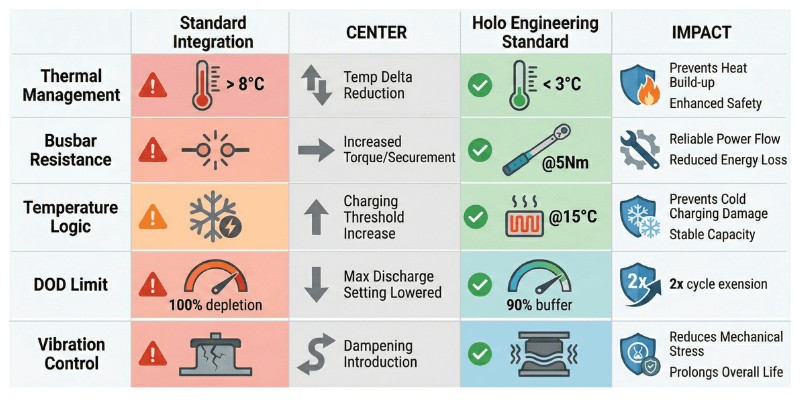
| Technischer Faktor | Standardintegration | Holo Battery Engineering Standard | Lebenslange Auswirkungen |
| Zelltemperaturdelta | > 8 Grad Celsius | < 3 Grad Celsius | Verhindert ein Ungleichgewicht der Saiten |
| Sammelschienenwiderstand | Von Hand festgezogen | Drehmoment überprüft (5 Nm) | Eliminiert lokale Hitze |
| Niedrigtemperaturlogik | Aufladen bei jeder Temperatur | Auf 15 Grad Celsius vorheizen | Verhindert Lithiumplattierung |
| DOD-Limit | 100 Prozent | 90 Prozent | 2-fache Verlängerung der Zykluslebensdauer |
| Vibrationskontrolle | Starre Montage | Angefeuchtetes Tablett | Verhindert Laschenbrüche |
FAQ
Warum sinkt der Prozentsatz der AGV-Batterie während des Aufzugsbetriebs plötzlich?
Hohe Stromentnahmen erzeugen einen IR-Abfall über Verbindungen mit hohem Widerstand. Das BMS erkennt einen Spannungseinbruch. Dadurch springt der SOC-Algorithmus auf einen niedrigeren Wert. Untersuchen Sie die Sammelschienen auf Oxidation. Überprüfen Sie die Drehmomenteinstellungen auf 5 Nm.
Sollten Sie aktive Kühlung für AGV-Batterien verwenden?
Für AGVs mit hohem Arbeitszyklus ist eine aktive Kühlung erforderlich. Im Mehrschichtbetrieb entsteht ein Wärmestau. Bei der passiven Kühlung gelingt es nicht, die Wärme aus dem Packungskern abzuleiten. Die mittleren Zellen werden überhitzen und ausfallen.