

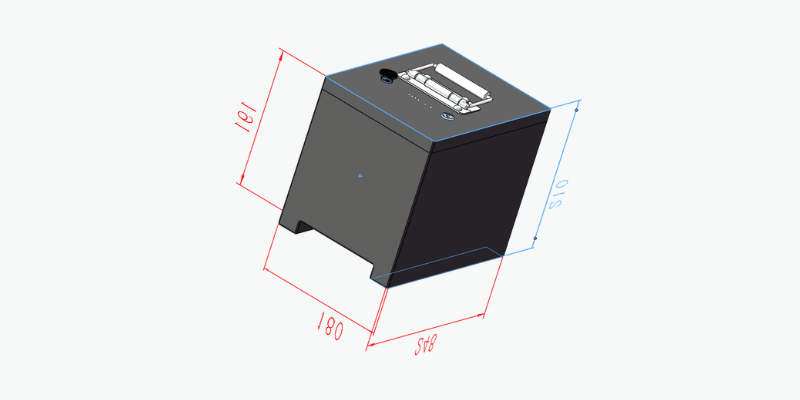
Most AGV battery failures stem from five preventable integration errors. These mistakes accelerate chemical degradation. Integration errors reduce rated cycle life by 50 to 70 percent. Understanding root causes allows engineers to design systems reaching 4,000 plus LFP cycles.
Réponse directe
AGV batteries fail to reach rated cycle de vie due to integration mistakes. Cell quality is rarely the primary cause. The five primary failure modes include:
- Internal thermal gradients creating 5 to 8 degrees Celsius deltas. This accelerates center cell aging by 1.5x.
- High DC resistance from undertorqued busbars. This triggers false low voltage shutdowns at 20 percent remaining charge.
- Lithium plating from cold charging below 10 degrees Celsius. This permanently reduces capacity.
- Deep discharge to 2.5V per cell. This increases internal resistance and cuts cycle life in half.
- Mechanical vibration at 10 to 500Hz. This causes tab fatigue and erratic voltage readings.
Proper thermal management and conservative voltage limits extend LFP service life to 4,000 plus cycles. Standard integration serves low duty cycle AGVs in climate controlled warehouses with daily opportunity charging above 15 degrees Celsius.
Thermal Gradients Cause Divergent Aging
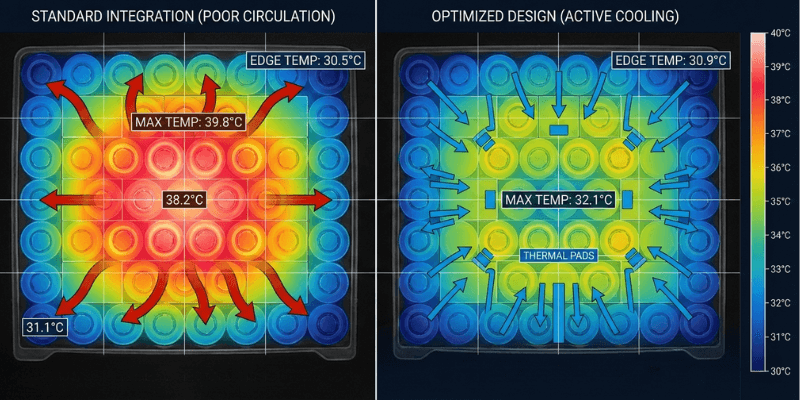
Center cells in dense 16S packs run 5 to 8 degrees Celsius hotter than edge cells. Poor airflow traps heat. Hotter cells lose capacity at 1.5x the rate of cooler cells. This imbalance triggers premature GTC low voltage cutoffs. The pack stops while healthy cells still hold 20 percent energy.
Solution: Design active airflow channels between cell modules. Use high conductivity thermal pads to sink heat to the outer chassis. Keep the internal temperature delta below 3 degrees Celsius across all cells.
High DC Resistance Creates False Shutdowns
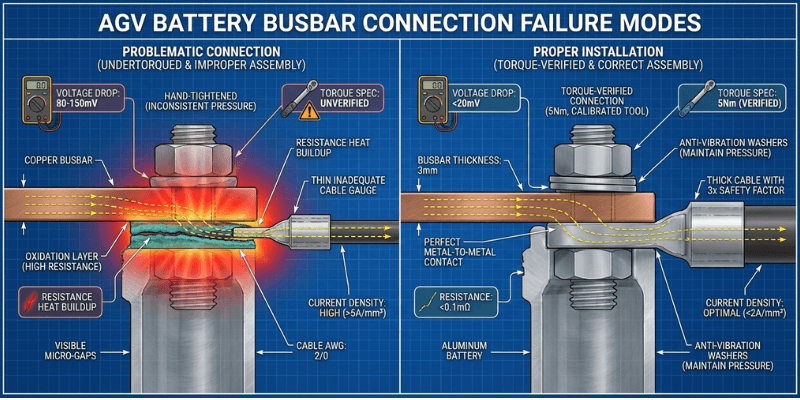
Thin power cables and hand tightened busbars increase internal resistance. AGVs require high peak current for acceleration and lifting. High resistance causes significant IR voltage drops. Undertorqued connections create 80 to 150mV additional voltage sag. The BMS triggers cutoffs while 30 percent charge remains.
Solution: Calculate cable gauges for peak current. Use a 3x safety factor for current density. Verify all busbar connections with calibrated torque wrenches. Set torque to 5Nm. Apply anti vibration washers to maintain contact pressure during floor transit.
Cold Charging Causes Permanent Damage
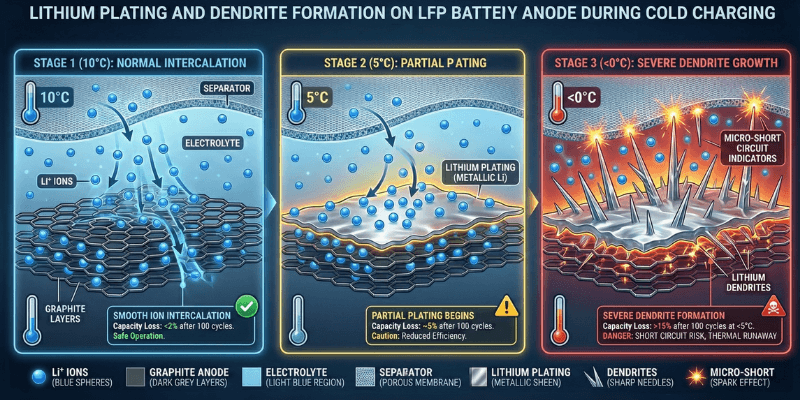
Charging LFP batteries below 10 degrees Celsius without pre heating causes lithium ions to plate on the anode surface. Ions fail to intercalate into graphite layers. Plating forms metallic dendrites. Dendrites cause micro shorts. Capacity drops permanently. Fire risks increase. Cold charging below 5 degrees Celsius reduces total capacity by 15 percent after 100 cycles.
Solution: Integrate PTC heaters or polyimide heating films. Program the BMS to block charging until cells reach 15 degrees Celsius. Use temperature gated charge controllers for freezer environments.
Deep Discharge Accelerates Resistance Growth
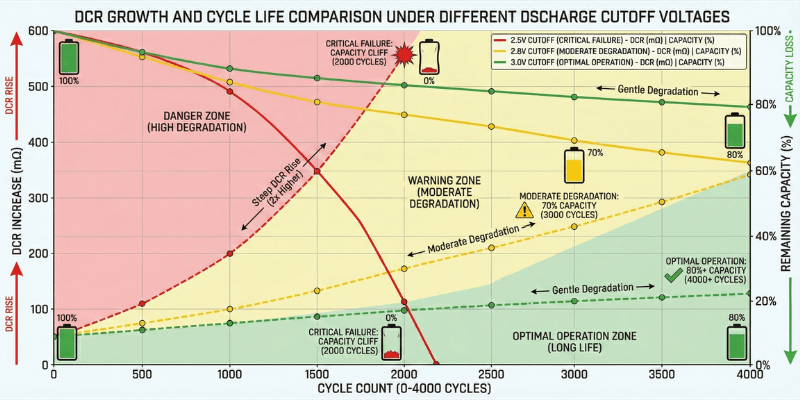
Factory BMS settings often allow discharge to 2.5V per cell. Frequent deep discharge increases internal resistance (DCR) permanently. High resistance reduces power delivery. AGVs lose torque and speed. Discharge cutoffs below 2.8V per cell reduce LFP cycle life by 50 percent.
Solution: Set the software discharge cutoff to 3.0V per cell. Maintain a 10 percent State of Charge (SOC) buffer. This conservative limit extends LFP cycle life to 4,000 cycles.
Mechanical Resonance and Tab Fatigue
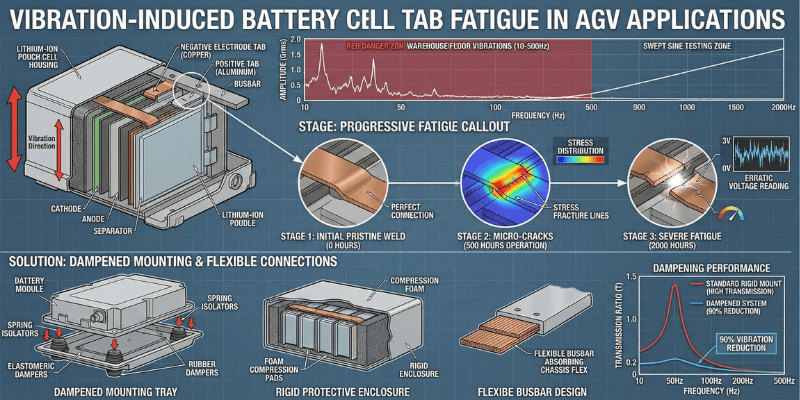
Warehouses have uneven floors. Constant micro vibrations at 10 to 500Hz cause mechanical fatigue on cell tabs. Loose tabs create sparks and erratic voltage readings. Internal cell damage from shock is irreversible. Battery systems in material handling equipment must withstand 10 to 2000Hz swept sine vibration.
Solution: Use dampening mounts for the battery tray. Secure cells inside a rigid enclosure with foam compression. Ensure internal busbars remain flexible to absorb chassis flex without stressing cell terminals.
Engineering Impact Comparison
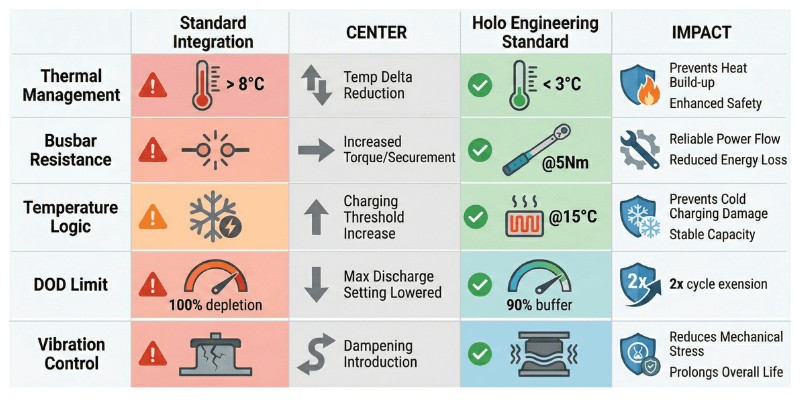
| Engineering Factor | Standard Integration | Holo Battery Engineering Standard | Lifetime Impact |
| Cell Temperature Delta | > 8 degrees Celsius | < 3 degrees Celsius | Prevents string imbalance |
| Busbar Resistance | Hand tightened | Torque verified (5Nm) | Eliminates localized heat |
| Low Temp Logic | Charge at any temp | Pre heat to 15 degrees Celsius | Prevents lithium plating |
| DOD Limit | 100 percent | 90 percent | 2x cycle life extension |
| Vibration Control | Rigid mounting | Dampened tray | Prevents tab fractures |
FAQ
Why Does the AGV Battery Percentage Drop Suddenly During Lift Operations?
High current draws create an IR drop across high resistance connections. The BMS detects a voltage dip. This causes the SOC algorithm to jump to a lower value. Inspect busbars for oxidation. Verify torque settings to 5Nm.
Should You Use Active Cooling for AGV Batteries?
Active cooling is necessary for high duty cycle AGVs. Heat accumulates during multi shift operations. Passive cooling fails to remove heat from the pack core. Center cells will overheat and fail.