

If you are building an off-grid power system, you likely use LiFePO4 batteries. These batteries are safer and last longer than older lead-acid batteries.
However, they work differently. You cannot guess how full the battery is just by looking at the voltage. You must also program your equipment with the correct numbers. If you use the wrong settings, you could damage the battery.
This guide provides the simple charts and numbers you need to set up your system.
Basics about LiFePO4 Battery Voltage
To understand your battery, know that a “cell” is its basic unit. A battery pack contains several connected cells.
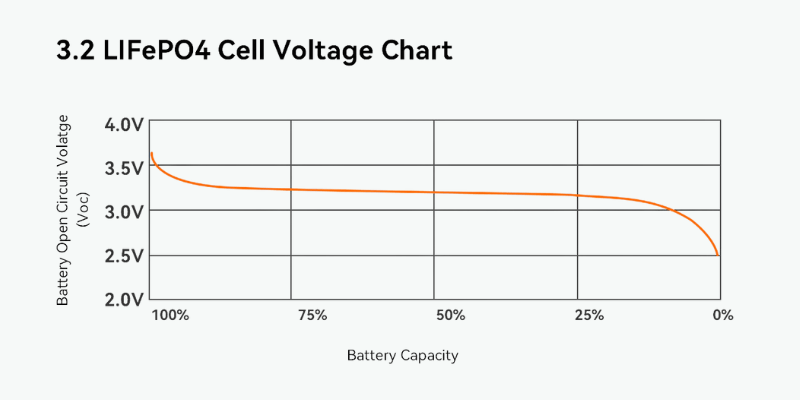
Each LiFePO4 cell has a nominal voltage of 3.2V, which is its average voltage during use. Its safe range is 2.5V to 3.65V.
LiFePO4 batteries have a flat discharge curve, so voltage stays steady during use, unlike car batteries where voltage drops steadily. This efficiency makes it hard to gauge the remaining energy.
The LiFePO4 Voltage Chart: 12V, 24V, and 48V
The following charts show the Resting Voltage, which is measured when the battery is neither charging nor powering devices. Wait at least 30 minutes after use before checking this number.
| Pecentage (SOC) | 1 Cell | 12V | 24V | 48V |
| 100% Charging | 3.65V | 14.6V | 29.2V | 58.4V |
| 100% Rest | 3.40V | 13.6V | 27.2V | 54.4V |
| 90% | 3.35V | 13.4V | 26.8V | 53.6V |
| 80% | 3.32V | 13.3V | 26.6V | 53.1V |
| 70% | 3.30V | 13.2V | 26.4V | 52.8V |
| 60% | 3.27V | 13.1V | 26.1V | 52.3V |
| 50% | 3.26V | 13.0V | 26.1V | 52.2V |
| 40% | 3.25V | 13.0V | 26.0V | 52.0V |
| 30% | 3.22V | 12.9V | 25.8V | 51.5V |
| 20% | 3.20V | 12.8V | 25.6V | 51.2V |
| 10% | 3.00V | 12.0V | 24.0V | 48.0V |
| 0% | 2.50V | 10.0V | 20.0V | 40.0V |
LiFePO4 Battery Charging Parameters
You must program your solar charge controller or inverter with the right limits.
Unlike lead-acid batteries, LiFePO4 batteries are sensitive to high voltage. If you go too high, the Battery Management System (BMS) inside the battery will shut it off for protection.
Use these settings as a baseline and always consult your battery brand’s manual.
| Nornimal Voltage | 3.2V | 12V/12.8V | 24V/25.6V | 48V/51.2V |
| Charging Voltage | 3.5V-3.65V | 14.2V-14.6V | 28.4V-29.2V | 56.8V-58.4V |
| Floate Voltage | 3.2V | 13.6V | 27.2V | 54.4V |
| Max. Voltage | 3.65V | 14.6V | 29.2V | 58.4V |
| Min. Voltage | 2.5V | 10V | 20V | 40V |
LiFePO4 Batteries Bulk, Float, and Equalize Voltages
You will see these terms in your equipment settings. Here is what they mean and what numbers to use.
Bulk Voltage (Absorption): This is the voltage used to charge the battery from empty to full. It is the highest voltage the charger will reach.
- 12V System: 14.2V to 14.6V
- 24V System: 28.4V to 29.2V
- 48V System: 56.8V to 58.4V
Float Voltage: Once the battery is full, the charger drops the voltage. This maintains the charge without stressing the cells.
- 12V System: 13.5V to 13.6V
- 24V System: 27.0V to 27.2V
- 48V System: 54.0V to 54.4V
Equalize Voltage: Equalization is a controlled overcharge used for lead-acid batteries to clean the plates.
- Setting: OFF or Disabled.
- Warning: Do not use equalization on LiFePO4 batteries. It causes high voltage that can permanently damage lithium cells.
LiFePO4 Batteries: Charging and Discharging Processes
The behavior of the battery changes depending on if energy is going in or out.
The Charging Process
When you charge the battery, the voltage rises.
The charger puts in constant current until the voltage hits the Bulk setting (like 14.4V). Then, the current drops as the battery absorbs the final bit of energy.
The Discharging Process
When you use the battery, the voltage drops.
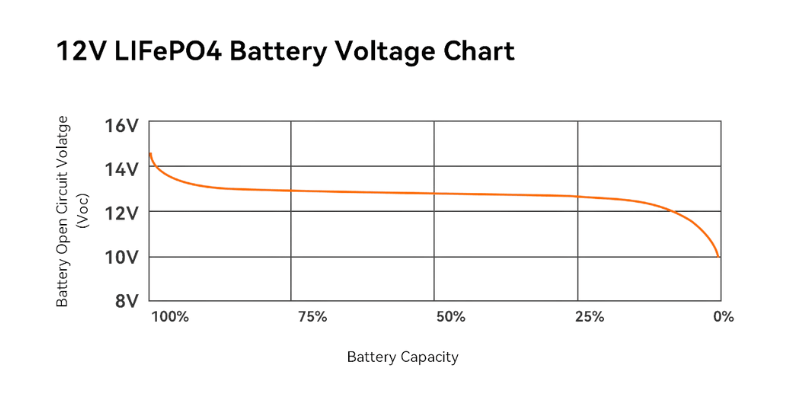
- Full: It starts high (around 13.6V or higher).
- Middle: It drops quickly to about 13.3V and stays there for most of the day. This is the flat part of the curve.
- Empty: Once it hits about 12.9V, it is getting low. Below 12.8V, the voltage will drop very fast. This is often called the “cliff.”
Does Voltage Affect LiFePO4 Battery Performance?
Yes, voltage affects how your system runs.
- Capacity: Voltage and capacity are directly related – higher voltage increases capacity, allowing the battery to store more energy and power devices longer.
- Lifespan: High-voltage LiFePO4 batteries last longer and can handle more cycles. Maintaining optimal voltage prevents thermal runaway, incomplete chemical reactions, and degradation.
- Charging: Battery voltage affects charging safety and efficiency. Incorrect voltage causes overheating or undercharging, harming performance, health, and lifespan.
- Discharging: Discharging below recommended voltage permanently damages the battery and shortens its life.
- Efficiency: Higher voltage improves power delivery efficiency.
How to Check LiFePO4 Battery Capacity
Using a voltmeter to check how full your battery is does not work well.
Because the voltage curve is so flat, the difference between a battery at 40% full and 70% full is very small. It might only be 0.1 volts. Cheap voltmeters are not accurate enough to read this difference.
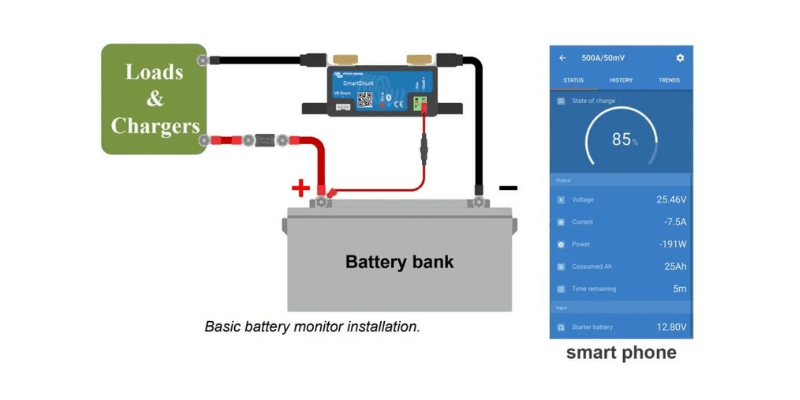
The Solution You should use a Smart Shunt.
- A Smart Shunt is a device installed on the negative battery cable.
- It counts every amp of energy that goes into the battery.
- It counts every amp that leaves the battery.
- It calculates the exact percentage (State of Charge) and displays it on a screen or your phone.
Conclusion
LiFePO4 batteries are excellent for off-grid living, but they require attention to detail.
- Memorize the nominal voltage: 3.2V per cell.
- Program your charger: Use the Bulk and Float numbers listed above.
- Disable Equalization: This protects your battery from damage.
- Ignore the voltage for daily checks: Use a Smart Shunt to know exactly how much power you have left.
FAQ
Why Does My Battery Read 13.3V After I Just Charged It To 14.6V?
This is normal. 14. 6V is the charging voltage, and the battery returns to its resting voltage after charging. A resting voltage of 13. 6V means it’s fully charged, but it drops to 13. 3V with minimal use.
Can I Use A Lead-acid Charger?
Use it only if you can disable the “desulfation” or “equalize” mode. If the charger exceeds 14. 6V, it will damage your 12V lithium battery. Using a charger designed for lithium is safer.
At What Voltage Should I Disconnect My Load?
For a 12V system, stop using the battery at 12. 0V to preserve some power. Draining it to 10. 0V triggers the BMS shutdown, possibly requiring a special charger to restart the battery.