

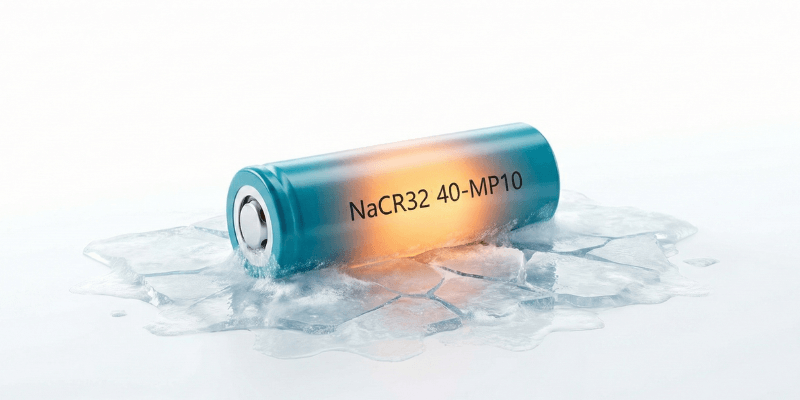
Samenvatting voor ingenieurs:
- De concurrent: Premium “Lage temperatuur” LFP-cellen (zoals de PLB 26650) zijn uitstekend en bieden een ontlading van 75% bij -20°C.
- Het probleem: Om op te laden onder -20°C heeft LFP actieve verwarming nodig. Dit voegt kosten, faalpunten en parasitair energieverlies toe.
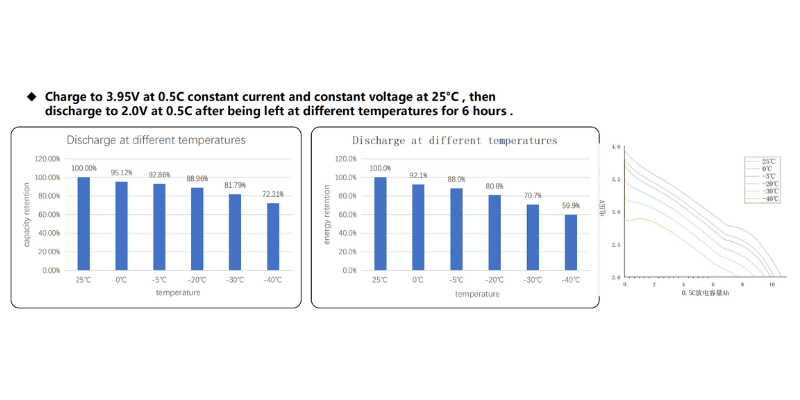
- De oplossing: Natrium-ionbatterijpakketten leveren 88% natuurlijke retentie bij -20°C en kunnen voor onbepaalde tijd op 0V blijven staan.
- Oordeel: Gebruik Low-Temp LFP voor energiedichtheid. Gebruik natriumionen voor vereenvoudigde, onderhoudsvrije betrouwbaarheid bij koud weer.
De afgelopen vijf jaar heeft “LFP bij lage temperaturen” was de enige betrouwbare batterijoptie voor extreme kou – zoals GPS-trackers in Minnesota of zonnestations in Harbin.
Deze batterijen, zoals de PLB IFR26650-34D, kunnen ontladen bij -40°C, maar opladen en opslag blijven een uitdaging.
Behouden LFP-batterijen alive in winter requires PI heating films, insulation cotton, and complex BMS programming to pre-warm before charging. This heated setup works but is complicated and introduces extra loads and failure points.
At Holo Battery, we asked: What if the battery didn’t need all that? That’s why we’re now focusing on natriumion for cold-weather use. Here’s the engineering breakdown.
Native Capacity vs. Parasitic Heating
When we look at the raw data from our lab tests at -20°C, the difference between “Native Performance” En “Managed Performance” becomes clear:
| Functie | Premium Low-Temp LFP | Sodium-ion |
| -20°C Discharge | 75% (at 1C) | 88.9% (at 0.5C) |
| Voltage Sag | Significant (avg 2.8V) | Moderate (avg 2.9V) |
| Heating Req. | Mandatory for Charging | Geen |
The Mathematics of “The Heating Tax”
Om LFP betrouwbaar te laten werken bij -30°C, kunt u de kale cel niet gebruiken. Je moet een verwarmingselement gebruiken. Dit introduceert een “Verwarmingsbelasting” – energie die alleen wordt verbrand om de werking van de batterij te vergemakkelijken, in plaats van uw apparaat van stroom te voorzien.
Laten we eens rekenen op een typisch zonnescenario:
- Thermische massa: A 12V 100Ah LFP-accupakket weegt ca. 9-12 kg.
- Soortelijke warmte: Het verhogen van die massa van -30°C naar 0°C (de veilige laadtemperatuur) vereist aanzienlijke energie.
- Het verlies: In een realistisch systeem verliest u vaak 10-15% van uw totale zonne-opbrengst alleen al om de verwarmingsfilm van stroom te voorzien.
Natrium-ion-aanpak: We hebben de verwarmingselementen gestript. De natriumionenchemie is van nature geleidend bij lage temperaturen vanwege de kleinere stookradius van natriumionen in de elektrolyt. Around 90% capacity is available instantly, with zero warm-up time and zero parasitic loss.
The Charging Wall: -20°C Limit
The most dangerous line in any LFP datasheet is usually buried in the fine print. For the PLB 26650, it reads: “Standard charging current: 0.2C at -20°C.”
Why Lithium Plates (and Sodium Doesn’t)
Below -20°C, the intercalation of lithium ions into the graphite anode becomes sluggish. If you force current into the battery (Charging), the ions pile up on the surface of the anode instead of going inside. This forms Metallic Lithium Plating.
- The Risk: These dendrites can pierce the separator, causing an internal short circuit and thermische vluchteling.
This is why LFP must heat itself above freezing before accepting high currents.
In a solar street light application, winter daylight is short (4-6 hours). If your LFP battery spends the first hour heating itself up, you have wasted 20% of your precious charging window.
Sodium-ion Advantage: Sodium ions have superior solvation kinetics. They don’t “plate” as easily as lithium. While charging slows down in extreme cold, it remains safe. We have validated safe charging at -20°C without external heat, simplifying the BMS architecture significantly.
The Supply Chain Killer: 0V Storage
This feature is often overlooked by engineers but is the number one request from Supply Chain Managers.
The Chemistry of “Death by Zero Volts”
Why does an LFP battery die if it hits 0V?
It comes down to the current collectors. The anode uses Copper Foil. When voltage drops below 1.5V, the copper begins to oxidize and dissolve into the electrolyte. When you try to recharge it, that dissolved copper precipitates as sharp dendrites, causing a short circuit. The battery is effectively scrap metal.
The Sodium Miracle:
Sodium-ion batteries use Aluminum Foil for both the cathode and the anode (because sodium doesn’t alloy with aluminum). Aluminum is chemically stable at 0V.
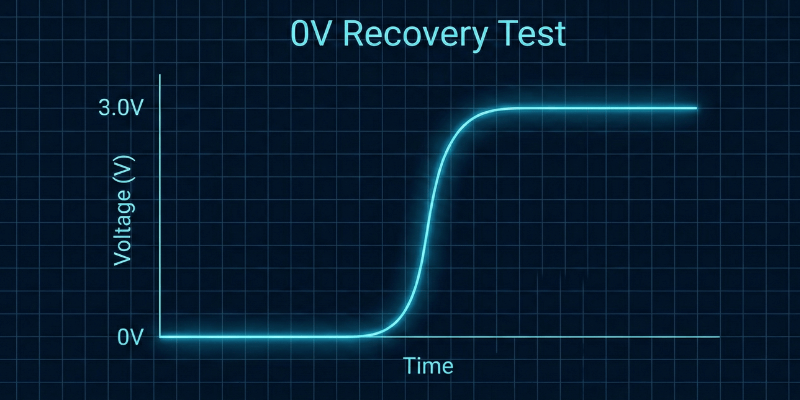
We tested the NaCR32140 cell by intentionally draining it to 0V, shorting the terminals, and leaving it for 24 hours.
Result: Upon reconnection, it charged back to full capacity with no side effects.
What this means for your logistics:
Air Freight Safety: We can ship sodium-ion packs completely discharged (0V), bypassing many dangerous goods regulations.
Inventory Resilience: You can leave equipment in a warehouse for 2 years. When you pull it out, it works. No “maintenance charging” schedules required.
The Verdict: Engineering the Right Choice
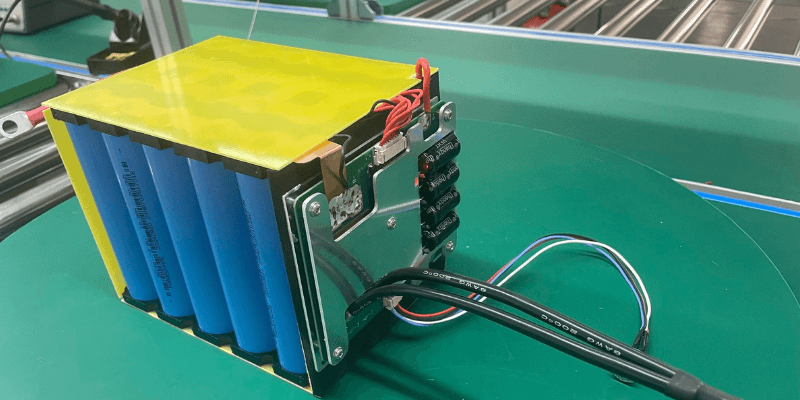
We are not saying LFP is dead. If you need maximum runtime in a heated warehouse, LFP is still king (high energy density).
But for the edge of the grid, simplicity is reliability.
Choose Sodium-ion if:
- Temperature: Your device faces -20°C to -40°C.
- Power Source: Intermittent charging (Solar/Wind) where you can’t waste power on heaters.
- Betrouwbaarheid: U wilt de faalpunten van verwarmingsfilms, thermostaten en GBS-relais elimineren.
- Opslag: U heeft lange toeleveringsketens of seizoensgebonden voorraad.
Stop met het bestrijden van de kou met verwarming. Omarm de chemie die van de kou houdt.