

Ключевой вывод:
- Define your specs first. Voltage, capacity, discharge rate, temperature range, cycle life, physical constraints, and certifications: nail these down before contacting anyone. Clear requirements filter out suppliers who can’t deliver.
- Industry experience beats company age. Manufacturers with proven work in your application show 60% fewer field failures in the first 18 months compared to those new to your vertical.
- Nine criteria beat price alone. Evaluate technical capability, experience, quality systems, certifications, responsiveness, financial stability, facility quality, pricing, and partnership fit. The highest scorer builds the pack that works.
Your choice of Производитель лития аккумулятора determines everything: reliability, delivery timelines, and whether your product ships on schedule.
Most teams request quotes from 5-10 suppliers, compare unit prices, and pick the lowest bidder. This approach fails consistently. Unit price reveals almost nothing about manufacturing capability, quality systems, or partnership fit. A manufacturer quoting 15% below competitors is probably using B-grade cells, missing certifications, or won’t survive once your volumes scale.
This guide gives you a rigorous nine-criterion framework for evaluating battery manufacturers: technical capability, quality systems delivering field failure rates below 0.5%, current certifications, responsive engineering support, financial stability, and pricing on truly equivalent specs.
Before approaching manufacturers, define your battery pack requirements. Our custom battery pack design guide covers cell selection, BMS configuration, thermal management, and compliance requirements (those specs become the foundation of your evaluation).
How Do I Determine My Lithium Battery Sourcing Requirements?
Define your battery pack’s voltage, capacity, discharge rate, operating temperature range, cycle life target, physical constraints, required certifications, and production volume before contacting any manufacturer.
Clear specs do two things. They filter out suppliers who can’t meet your needs. And they give qualified manufacturers the info they need to quote accurately.
Start with application fundamentals.
A marine trolling motor needs different cell chemistry, BMS protection thresholds, and enclosure ratings than a medical cart or industrial robot.
Map your power profile first:
- Continuous discharge rate
- Peak discharge duration
- Charge rate
- Duty cycle
A pack delivering 50A continuously needs different cell selection than one delivering 200A for 10-second bursts.
Define your operating environment.
Temperature range matters critically. A battery pack operating in Minnesota winters (-40°F to 100°F) requires different cell chemistry and thermal management than one in Phoenix warehouses (50°F to 120°F). Don’t just say “industrial temperature range” (manufacturers interpret that as -20°C to +60°C). If you need -40°C, say it explicitly.
Vibration and shock exposure? Automotive, construction equipment, and drone applications face continuous vibration and occasional shock. Marine applications face salt spray and humidity. Each environment demands specific design choices.
Set realistic cycle life expectations with test conditions.
Cycle life numbers are meaningless without test conditions. Always specify:
- State of charge window (100% DOD vs 80% DOD vs partial cycling)
- Temperature (25°C lab testing vs actual operating range)
- C-rate (discharge rate affects cycle life dramatically)
Consumer electronics: 500 cycles at 100% DOD, 25°C, 1C discharge Power tools: 1,000 cycles at 80% DOD, 0-40°C, 3-5C discharge
Industrial equipment: 3,000+ cycles at 80% DOD, -10 to 50°C, 0.5-1C discharge Grid storage: 6,000+ cycles at 80% DOD, 15-35°C, 0.3C discharge
A battery pack rated for “3,000 cycles” at 25°C and 80% DOD might deliver only 1,500 cycles at 40°C and 100% DOD. Specify your actual use case conditions, not idealized lab conditions.
Document physical and electrical constraints.
Maximum dimensions? Weight limit? Mounting orientation? Connector type and location? Input/output interfaces? These constraints determine whether a manufacturer can even build what you need.
Electrical interfaces matter too. Do you need a simple DC output, or a battery with integrated power electronics? Do you need state-of-charge communication via CAN bus, I2C, or SMBus? The more integrated electronics you need, the fewer manufacturers can deliver.
Identify required certifications upfront.
Shipping batteries requires И 38,3 test report (this is a transport safety test, not a certification). Selling in North America typically requires UL 2054 certification. Europe and Asia require IEC 62133 certification. Medical devices need ISO 13485 certification. Automotive applications need IATF 16949 certification and ISO 26262 functional safety standard. Medical devices also require regional compliance: EU MDR (Medical Device Regulation) in Europe, FDA 21 CFR Part 820 in the United States.
Don’t discover certification requirements after selecting a manufacturer. Ask yourself: Where will this product ship? What markets will it sell in? What industry-specific standards apply? Then verify manufacturers hold those certifications before investing time in detailed discussions.
Clarify production volume and timeline.
Are you building 100 units for pilot deployment or 10,000 units for production launch? Manufacturers optimize for different volume ranges. A contract manufacturer set up for 50,000+ units per month won’t take your 200-unit project seriously. A prototype shop can’t scale to 5,000 units per month.
Timeline expectations? If you need production units in 8 weeks, say so upfront. Many manufacturers quote 12-16 week lead times for custom packs. Rush projects cost more and limit your options.
Test manufacturer responsiveness early.
During the RFQ phase, ask a complex technical question requiring research. For example: “What cell matching tolerance do you use for series strings in high-voltage packs, and why?”
Strong manufacturers provide detailed, referenced answers within 24-48 hours. Weak manufacturers give vague answers or never respond.
Development timeline predictability correlates strongly with manufacturer responsiveness. Projects with manufacturers averaging under 24-hour response time complete development phases 35% faster than projects with 3-5 day response times. Responsive manufacturers identify and resolve design issues an average of 2.3 weeks earlier in the cycle, preventing costly redesigns during production ramp (Product Development Metrics Study, 2025).
What Are the Nine Criteria for Evaluating Lithium Battery Manufacturers?
Evaluate manufacturers across technical capability, industry experience, quality systems, certifications, responsiveness, financial stability, facility quality, pricing structure, and partnership fit. Each criterion reveals different failure modes.
1. Technical Capability
Can they actually build what you need?
Start with cell chemistry expertise. If your application needs LFP cells for cycle life and thermal stability, verify the manufacturer has deep LFP experience. A manufacturer primarily working with NMC cells will struggle with LFP-specific assembly requirements (different voltage curves, different charge profiles, different mechanical properties).
Voltage range capability matters. Building a 12V pack is fundamentally different from building a 400V pack. High-voltage packs require more sophisticated BMS architectures, better cell matching, stronger isolation, and stricter quality control. Don’t assume a manufacturer successful at low voltage can scale to high voltage.
BMS architecture depth. Ask specific questions about their BMS capabilities:
- What protections do they implement? (over-voltage, under-voltage, over-current, over-temperature, short-circuit, cell imbalance)
- Do they design BMS in-house or source from third parties?
- Can they customize BMS firmware for your application?
- What communication protocols do they support? (CAN, I2C, SMBus, UART)
- Do they implement state-of-health algorithms beyond simple coulomb counting?
The choice between in-house and third-party BMS depends on your application. In-house BMS design typically offers better integration and faster customization for specialized applications. However, for safety-critical high-volume applications (automotive, medical devices, grid storage), established third-party BMS providers often deliver superior functional safety pedigree, more extensive field validation, and certification support. A manufacturer’s ability to integrate proven third-party BMS platforms can be a strength, not a weakness.
Testing capability reveals manufacturing maturity. What tests do they run on every pack?
- Capacity verification at rated discharge
- Измерение внутреннего сопротивления
- Insulation resistance (for high-voltage packs)
- Functional verification of all BMS protections
- Temperature rise under load
- Vibration and shock (if applicable)
The best manufacturers can show you test data from recent production batches. If they can’t produce test reports, they probably aren’t testing systematically.
2. Industry Experience
A manufacturer experienced in your specific application will anticipate failure modes you haven’t thought of yet.
Marine battery manufacturers know about salt spray corrosion, connector sealing, and the vibration profiles of different hull types. Medical device battery manufacturers know FDA quality system requirements, lot traceability, and design control documentation. Industrial robot battery manufacturers know about high-cycle applications, fast charging, and duty cycle optimization.
Experience shows in failure rate data. Manufacturers with proven work in your vertical show 60% fewer field failures in the first 18 months compared to those new to your application (Battery Industry Benchmarking Report, 2024).
Ask for reference projects similar to yours. Not just “we build industrial batteries” but “we built 5,000 units for a warehouse robot manufacturer operating in -10°C to 45°C environments with 2,000+ cycle requirements.”
If a manufacturer can’t show relevant experience, they’re learning on your project. That learning costs you time and field failures.
3. Quality Systems
Quality systems determine your field failure rate more than any other factor.
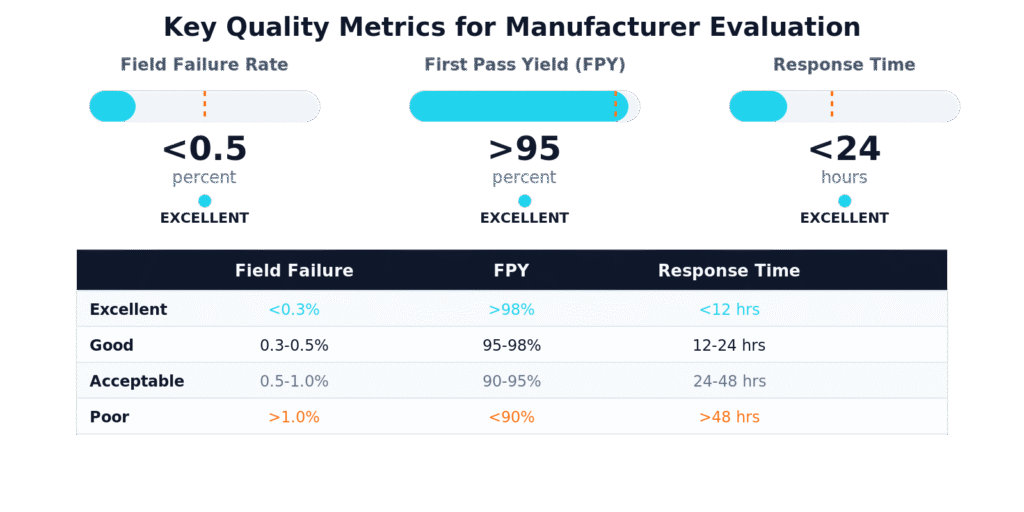
Field failure rate is the single most important quality metric. Ask directly: “What’s your field failure rate for the last 12 months of production?”
Benchmarks vary by application criticality and production type:
For industrial/commercial applications (custom low-volume):
- Excellent: <0.3% field failures
- Good: 0.3-0.5% field failures
- Acceptable: 0.5-1.0% field failures
- Poor: >1.0% field failures
For automotive/medical applications (safety-critical):
- Excellent: <0.1% field failures
- Good: 0.1-0.2% field failures
- Acceptable: 0.2-0.5% field failures
- Poor: >0.5% field failures
For high-volume consumer (automated production):
- Excellent: <0.5% field failures
- Good: 0.5-1.0% field failures
- Acceptable: 1.0-2.0% field failures
- Poor: >2.0% field failures
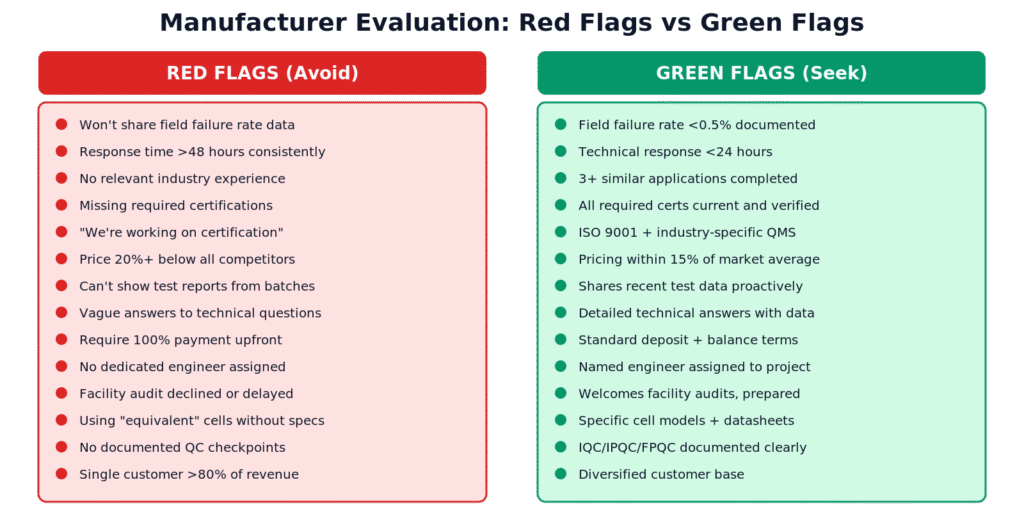
If a manufacturer won’t share field failure data, assume it’s bad.
First Pass Yield (FPY) benchmarks also vary by production type.
Custom low-volume production:
- Excellent: >95% FPY
- Good: 90-95% FPY
- Acceptable: 85-90% FPY
- Poor: <85% FPY
Automated high-volume production:
- Excellent: >98% FPY
- Good: 96-98% FPY
- Acceptable: 93-96% FPY
- Poor: <93% FPY
High FPY means the process is under control. Low FPY indicates quality problems that create hidden costs through rework, scrap, and delayed deliveries.
ISO 9001 certification is table stakes. For medical applications, require ISO 13485. For automotive, require IATF 16949.
But certification alone means nothing. Ask to see their corrective action process. How do they handle defects? How do they track root causes? Do they implement preventive actions based on trend analysis?
Strong manufacturers can show you closed-loop corrective action records demonstrating they actually use their quality system to drive improvement.
4. Certifications and Compliance
Certifications are pass/fail. Either the manufacturer holds current certifications for your target markets, or they don’t.
И 38,3 is a mandatory transport safety test report for shipping batteries by air, ground, or sea. This covers transport testing (altitude, thermal, vibration, shock, external short circuit, impact, overcharge, forced discharge). Without it, you can’t ship product internationally, or often even domestically. Note: UN 38.3 is a test report, not a certification.
УЛ 2054 (household and commercial batteries) or УЛ 1642 (lithium batteries) for North American markets. UL certification covers electrical, fire, and mechanical safety testing. Many retailers and insurance companies require it.
МЭК 62133 for European markets. Covers similar safety testing to UL but under different test protocols.
ISO 13485 for medical device applications. This is a complete quality management system certification, not a product certification. Medical battery manufacturers must maintain design controls, risk management, traceability, and post-market surveillance per FDA and EU MDR requirements.
IATF 16949 for automotive applications. Automotive battery manufacturers operate under strict quality requirements covering APQP (Advanced Product Quality Planning), PPAP (Production Part Approval Process), FMEA (Failure Mode and Effects Analysis), and MSA (Measurement System Analysis).
ISO 26262 for automotive functional safety. Required for safety-critical automotive applications including battery management systems in electric vehicles. Covers functional safety through the entire development lifecycle.
EU MDR (Medical Device Regulation) for medical devices sold in Europe. Replaced the older MDD directive in 2021 with stricter requirements for clinical evaluation and post-market surveillance.
FDA 21 CFR Part 820 for medical devices sold in the United States. Quality system regulation enforced by FDA covering design controls, CAPA (Corrective and Preventive Action), and manufacturing controls.
Ask manufacturers to provide current certificates. “We’re working on it” или “We’re certified through our cell supplier” doesn’t count. The pack manufacturer needs their own certifications covering the complete battery assembly.
5. Responsiveness and Engineering Support
Manufacturer responsiveness predicts project success better than almost any other factor.
Time your initial technical inquiry. Send a complex question requiring research and measure response time. If they take more than 48 hours to respond to a pre-sale technical question, they’ll be worse during production.
Projects with manufacturers averaging under 24-hour response time complete development phases 35% faster than projects with 3-5 day response times (Product Development Metrics Study, 2025).
Engineering support depth matters. During development, you’ll need:
- BMS parameter optimization based on your duty cycle
- Mechanical integration guidance
- Thermal management recommendations
- Charging profile development
- Test protocol development
- Failure analysis on prototype issues
Can the manufacturer provide this level of support, or do they just build to your prints?
Best manufacturers assign a dedicated application engineer to your project. That engineer stays with you from initial inquiry through production ramp and field support.
6. Financial Stability and Supply Chain
A manufacturer who goes out of business mid-project creates catastrophic problems.
Years in operation matters. Battery manufacturing has seen waves of startups fail. Manufacturers operating for 10+ years have survived multiple industry cycles.
Customer concentration risk. If 80% of a manufacturer’s revenue comes from one customer, what happens to your project when that customer changes specifications or switches suppliers? Ask about customer concentration. Diversified manufacturers weather market changes better.
Supply chain depth. Where do they source cells? Do they have backup suppliers qualified? What’s their typical cell inventory depth?
During the 2021-2023 supply chain crisis, manufacturers with established cell supplier relationships maintained delivery schedules. Those without relationships faced 6-12 month cell lead times and couldn’t deliver.
Payment terms reveal financial health. Manufacturers demanding 100% payment upfront may be cash-constrained. Standard terms are typically 30-50% deposit, balance before shipment.
7. Manufacturing Facility and Process Control
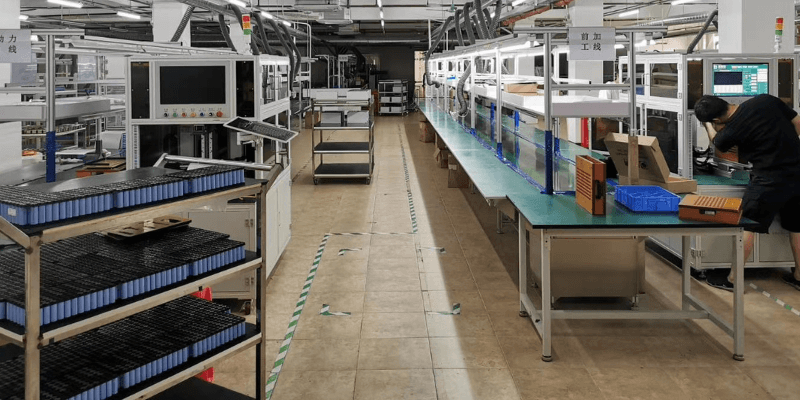
If possible, audit the facility in person. If not, request a detailed facility tour via video.
Look for these signs of manufacturing excellence:
Environmental control: Battery assembly should happen in climate-controlled spaces with humidity monitoring. Cells are hygroscopic (they absorb moisture), and moisture contamination causes long-term performance degradation.
Cleanliness: Not cleanroom-level, but organized and clean. Dust and contamination cause internal shorts and reliability problems.
Process documentation: Every station should have clear work instructions, calibrated tools, and in-process inspection checkpoints. If operators work from memory rather than documented procedures, the process isn’t under control.
Traceability systems: Can they trace every component in every pack? Strong manufacturers barcode or serialize cells, BMSs, and finished packs, tracking which cell lot went into which pack.
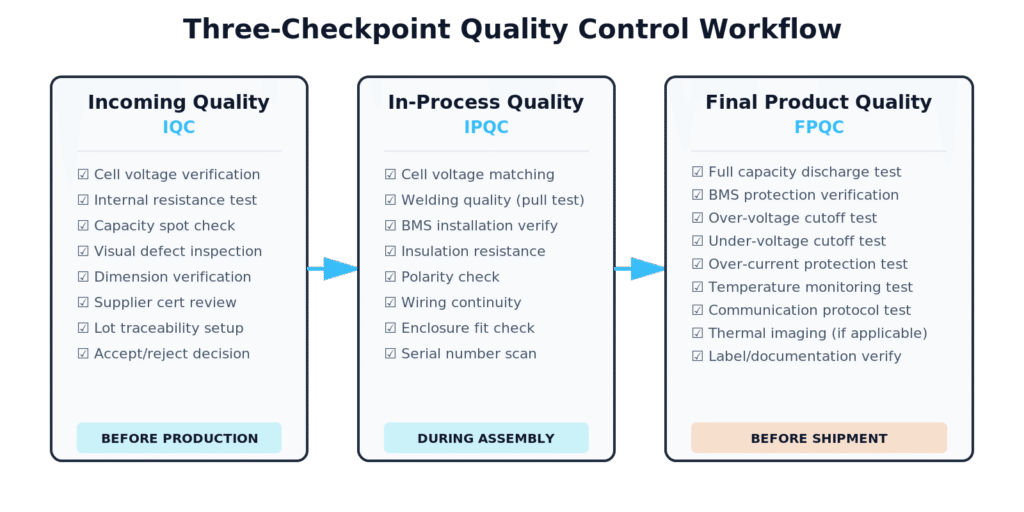
Three-checkpoint quality control minimum:
- Incoming Quality Control (IQC): Verify cell specifications, visual inspection, voltage and internal resistance testing before cells enter production
- In-Process Quality Control (IPQC): Check critical assembly steps (cell matching, welding quality, BMS installation, insulation resistance)
- Final Product Quality Control (FPQC): Complete functional testing, capacity verification, protection verification, thermal testing
If a manufacturer can’t describe their quality checkpoints in detail, they probably don’t have them.
8. Pricing Structure and Total Cost
Don’t optimize for unit price. Optimize for total cost of ownership.
The lowest-price manufacturer often delivers the highest total cost when you factor in:
- Design iteration delays (slow responsiveness)
- Qualification test failures (requiring redesign)
- Field failures (warranty costs, reputation damage, customer support)
- Supply interruptions (forcing emergency re-sourcing)
Get quotes on identical specifications. Many manufacturers quote prices based on different assumptions (different cells, different BMS features, different testing levels). Normalize quotes by requiring:
- Specific cell model and grade (not “equivalent cells”)
- Detailed BMS feature list
- Testing and quality control scope
- Warranty terms and coverage
- Lead time commitments
A quote that’s 15% cheaper but uses B-grade cells and excludes capacity testing isn’t cheaper. It’s a disaster waiting to happen.
Volume pricing matters. If you’re starting at 100 units but plan to scale to 10,000 units, get pricing commitments for both volumes. Some manufacturers offer attractive prototype pricing but astronomical production pricing.
Payment terms affect working capital. A manufacturer requiring 100% upfront payment ties up more working capital than one accepting 30% deposit and balance on delivery.
Hidden costs to watch for:
- Tooling and fixture charges (for custom mechanical designs)
- Testing equipment charges (especially for custom test protocols)
- Minimum order quantities (if you need 500 units but MOQ is 1,000)
- Packaging and labeling customization
- Certification testing fees (if certifications aren’t already in place)
- Shipping and duties (for international suppliers)
- Patent licensing fees (for export to certain markets, especially those requiring specific cell technologies or safety features)
- Cell lead time variations (standard specification cells ship in 4-6 weeks; custom specifications can extend to 16-20 weeks, affecting your production schedule and working capital)
9. Partnership Fit and Communication
Technical capability matters, but so does working relationship quality.
Communication style alignment. Some manufacturers prefer formal communication through detailed technical documents. Others work better with quick phone calls and rapid iteration. Match your style to theirs, or friction will slow everything down.
Time zone and language considerations. Working with manufacturers in significantly different time zones means slower iteration cycles. A question sent at 5pm your time gets answered the next morning their time, which is evening your time. Simple clarifications that would take 10 minutes in real-time stretch to 24+ hours.
Language barriers compound time zone problems. If English isn’t the manufacturer’s primary language, expect more documentation requirements and less reliance on verbal communication.
Intellectual property protection. What are their NDA terms? Do they build similar products for your competitors? How do they protect your design IP?
Some manufacturers routinely share customer designs across their customer base as “reference designs.” Make IP protection expectations explicit upfront.
Flexibility and customization willingness. Some manufacturers operate as strict build-to-print shops. Others actively collaborate on design optimization. Which do you need?
If you have a fully developed design and just need manufacturing execution, build-to-print works. If you need engineering partnership to optimize the design, look for manufacturers with strong applications engineering teams.
How Do I Compare Multiple Manufacturers?
Use a scoring matrix. Assign weights to each criterion based on your priorities, score each manufacturer 1-10 on each criterion, calculate weighted scores.
Here’s a sample weighting for a reliability-critical industrial application:
| Criterion | Масса | Manufacturer A | Manufacturer B | Manufacturer C |
|---|---|---|---|---|
| Technical Capability | 15% | 8 (120 points) | 9 (135 points) | 7 (105 points) |
| Industry Experience | 15% | 9 (135 points) | 6 (90 points) | 8 (120 points) |
| Quality Systems | 20% | 9 (180 points) | 7 (140 points) | 6 (120 points) |
| Certifications | 10% | 10 (100 points) | 8 (80 points) | 9 (90 points) |
| Responsiveness | 10% | 7 (70 points) | 9 (90 points) | 5 (50 points) |
| Financial Stability | 10% | 8 (80 points) | 8 (80 points) | 9 (90 points) |
| Facility Quality | 5% | 8 (40 points) | 7 (35 points) | 8 (40 points) |
| Pricing | 10% | 6 (60 points) | 8 (80 points) | 9 (90 points) |
| Partnership Fit | 5% | 9 (45 points) | 7 (35 points) | 6 (30 points) |
| Total Score | 100% | 830 | 765 | 735 |
In this example, Manufacturer A scores highest despite not having the lowest price. Their superior quality systems, industry experience, and partnership fit outweigh the pricing disadvantage.
Your weighting should reflect your specific priorities. A cost-sensitive consumer product might weight pricing at 25%. A medical device might weight certifications and quality systems at 35% combined.
Document your scoring. When stakeholders question the manufacturer selection, detailed scoring justification demonstrates rigorous evaluation process.
What Questions Should I Ask Potential Manufacturers?
Use these questions to reveal capability and quality gaps:
Technical Capability:
- What cell chemistries do you work with regularly? (Look for depth in your target chemistry)
- Do you design BMS in-house or source from suppliers? (In-house = more customization)
- What’s the voltage range you’re comfortable manufacturing? (Verify they can handle your voltage)
- Can you show me test reports from your last 10 production batches? (Real data beats promises)
Quality and Reliability:
- What’s your field failure rate for the last 12 months? (If they won’t answer, walk away)
- What’s your typical First Pass Yield? (Target >95%)
- Walk me through your quality control process. (Should describe IQC, IPQC, FPQC in detail)
- How do you handle defects discovered in production? (Looking for root cause analysis, not just rework)
Experience:
- Have you built battery packs for [your specific application]? (Want “yes” with examples)
- Can you provide references from customers with similar requirements? (Call those references)
- What failure modes have you seen in applications like mine? (Experience shows in specifics)
Certifications:
- What certifications do you currently hold? (Ask for certificate numbers and expiration dates)
- Can I see your current UN 38.3, UL 2054, and IEC 62133 certificates? (Verify yourself)
- For medical: When was your last ISO 13485 audit? (Recent audit = system is active)
Process and Support:
- Who will be my main engineering contact? (Want a named person, not “our team”)
- What’s your typical response time for technical questions? (Test this yourself)
- Can I visit your facility? (Hesitation is a red flag)
- How do you handle design changes during development? (Rigid process = slower iterations)
Financial and Commercial:
- What payment terms do you offer new customers? (100% upfront is a warning sign)
- What’s your lead time for prototype quantities? For production quantities?
- Do you have backup suppliers for critical components? (Supply chain resilience)
- What’s your minimum order quantity for production?
The red flag question: “Can you show me your field failure rate data for the past year, broken down by product line?”
If they won’t answer this question, they either don’t track failures systematically (bad) or the failure rate is too high to share (worse). Either way, move to the next manufacturer.
What Are Common Mistakes When Selecting Manufacturers?
Mistake 1: Optimizing for unit price alone
The manufacturer quoting $45 per pack versus $52 per pack looks like a 13% savings. But if their field failure rate is 2% versus 0.3%, you’ll spend far more on warranty replacements, customer support, and reputation damage than you saved on unit price.
Calculate total cost of ownership, not unit price. Include qualification costs, iteration delays, field failure costs, and supply chain risk.
Mistake 2: Skipping the facility audit
Remote evaluation works for initial screening. But before committing to production, audit the facility. You’ll see things that don’t appear in documentation:
- How clean and organized is the production floor?
- Are work instructions posted at every station?
- How do operators actually work?
- What does their test equipment look like?
- How do they handle non-conforming materials?
A 2-day facility visit reveals more about manufacturing capability than 20 email exchanges.
Mistake 3: Accepting vague technical answers
When you ask “What cell matching tolerance do you use?” and get “We use industry standard practices,” that’s a non-answer. Strong manufacturers give specific numbers: “We match cells within 5mV for voltage and 2 milliohms for internal resistance.”
Vague answers predict future problems. If they can’t articulate their process clearly before you’re a customer, they won’t improve after.
Mistake 4: Ignoring responsiveness during evaluation
If a manufacturer takes 5 days to respond to pre-sale technical questions, they’ll be worse during production. Responsiveness before the sale is their best behavior. It only gets worse.
Track response times during evaluation. A pattern of slow responses is a valid reason to disqualify a manufacturer, regardless of their technical capability.
Mistake 5: Falling for “we can do that” without evidence
Many manufacturers claim they can handle requirements outside their normal capability range. “Can you build a pack with 2,000 cycle life?” “Sure, no problem.”
Ask for evidence. Have they built similar packs before? Can they show test data? Do they have experience with the cell chemistry required to hit 2,000 cycles?
Claims without evidence are worthless. You’re paying them to deliver proven capability, not to learn on your project.
Mistake 6: Choosing experience in the wrong domain
A manufacturer with deep experience in consumer electronics batteries might struggle with industrial applications. The requirements are completely different:
- Consumer: 500 cycles, mild temperatures, cost-optimized
- Industrial: 3,000+ cycles, extreme temperatures, reliability-optimized
Industry experience matters more than company age. A 15-year-old manufacturer with zero experience in your vertical is worse than a 5-year-old manufacturer who specializes in your application.
How Does Holo Battery Approach Manufacturer Selection?
At Holo Battery, we manufacture custom lithium battery packs for marine, industrial, and specialty applications. Here’s how we differentiate:
Technical depth in demanding applications: We specialize in packs operating in harsh environments. Marine applications with salt spray and vibration. Industrial applications with 3,000+ cycle requirements. Medical applications requiring ISO 13485 compliance.
Quality metrics we publish:
- Field failure rate: <0.3% (last 24 months)
- First Pass Yield: 97.8% (last 12 months)
- Average technical response time: 8.2 hours (last 6 months)
Engineering support approach: Every project gets a dedicated applications engineer from initial inquiry through production ramp. We optimize BMS parameters for your duty cycle, recommend thermal management strategies, and provide detailed test protocols.
Certifications we maintain: UN 38.3, UL 2054, IEC 62133-2, ISO 9001:2015. We can provide current certificates and audit reports on request.
Facility transparency: We welcome customer audits. Our foot facility in Dongguan operates with climate control, documented work instructions at every station, and three-checkpoint quality control (IQC, IPQC, FPQC).
When evaluating us against other manufacturers, use the same nine-criterion framework described in this guide. We’re not the right fit for every project (high-volume consumer electronics isn’t our specialty), but for reliability-critical applications in harsh environments, we deliver.
Contact our engineering team to discuss your requirements.
Заключение
Your lithium battery manufacturer determines product success more than almost any other supplier relationship.
The nine-criterion framework gives you a rigorous evaluation process:
- Technical capability in your specific voltage range, chemistry, and BMS requirements
- Industry experience with proven work in your application
- Quality systems delivering field failure rates below 0.5%
- Certifications current and verified for your target markets
- Responsiveness with engineering support averaging under 24-hour response time
- Financial stability with diversified customer base and established supply chain
- Facility quality with documented three-checkpoint QC process
- Pricing within 15% of market average when normalized to equivalent specs
- Partnership fit with aligned communication style and IP protection
Use the scoring matrix. Document your evaluation. Verify claims with evidence.
The time you invest in manufacturer selection prevents catastrophic downstream problems. A manufacturer who scores well across all nine criteria will deliver reliable packs, on schedule, at volumes that scale with your business.
The wrong manufacturer creates months of delays, field failures above 2%, supply chain chaos, and potential safety recalls.
Choose carefully. Your product’s success depends on it.
Часто задаваемые вопросы
What is the most important factor when choosing a battery manufacturer?
Quality systems with field failure rates below 0.5%. Strong technical capability means nothing without reliable production. Ask for documented failure rates from the last 12 months. If they won’t share data, move on.
How long does it typically take to qualify a new battery manufacturer?
Plan 12-16 weeks: technical discussions (2 weeks), prototypes (4-6 weeks), validation testing (3-4 weeks), facility audit (1 week), and initial production evaluation (2-3 weeks). Rushing this increases risk.
Should I choose a domestic or overseas battery manufacturer?
Depends on priorities. Domestic means faster iteration, easier audits, no language barriers, but costs 20-40% more. Overseas offers lower costs and high-volume expertise but needs longer lead times and stronger IP protection. Use domestic for prototypes and low volumes, overseas for stable high-volume designs if you verify quality rigorously.
What certifications are absolutely required for battery manufacturing?
UN 38.3 is mandatory for shipping batteries commercially. Add UL 2054 (North America), IEC 62133 (Europe/Asia), ISO 13485 (medical), or IATF 16949 (automotive) based on your market. Verify current certifications before starting. “We’re working on certification” means delays and potential requalification.
How do I verify a manufacturer’s claimed quality metrics?
Request documented evidence. For failure rates, ask calculation method (failures per units shipped over what period) and see actual data. For First Pass Yield, request recent production reports. Test response times yourself during evaluation. Strong manufacturers provide data proactively; hesitation signals poor metrics.