

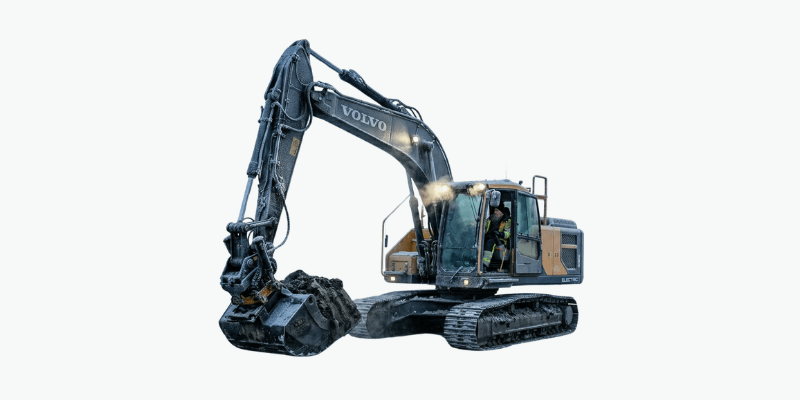
Low temperature reduces battery power capability. In heavy equipment, that can lead to voltage sag, controller trips, and avoidable battery damage during charging.
This case study outlines how Holo Battery redesigned a 48V 400Ah LFP battery system for a Norwegian electric excavator fleet operating in winter conditions down to −25°C.
The Problem
The customer operated 50 electric excavators in the Oslo region. The original machines used standard 48V 400Ah LFP battery packs with no active preheat function and no effective low-temperature charge interlock.
At −25°C, cell impedance increased sharply. During heavy lifting, hydraulic pumps drew burst currents up to 300A. Under those conditions, pack voltage sagged enough to trip the machine’s 36V DC bus undervoltage protection. Operators reported four to five restarts per shift.
Charging created a second issue. Because the original system did not enforce a preheat-before-charge sequence, charging could begin while the cells were still below the safe temperature window. Over one winter season, the packs lost roughly 30% of usable capacity.

The Battery Redesign
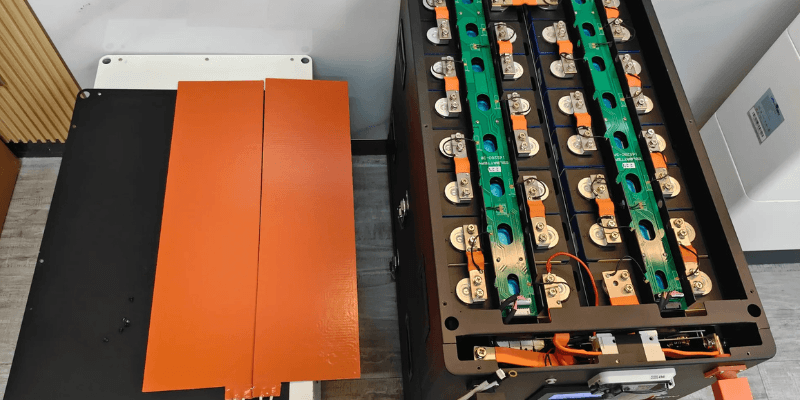
Holo Battery developed a thermally managed LFP system for low-temperature field use. The pack uses a 15S configuration with a nominal voltage of 48V. The design addressed three areas: pack heating, heat retention, and charging control.
1. Distributed Heating
Polyimide heater films were integrated between cell modules. The heating network provided up to 0.8W/cm² of controlled heat flux.
When connected to grid power, the pack could be warmed from −25°C to 15°C in about 45 minutes.
2. Thermal Insulation
The module assembly was insulated with 3mm aerogel to reduce heat loss during outdoor use. After preheating and typical operation, the pack maintained core temperature above 15°C during a two-hour idle period at −25°C ambient.
3. Preheat-Before-Charge Logic
De GBS controlled charger access based on internal temperature feedback. When the machine was plugged in, incoming power was routed first to the heaters. Charging remained disabled until the pack reached a validated minimum temperature of 15°C.
The 15°C threshold was selected based on internal test data showing acceptable charge acceptance and negligible plating risk at this temperature for the cells used.
This prevented charging at unsafe cell temperature and reduced the risk of lithium plating.
Test Results
Test condition: 300A pulse discharge at −25°C ambient.
The original pack was tested at ambient temperature. The Holo Battery system was preheated before pulse testing.
| Metrisch | Original Standard Pack | Holo Battery Engineered System | Practical Impact |
|---|---|---|---|
| Pack core temperature at test start | −25°C | 18°C | Higher usable power |
| Voltage sag during 300A pulse | 14.2V drop | 3.1V drop | Fewer shutdowns under lift load |
| Charge control in sub-zero conditions | No effective preheat interlock | Charging enabled only above 15°C | Reduced low-temperature charge damage |
| Capacity loss after one winter-equivalent season | 32% | <2% | Longer service life |
Note: Capacity retention was measured at room temperature before and after one winter-equivalent operating season. One season represents about five months of use at eight hours per day. Actual results depend on duty cycle, charging behavior, and thermal exposure.
Business Impact
The customer estimated downtime cost at approximately USD 150 per hour. Based on reported productivity loss, cold-weather interruptions were costing around USD 600 per machine per day.
Battery replacement added further cost. The original packs often required replacement after winter operation, at roughly USD 4,500 per pack.
Following the redesign, the monitored fleet completed two winter seasons with no battery replacements attributed to low-temperature charging damage and no reported cold-weather shutdowns during normal operation.
The customer recovered the additional engineering cost in about four months.
Why It Matters
In sub-zero environments, battery reliability depends on more than nominal capacity. Heavy equipment batteries must be designed as thermal-electrical systems.
That means accounting for:
- cold-start temperature
- peak current demand
- insulation strategy
- idle heat loss
- charge interlocks
- BMS logic
- service conditions in the field
For construction and off-highway equipment, these factors directly affect uptime and total cost of ownership.
Next Step
If your equipment operates below freezing, send Holo Battery your peak current profile, duty cycle, charging method, and minimum ambient temperature atsales@holobatery.com.
Our engineering team can provide a thermal architecture recommendation within 48 hours.