

For industrial equipment makers, robotics OEMs, and energy storage integrators placing lithium-ion battery packs on the European Union market, Regulation (EU) 2023/1542 (the EU Batteries Regulation) is already shaping engineering and procurement specs. Core conformity, substance, and EPR obligations are in force, and the next major statutory milestone arrives on 18 febbraio 2027, when the Digital Battery Passport (Article 77) becomes mandatory for electric vehicle (EV) batteries, light means of transport (LMT) batteries, and all industrial batteries with a capacity greater than 2 kWh placed on the market or put into service, alongside the Article 13(6) QR code requirement across all battery categories.
This 2027 compliance checklist clarifies how battery category and capacity determine your legal scope, separates EU manufacturer, importer, and producer duties across three common B2B sourcing scenarios, and gives buyers a practical RFQ deliverable checklist for their battery pack factory. Regulatory dates and article references were verified against the consolidated EUR-Lex text of Regulation (EU) 2023/1542 E Regulation (EU) 2025/1561 in November 2026. This guide is for engineering and procurement planning and does not constitute legal advice.
1. Confermare prima la categoria di batteria e l’ambito normativo degli articoli
Under Article 3 of Regulation (EU) 2023/1542, batteries fall into five legal categories: portable, light means of transport (LMT), starting-lighting-ignition (SLI), electric vehicle (EV), and industrial. All categories require CE marking, technical documentation, an EU Declaration of Conformity (DoC), substance compliance (Article 6), and national EPR registration. However, QR codes (Article 13(6)), Battery Passports (Article 77), E BMS State of Health data (Article 14) follow different triggers:
| Battery Category | QR Code (Art. 13(6), Feb 18, 2027) | Battery Passport (Art. 77, Feb 18, 2027) | BMS State of Health (Art. 14, In Force) |
|---|---|---|---|
| Industrial (≤ 2 kWh) Compact robotics, handheld industrial tools, small AGVs | Mandatory (links to applicable statutory info) | Exempt from Art. 77 passport | Applies only if configured as a stationary BESS (SBESS) |
| Industrial (> 2 kWh) Forklifts, heavy AGVs & mobile robots, commercial BESS, off-grid machinery | Mandatory (links to Battery Passport) | Obbligatorio (all industrial batteries > 2 kWh, not limited to rechargeable) | Mandatory for SBESS; motive/non-SBESS industrial packs are not triggered by capacity alone |
| LMT Batteries Batteries weighing ≤ 25 kg for e-bikes, e-scooters, and light electric utility vehicles | Mandatory (links to Battery Passport) | Obbligatorio | Obbligatorio |
| Batterie per veicoli elettrici Traction batteries for M, N, and O category electric/hybrid vehicles (no weight threshold), and traction batteries weighing > 25 kg for L-category vehicles | Mandatory (links to Battery Passport) | Obbligatorio | Obbligatorio |
| SLI Batteries Starting, lighting, and ignition batteries for vehicles and machinery | Mandatory (links to applicable statutory info) | Exempt from Art. 77 passport | Not required by Art. 14 |
| Portable (≤ 5 kg) Medical devices, power tools, commercial portables | Mandatory (links to applicable statutory info) | Exempt from Art. 77 passport (removability rules apply Feb 18, 2027) | Not required by Art. 14 |
Why category and capacity must be checked separately: A 1.5 kWh stationary battery energy storage system (SBESS) can fall under Article 14 BMS State of Health rules even though it does not require an Article 77 Battery Passport. Conversely, a 3 kWh industrial forklift battery pack requires an Article 77 Battery Passport because its capacity exceeds 2 kWh, yet capacity alone does not trigger Article 14 BMS SoH requirements.
2. Cronoprogramma di conformità verificato 2024–2031 (Omnibus IV incluso)
Under Regulation (EU) 2025/1561, the EU formally postponed Chapter VII supply chain due diligence obligations by two years to August 18, 2027. Several carbon footprint, recycled content documentation, and labelling milestones under Articles 7, 8, and 13 also depend on the entry into force of European Commission delegated or implementing acts, so procurement teams should track both statutory baseline dates and secondary-act triggers:
| Milestone Date | Obligation under Regulation (EU) 2023/1542 | Si applica a | Status (Verified Nov 2026) |
|---|---|---|---|
| August 18, 2024 | CE marking, EU Declaration of Conformity (DoC), technical documentation, substance limits (Art. 6), stationary BESS safety (Art. 12 & Annex V), and BMS SoH data (Art. 14) | All categories for CE/DoC/Art. 6; SBESS for Art. 12; SBESS, LMT, and EV for Art. 14 | In force |
| August 18, 2025 | Repeal of Directive 2006/66/EC; national Extended Producer Responsibility (EPR) registration and separate collection symbol rules | All battery categories placed on the EU market | In force |
| February 18, 2026 (baseline) | Carbon footprint declaration (Article 7), applying from Feb 18, 2026 or 18 months after entry into force of the relevant delegated and implementing acts, whichever is latest | Rechargeable industrial batteries > 2 kWh (excluding those with exclusively external storage) | Conditional on secondary legislation; verify delegated/implementing act status |
| August 18, 2026 (baseline) | General battery labelling details (Article 13), applying from Aug 18, 2026 or 18 months after entry into force of the Art. 13(10) implementing act, whichever is latest | All battery categories | Conditional on implementing act timing; prepare label layout early |
| 18 febbraio 2027 | Digital Battery Passport (Article 77); QR code data carrier (Article 13(6)); portable & LMT removability and replaceability (Article 11) | Art. 77: all industrial > 2 kWh, LMT, and EV batteries. Art. 13(6) QR: all batteries (linking to passport or applicable statutory info). Art. 11: portable & LMT | Upcoming statutory deadline |
| August 18, 2027 | Supply Chain Due Diligence (Chapter VII, Art. 47 to 49) for cobalt, natural graphite, lithium, and nickel (postponed 2 years by Regulation (EU) 2025/1561) | Economic operators placing batteries on the EU market or putting them into service, except those exempt under Art. 47 (own net turnover below EUR 40 million in the financial year preceding the last financial year, and not part of a group whose consolidated net turnover exceeded EUR 40 million in that year) | Postponed deadline; confirm any further EU Omnibus threshold amendments prior to launch |
| August 18, 2028 (baseline) | Recycled content documentation (Article 8(1)), applying from Aug 18, 2028 or 24 months after entry into force of the relevant delegated act, whichever is latest | Industrial batteries > 2 kWh (excluding exclusively external storage), EV, and SLI batteries containing cobalt, lead, lithium, or nickel in active materials | Conditional on delegated act timing |
| August 18, 2031 | Minimum recycled content thresholds (cobalt 16%, lead 85%, lithium 6%, nickel 6%) under Article 8(2) | Industrial batteries > 2 kWh (excluding exclusively external storage), EV, and SLI batteries containing cobalt, lead, lithium, or nickel in active materials | Long-term sourcing milestone |
3. Legal Roles & RFQ Deliverable Checklist (Three EU Sourcing Scenarios)
Under Regulation (EU) 2023/1542, legal responsibility is not a single blanket bucket labeled “EU importer.” Articles 38, 41, 44, 55, 56, and 77 split obligations across the produttore, importer, national producer (EPR), e il economic operator placing the battery on the market or putting it into service. Before issuing a purchase order, confirm which of these three common B2B scenarios fits your supply chain:
- Scenario A: Importing a supplier-branded battery pack. The battery manufacturer (Article 38) draws up the technical file, runs conformity assessment, and signs the EU DoC. The EU importer (Article 41) verifies those documents before market placement, retains a copy of the EU DoC for 10 years, and handles national EPR registration as a producer where applicable (for example, registering with Stiftung EAR in Germany).
- Scenario B: Procuring a private-label or own-brand custom battery pack. Under Article 44, if an EU importer or OEM places a battery on the EU market under its own name or trademark (or modifies a battery in a way that affects compliance), that EU company is treated as the legal manufacturer and assumes full Article 38 obligations, including drawing up and signing the EU DoC.
- Scenario C: Importing equipment with an integrated battery pack. Regulation (EU) 2023/1542 still applies to batteries incorporated into machinery, robots, or storage cabinets placed on the EU market. Confirm whether your EU entity acts as the legal manufacturer (own-brand/integrated assembly) or importer, and verify Member State EPR producer registration for the incorporated battery.
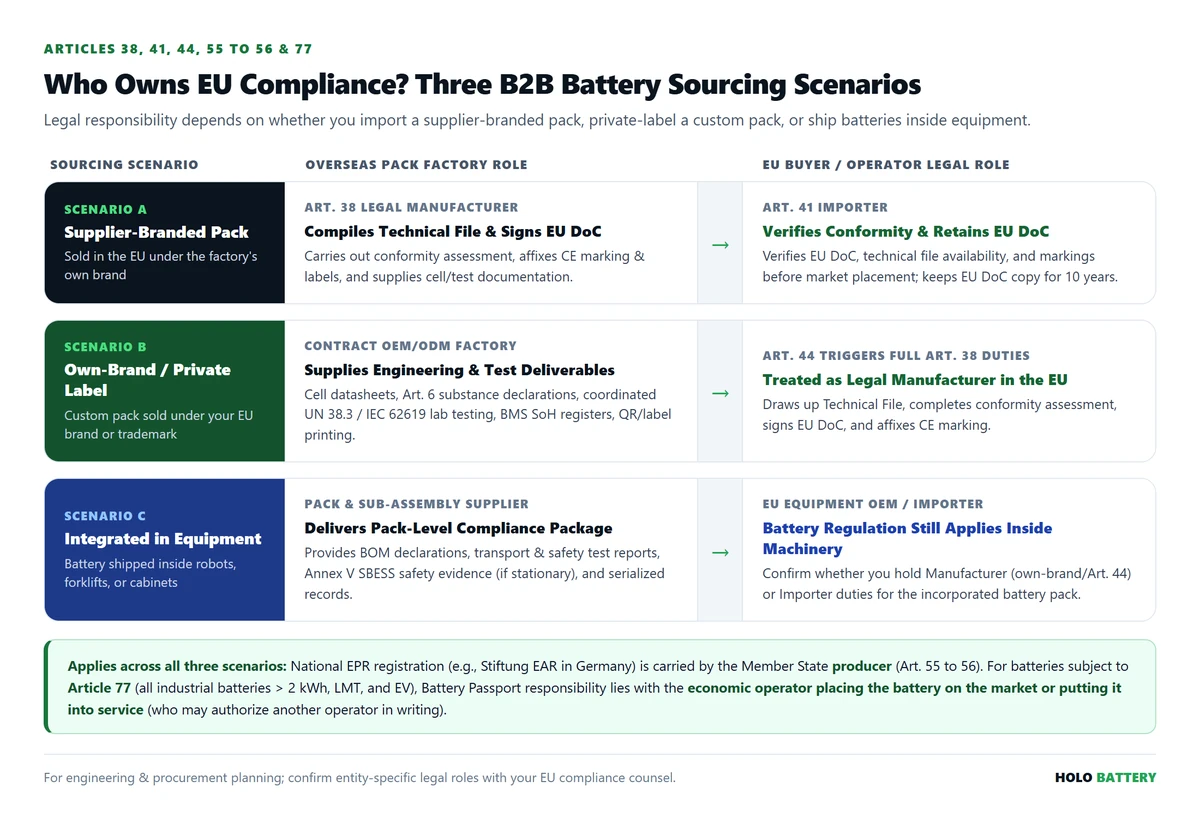
Use the RFQ checklist below to align factory deliverables with EU legal ownership before freezing your pack specification:
| Compliance Area | What to Request from Your Pack Factory | EU Legal Owner (by Role) | When to Lock It |
|---|---|---|---|
| Cell Origin & Substance Compliance (Art. 6) | Tier-1 cell datasheets, chemistry and material declarations, RoHS/REACH and Art. 6 restricted-substance declarations (mercury, cadmium, lead), plus recommended cell-lot traceability records | Manufacturer compiles into the technical file; Importer verifies compliance | RFQ & BOM freeze |
| Sicurezza & Transport Testing | Cell-level UL/IEC/UN 38.3 files; coordinated pack-level UN 38.3 testing and Test Summary (with packaging, marking, state-of-charge limits, and carrier-requested SDS confirmed per transport mode, battery classification, and applicable packing instruction); IEC 62619 safety testing for industrial packs (or IEC 62133-2 for portable); Art. 12 & Annex V safety documentation and test evidence for stationary BESS | Manufacturer completes conformity assessment and signs EU DoC; Importer verifies and retains EU DoC copy for 10 years | Prototype sign-off & pre-shipment |
| BMS State of Health Data (Art. 14) | BMS firmware (CANbus / RS485 / SMBus) storing and exposing SoH and expected lifetime parameters where required by category (SBESS, LMT, EV) | Manufacturer ensures BMS compliance and read-only access under Art. 14(2) for the natural or legal person who legally purchased the battery, or any third party acting on their behalf, on a non-discriminatory basis for the statutory evaluation/reuse purposes (without prejudice to IP rights) | BMS spec freeze |
| QR Code & Battery Passport (Art. 13(6) & Art. 77) | Durable laser-marked or label-printed QR codes on the enclosure and agreed batch/model manufacturing data exports | Economic operator placing the battery on the market or putting it into service is responsible for the Art. 77 passport and may authorize another operator in writing to act on its behalf | Involucro & label freeze |
| CE Marking, Labelling & EPR (Art. 13, 20, 55 to 56) | Printing agreed CE, separate-collection, and battery rating artwork onto pack labels | Manufacturer affixes CE/signs EU DoC (own-brand EU buyers under Art. 44); Member State Producer completes national EPR registration (e.g., Stiftung EAR in Germany) | Prior to first EU market placement |
4. Five-Point Engineering & Procurement Checklist Ahead of February 18, 2027
Step 1: Verify Whether Article 14 BMS SoH Applies to Your Battery Category
Check Article 14 by battery category rather than assuming every pack over 2 kWh triggers it. If your project is a stationary battery energy storage system (SBESS), LMT battery, or EV battery, Article 14 is already in force and requires the BMS to store up-to-date State of Health (SoH) and expected lifetime parameters, with read-only access under Article 14(2). Even for non-SBESS industrial packs above 2 kWh, defining diagnostic registers during initial BMS specification avoids costly firmware revisions later.
Step 2: Separate Transport Compliance (UN 38.3 + Freight Rules) from EU Market Safety
UN 38.3 testing is one core part of lithium battery transport compliance, while exact packaging, hazard markings, state-of-charge limits, and any carrier-requested SDS depend on your transport mode (air vs. sea), battery classification, shipping configuration (standalone vs. packed with/in equipment), and applicable packing instruction (IATA does not universally mandate an SDS, though carriers or forwarders may request one). Transport clearance does not satisfy EU Battery Regulation safety or conformity requirements. For industrial battery packs, CEI 62619 serves as a widely recognized safety test basis, and stationary BESS units additionally require technical documentation and test evidence addressing the applicable hazards under Article 12 and Annex V. For a breakdown of cell-level versus pack-level test deliverables, see our Test delle batterie e supporto per la conformità pagina.
Step 3: Plan Physical Labels, QR Codes, and Conditional Carbon Footprint Early
From February 18, 2027, every battery requires a scannable QR code under Article 13(6), linking to the Digital Battery Passport for industrial batteries above 2 kWh, LMT, and EV batteries, or to the applicable statutory information for batteries outside the passport scope (such as portable, SLI, and industrial packs at or below 2 kWh). Separately, track the European Commission’s implementing and delegated acts for Article 13 general labelling and Article 7 carbon footprint declarations (which apply to rechargeable industrial batteries above 2 kWh excluding exclusively external storage). Confirm laser engraving versus chemical-resistant labels early and test QR readability after powder coating or IP67/IP68 sealing.
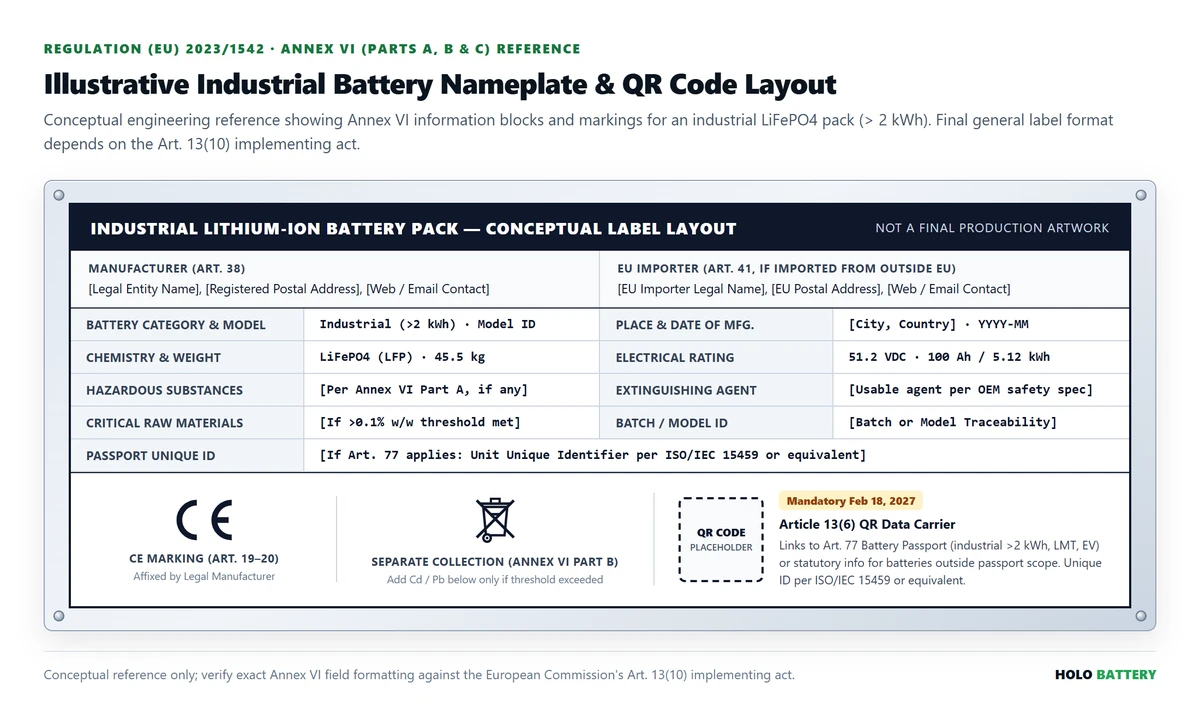
- Manufacturer vs. EU Importer (Articles 38 and 41): List the legal manufacturer’s name, postal address, and contact details; for batteries imported from outside the EU, display the EU importer’s details separately rather than merging both roles.
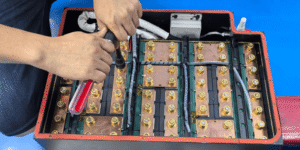
- Annex VI Part A core fields: Include battery category and model, place and date of manufacturing, chemistry, capacity, weight, applicable hazardous substances, usable extinguishing agent, critical raw materials exceeding the 0.1% w/w threshold, and batch or model traceability (engineering nameplates commonly also display nominal voltage, as shown in the example above).
- CE marking & Annex VI Part B separate collection symbol: Affix CE marking (Articles 19 to 20) after conformity assessment and EU DoC sign-off. Batteries carry the Annex VI Part B crossed-out wheeled bin symbol (where a battery is so small that the symbol would fall below the statutory minimum size, the symbol is printed on the packaging instead), adding Cd (>0.002%) or Pb (>0.004%) below it only when statutory thresholds are exceeded.
- Article 13(6) QR code & Passport Unique ID (from February 18, 2027): Mandatory on all batteries. For industrial batteries above 2 kWh, LMT, and EV batteries, the QR code links to the Article 77 Digital Battery Passport via a unit unique identifier conforming to ISO/IEC 15459 or an equivalent standard; for batteries outside the passport scope, it links to the applicable statutory information.
Step 4: Clarify Due Diligence Exemptions and Request Practical Factory Traceability
Chapter VII supply chain due diligence (postponed to August 18, 2027 by Regulation (EU) 2025/1561) exempts economic operators under Article 47 if their own net turnover in the financial year preceding the last financial year was below EUR 40 million and they are not part of a group whose consolidated net turnover exceeded EUR 40 million in that same reference year (confirm any further EU Omnibus amendments before the deadline). Even if your company qualifies for the small-operator exemption, requesting incoming cell lot codes, cell manufacturer documentation, and serialized end-of-line (EOL) factory test logs in your RFQ is a practical way to support quality audits, warranty root-cause tracing, and downstream enterprise customer questionnaires.
Step 5: Budget Compliance Fees Alongside NRE and Unit Price
Accredited lab testing (UN 38.3, IEC 62619, and Annex V safety verification where applicable), destructive test samples, passport record management, and national EPR fees all affect total Year-1 program cost. Before choosing between local European assembly and an export OEM factory, model your full first-year landed and compliance budget using our Guida ai costi dei pacchi batteria al litio personalizzati 2027.
5. Documentazione di fabbrica da confermare con Holo Battery in fase di RFQ
As an export-focused produttore di batterie al litio personalizzate supplying European industrial, robotics, marine, and off-grid equipment makers, Holo Battery aligns factory-side compliance deliverables to your project scope during RFQ review:
- Cella & material documentation: Tier-1 cell datasheets (EVE, REPT, CATL, Samsung), cell-level UN 38.3 Test Summaries and applicable UL/IEC files, and RoHS/material declarations matched to your approved BOM.
- Project-configured BMS & serialization: CANbus, RS485, or SMBus BMS register mapping (including SoH and cycle-count telemetry where specified), plus serialized pack barcode/QR label integration and factory EOL electrical test sheets confirmed per order specification.
- Coordinated third-party lab testing: Project-coordinated pack-level UN 38.3 testing and Test Summaries, IEC 62133-2 or IEC 62619 safety testing, and sample builds for accredited labs. Review delivered pack architectures in our OEM engineering case studies.
Domande frequenti
Does an industrial lithium battery pack under 2 kWh need an EU Digital Battery Passport in 2027?
No. Under Article 77 of Regulation (EU) 2023/1542, the February 18, 2027 Digital Battery Passport requirement applies to EV batteries, LMT batteries, and all industrial batteries with a capacity greater than 2 kWh placed on the market or put into service. Industrial packs at or below 2 kWh are exempt from the Battery Passport, but from February 18, 2027 they still require an Article 13(6) QR code linking to the applicable statutory information, along with CE marking, EU DoC, technical documentation, substance compliance, and EPR registration.
When does Supply Chain Due Diligence under the EU Battery Regulation take effect, and who is exempt?
Under Regulation (EU) 2025/1561 (Omnibus IV), the EU postponed Chapter VII battery supply chain due diligence obligations by two years from August 18, 2025 to August 18, 2027. Under current Article 47, economic operators are exempt if their own net turnover in the financial year preceding the last financial year was below EUR 40 million and they are not part of a group whose consolidated net turnover exceeded EUR 40 million in that reference year (confirm any subsequent EU Omnibus amendments before the deadline).
If a European OEM imports a custom battery pack from China, who signs the EU DoC and handles EPR and the Battery Passport?
Responsibility depends on your legal role. The legal manufacturer (Article 38) draws up and signs the EU DoC, while an importer (Article 41) verifies and retains a copy for 10 years. However, under Article 44, an EU OEM placing a custom pack on the market under its own brand or trademark assumes full manufacturer obligations. National EPR registration (such as Stiftung EAR in Germany) follows the Member State producer role (Articles 55 to 56). The Article 77 Battery Passport is the responsibility of the economic operator placing the battery on the market or putting it into service, who may authorize another operator in writing to assist.
Are IEC 62619 and UN 38.3 alone enough to sell an industrial battery pack in the EU?
No. UN 38.3 is part of lithium battery transport requirements (with exact packaging, hazard markings, state-of-charge limits, and any carrier-requested SDS determined by transport mode, battery classification, shipping configuration, and packing instruction), and IEC 62619 provides a recognized safety test basis for industrial packs. Placing an industrial battery on the EU market also requires full Regulation (EU) 2023/1542 conformity assessment, an EU Declaration of Conformity, substance compliance, Art. 12 and Annex V safety documentation/test evidence for stationary BESS, proper labelling and QR codes, national EPR registration, and an Article 77 Battery Passport for capacities above 2 kWh from February 18, 2027.