


Custom Drone and UAV Battery Packs
22.2V to 53.2V high-discharge lithium packs for industrial, agricultural, survey and delivery drones. Every gram costs flight time and every amp of sag costs control authority, so we choose cells and build the pack around your hover power, peak power and airframe, not around a catalogue size.
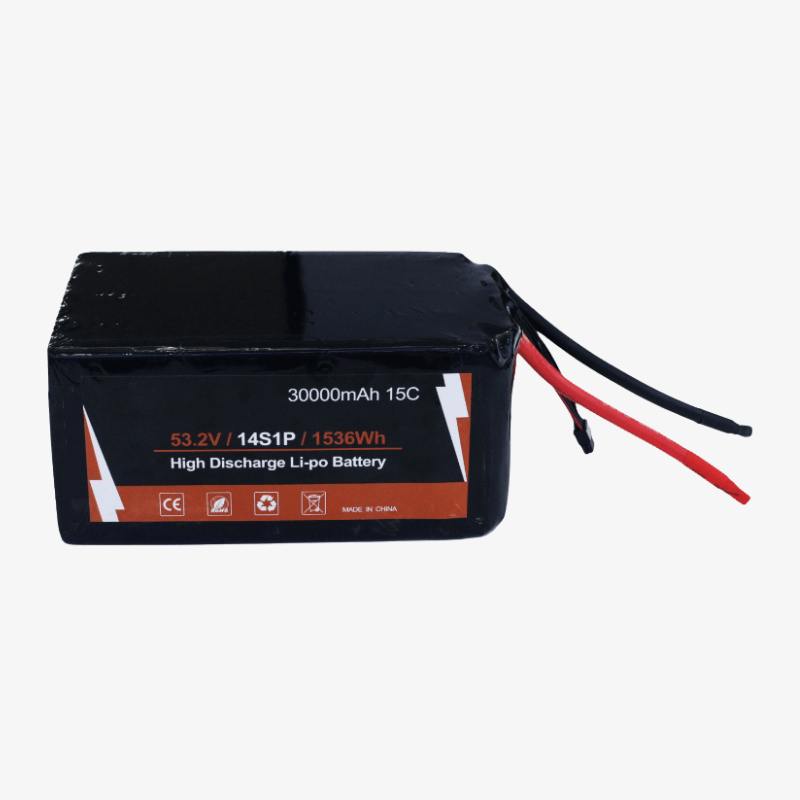
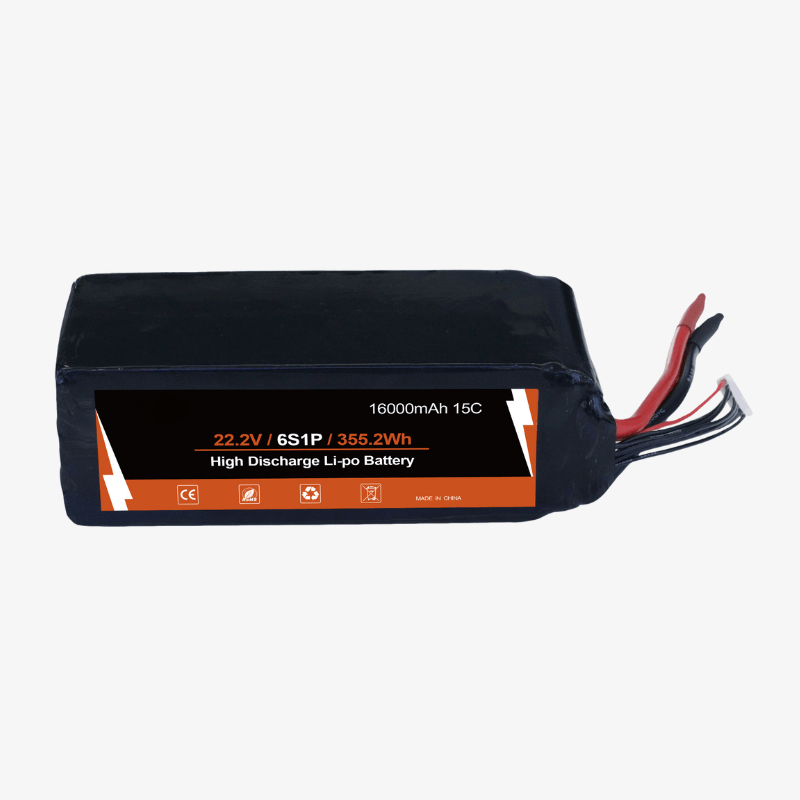

Drone packs we build
| Drone class | Configuración | ¿Qué impulsa el diseño? | Paquetes de referencia |
|---|---|---|---|
| Long-range survey and inspection | 6S (22.2V) | Energy density for endurance, moderate burst current | 22.2V 16Ah |
| Heavy-lift and mapping multirotors | 12S (44.4V) | Payload, redundancy, hot-swap between flights | 44.4V 22Ah |
| Agricultural spraying and delivery | 14S (product rated 53.2V) | High current under full tank or payload, frequent fast charging | 53.2V 30Ah, 15C |
| Fixed-wing and VTOL | Project-specific | Long cruise at low power, high power only for take-off and transition | Custom design |
Sizing a pack for flight time
Flight time is usable energy divided by average power. For multirotors the average is close to hover power at take-off weight; for spraying drones it falls as the tank empties. The catch is that adding capacity adds weight, which raises hover power, so each extra watt-hour buys less flight time than the one before. Check peak power separately: climb, wind gusts and aggressive manoeuvres set the current the pack must deliver without sagging.
- Pack: 14S 30Ah. With standard 3.7V cells (51.8V nominal)
51.8 × 30 ≈ 1,554 Wh; with 3.8V high-voltage cells (53.2V nominal)≈ 1,596 Wh. We use the lower figure - Usable energy, landing with about 20% reserve →
≈ 1,243 Wh - Average hover power at take-off weight, from test flights:
4 kW - Flight time:
1,243 ÷ 4,000 × 60 ≈ 18.6 min - Peak power in climb at 2× hover:
8 kW ÷ 51.8 V ≈ 154 A→ about5Con a 30Ah pack
Energy density vs discharge rate
High-energy cells
- More watt-hours per kilogram, longer endurance
- Lower continuous discharge rate
- Suit fixed-wing, VTOL cruise and light survey drones
- Sag more under climb and gust loads
High-power cells
- Lower internal resistance, higher C-rate
- Less sag and heat at peak current
- Suit heavy-lift, spraying and delivery multirotors
- Fewer watt-hours per kilogram
Most heavy multirotors land in the middle: a cell with enough C-rate for the climb peak and the best energy density at that rate. Cell formats are compared in 21700 frente a 18650 y lithium-ion vs LiPo.
What we engineer into a drone pack
- Cell matching
- Cells grouped by capacity and internal resistance so parallel groups share current evenly and the pack does not end its life early on one weak group.
- Interconnects and connectors
- Low-resistance busbars and connectors rated for the peak current, such as XT90 or AS150 class, chosen with the airframe’s wiring. See XT60 vs XT90.
- Smart BMS
- Cell voltage, temperature and cycle count reported to the flight controller or ground station, so pilots see remaining energy instead of guessing from voltage.
- Recinto
- Lightweight shells with vibration damping, quick-release mounting and protection against spray and dust for agricultural work.
- Carga
- Charge rates and balancing matched to field chargers and generators, with storage-voltage modes for packs left between seasons. See how to charge a drone battery.
- Shipping
- UN38.3 testing for the design and dangerous-goods packaging; large packs ship by sea or as cargo-aircraft freight. Which reports cover your exact design is confirmed at quotation.
Plazo de entrega y cantidad del pedido
A partir de una especificación bloqueada: muestras en 12 a 15 días hábiles cuando las células están en stock, 20 a 25 días cuando las células deben obtenerse; producción en 30-35 días laborables. Desde la primera conversación de diseño: alrededor de 4 semanas para un diseño finalizado sin herramientas nuevas, de 8 a 12 semanas para un proyecto personalizado típico, de 14 a 18 semanas cuando la certificación está dentro del alcance. Cómo funciona cada fase: proceso de desarrollo de paquete de baterías personalizado y nuestras capacidades de fabricación.
Drone battery questions
Will a bigger battery give me a longer flight?
What C-rate does my drone battery need?
Lithium-ion or LiPo for industrial drones?
Can you match our existing battery’s shape and connector?
How should drone batteries be stored between seasons?
Send your drone’s power profile
Un ingeniero responde con preguntas o una configuración propuesta. Cuanto más pueda compartir de esta lista, más rápido podremos cotizar:
- Drone type and take-off weight
- Configuration (6S, 12S, 14S…) and ESC voltage window
- Hover power and peak power, or logged current
- Target flight time
- Weight and size limits for the pack
- Connector and flight-controller protocol
- Charging setup in the field
- Annual volume