

If you source custom battery packs, three questions matter early:
- Can we ship the battery legally?
- Which safety standard applies to our product?
- How do we verify that supplier documents are real and relevant?
This guide explains how ONU38.3, IEC 62133-2, and IEC 62619 fit together for OEM buyers evaluating paquetes de baterías personalizados for industrial and portable equipment. It is written for teams building products such as AGVs, AMRs, forklifts, robotics, medical devices, outdoor equipment, and energy storage systems.
The short version: UN38.3 is about transport, while IEC 62133-2 and IEC 62619 are product safety standards used in different application categories. If you are buying a custom 24V, 48V, 72V, or 96V battery pack, do not assume cell-level documents automatically cover the finished pack. In many projects, the final battery assembly requires its own transport evaluation and, depending on the application, additional pack-level safety testing.
Important: This article is for planning and procurement purposes. Final compliance requirements depend on the destination market, carrier, application, and certification scheme. Always confirm the test plan with your accredited lab and regulatory partner.
Control de llave
- UN38.3 is transport compliance, not a quality badge. If you plan to ship lithium batteries commercially, start by confirming the battery has valid UN38.3 transport test evidence and the required shipping documents.
- Cell documents do not automatically transfer to the finished pack. If your final design changes the configuration, BMS, enclosure, wiring, or other safety-relevant features, check with your test lab whether pack-level testing or additional evaluation is required.
- IEC 62133-2 and IEC 62619 serve different use cases. Portable products usually start with IEC 62133-2. Industrial systems often require IEC 62619 and sometimes additional market-specific standards.
- Document verification should happen before PO placement. Match the exact model to the report, then confirm that the lab’s accreditation is active and that the relevant standard is within scope.
- Budget compliance early. For custom battery programs, transport and safety testing can add several weeks and meaningful NRE. It is easier to manage during design freeze than right before first shipment.
Quick Decision Guide
| What you need to answer | Usually starts with | Why it matters |
|---|---|---|
| Can we ship the battery? | ONU38.3 | Transport testing for lithium batteries and related shipping documentation |
| Is this a portable product? | IEC 62133-2 | Common safety baseline for portable lithium cells and batteries |
| Is this an industrial battery system? | IEC 62619 | Common safety standard for industrial lithium battery applications |
| Are we entering North America or other regulated markets? | Check additional regional / product standards | UL, end-product, or customer-specific requirements may also apply |
What Each Standard Actually Covers
A common source of confusion is treating all battery “certifications” as if they do the same job. They do not.
UN38.3: Transport Testing
UN38.3 comes from the UN Manual of Tests and Criteria and is used to demonstrate that a lithium battery type has passed required transport-related abuse tests. In practice, buyers usually ask suppliers for the UN38.3 test summary, and in some cases also request the underlying test report or supporting product identification.
UN38.3 does not mean a battery is broadly “safe for all uses,” and it does not replace product safety standards or market-specific packaging and labeling rules.
IEC 62133-2: Portable Battery Safety
IEC 62133-2 is the main IEC safety standard used for portable lithium cells and batteries. It is commonly relevant for products such as handheld devices, medical tools, portable instruments, and some light mobility or portable electronics applications.
IEC 62619: Industrial Battery Safety
IEC 62619 is used for industrial lithium battery systems, including equipment such as AGVs, forklifts, energy storage systems, outdoor robots, and other industrial platforms. It places more emphasis on system-level behavior, protection functions, and industrial use conditions.
For many OEM buyers, the practical takeaway is simple:
- Shipping question? Start with UN38.3.
- Portable product? Check IEC 62133-2.
- Industrial system? Check IEC 62619 and any customer-specific or regional standards.
What UN38.3 Tests and What Buyers Should Request
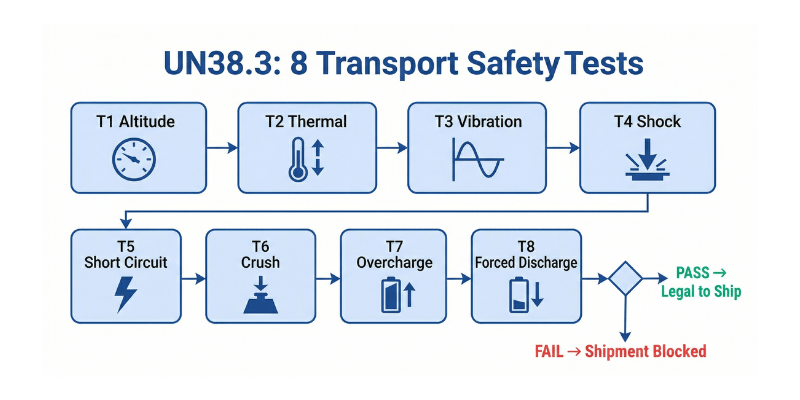
UN38.3 includes eight transport tests, commonly referred to as T.1 to T.8.
- T.1 Altitude simulation
- T.2 Thermal test
- T.3 Vibration
- T.4 Shock
- T.5 External short circuit
- T.6 Impact / crush
- T.7 Overcharge
- T.8 Forced discharge
These tests are intended to simulate transport-related stress conditions. Exact parameters depend on battery type, form factor, and the applicable test method in the UN Manual.
For OEM procurement teams, the more useful question is not “What is every exact test value?” but “What document set should we ask for?”
Request these documents at RFQ or supplier qualification stage
- UN38.3 test summary
- Battery model identification that matches the product you are buying
- Safety Data Sheet (SDS), if required by your logistics chain
- Packaging / labeling information required by your carrier or destination market
- Underlying report or additional evidence if the pack is custom or high-risk
A practical point: when people say “UN38.3 certificate,” they often mean the UN38.3 test summary and supporting compliance documents. There is no single universal global “certificate” format used the same way in every transaction.
Also remember: passing UN38.3 does not complete the whole shipping job. Packaging, state-of-charge limits, marking, labeling, and transport declarations still need to follow the applicable air, sea, road, or rail rules.
Why Certified Cells Do Not Automatically Make a Compliant Battery Pack
This is where many custom battery projects run into delays.
A cell manufacturer may provide valid transport and safety documents for the cell. But once you build those cells into a new battery pack with a different series/parallel configuration, BMS, fuse strategy, enclosure, connector set, or wiring harness, you have changed the product being evaluated.
That does not always mean the exact same amount of re-testing in every case, but it does mean you should not assume cell-level evidence automatically covers the final pack.
For custom programs, the safe planning assumption is:
- Treat the finished pack as its own compliance item
- Ask your test lab whether the final design requires pack-level testing, delta evaluation, or a new report
- Do this before tooling release or pilot build whenever possible
For Holo Battery’s typical customer base: OEMs buying custom 24V to 96V battery packs for industrial equipment – this is especially important because battery pack design usually includes application-specific protection electronics and mechanical integration.
Changes That Commonly Trigger a New Compliance Review
- Different cell count or configuration
- New BMS or protection logic
- New enclosure or mechanical layout
- Different busbar or wiring structure
- New connector, fuse, or contactor arrangement
- Material changes that affect heat, insulation, or spacing
In many projects, pack-level UN38.3 testing for a custom battery is a normal NRE item rather than an exception.
IEC 62133-2 vs IEC 62619: which one applies?
A simple rule of thumb is:
- IEC 62133-2 → portable battery applications
- IEC 62619 → industrial battery applications
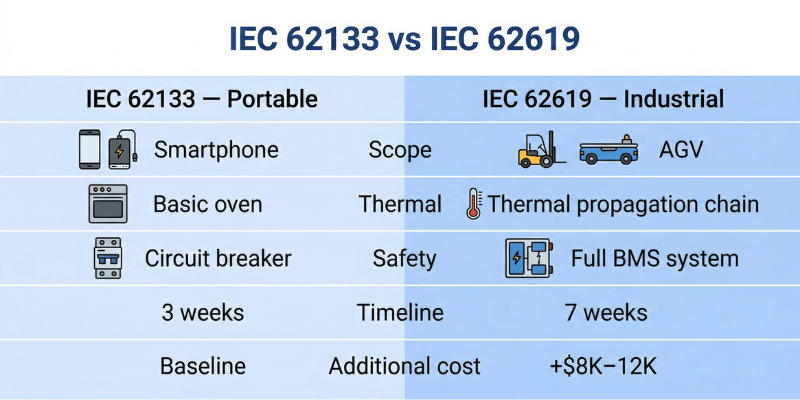
Here is the practical difference:
| Topic | IEC 62133-2 | IEC 62619 |
|---|---|---|
| Typical use case | Portable products | Industrial systems |
| Focus | Cell and battery safety for portable use | System-level safety in industrial use |
| Protection assessment | Basic abuse and protection checks | Stronger emphasis on system protection and industrial conditions |
| Typical products | Medical tools, handheld devices, portable instruments | AGVs, forklifts, robotics, ESS, industrial backup power |
For OEM buyers, however, there is one important nuance:
IEC 62133-2 or IEC 62619 may not be the only standards that matter.
Your end market may also require:
- UL standards in North America
- End-product standards tied to the equipment category
- Customer-specific approval requirements
- Certification body or importer requirements
So the question is not only “Which IEC standard applies?” but also:
- What does the end customer require?
- What does the destination market require?
- What does the end product standard require?
Practical Buying Guidance
If you are sourcing a battery pack for:
- Handheld or portable equipment → start with IEC 62133-2
- AGV, AMR, forklift, robotics, or industrial energy systems → check IEC 62619
- North America or regulated verticals → review additional UL or product-specific requirements early
How Battery Compliance Documents Get Misused in the Supply Chain
Battery document problems are common enough that every serious buyer should have a review process.
The issue is not only outright forgery. More often, the problem is that a document is real but not applicable to the product being sold.
Common Red Flags
1. Model Mismatch
The report belongs to a different cell or battery model than the one quoted.
2. Cell-to-pack Substitution
A supplier shares valid cell documents and presents them as if they fully cover a custom pack.
3. Edited PDF Files
Company name, model number, or date has been altered while the lab branding remains.
4. Invalid lab Scope
The lab exists, but its active accreditation does not cover the standard being claimed.
5. “Certificate only” with no technical traceability
A one-page conformity statement may be useful in some commercial files, but for higher-risk projects you should still ask for traceable test evidence.
For small and mid-sized OEMs, the risk is operational as much as legal: shipment rejection, launch delays, customer audit failure, rework, or insurance questions after an incident.
A Practical 4-step Document Verification Process for Procurement Teams
This is a simple workflow that works well for most battery sourcing programs.
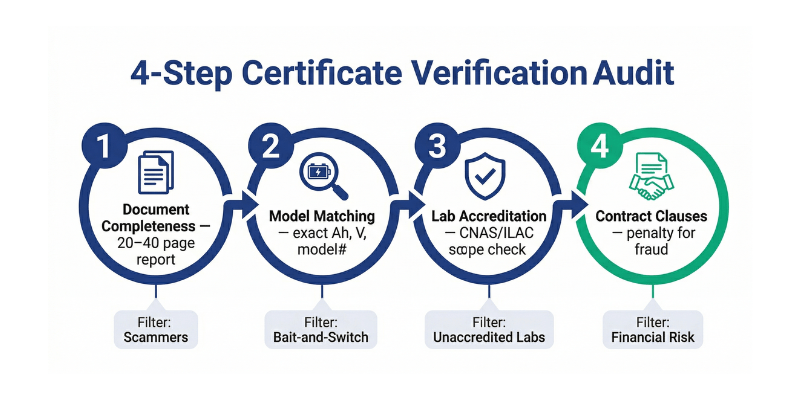
| Step | What to check | Why it matters |
|---|---|---|
| 1. Confirm document type | Ask for the UN38.3 test summary, relevant IEC report / certificate, and product identification | Prevents vague or incomplete submissions |
| 2. Match the exact model | Compare model number, voltage, capacity, chemistry, and pack description against the quote and datasheet | Filters out mismatched or reused documents |
| 3. Verify the lab | Check the laboratory’s accreditation status and whether the relevant standard is within scope | Screens out invalid or non-applicable lab claims |
| 4. Protect the contract | Add warranty language covering authenticity and applicability of compliance documents | Shifts part of the risk back to the supplier |
How to Verify the Lab Correctly
Do not stop at “the lab exists.”
Also confirm that the lab’s scope of accreditation covers the standard you care about, such as UN38.3, IEC 62133-2, or IEC 62619.
CNAS-accredited laboratories in China participate in internationally recognized accreditation frameworks, which can improve acceptance of test reports across borders. But buyers should still confirm any customer, carrier, or market-specific requirements before relying on a report for shipment or market entry.
For lean teams, this review does not need to be complicated. One person in procurement or engineering can own the checklist and apply it before the first PO.
What Custom Battery Compliance Typically Costs
The cost of compliance depends on battery size, chemistry, sample count, lab location, and whether the design is still changing. But for project planning, it is reasonable to treat compliance as a standard NRE line item.
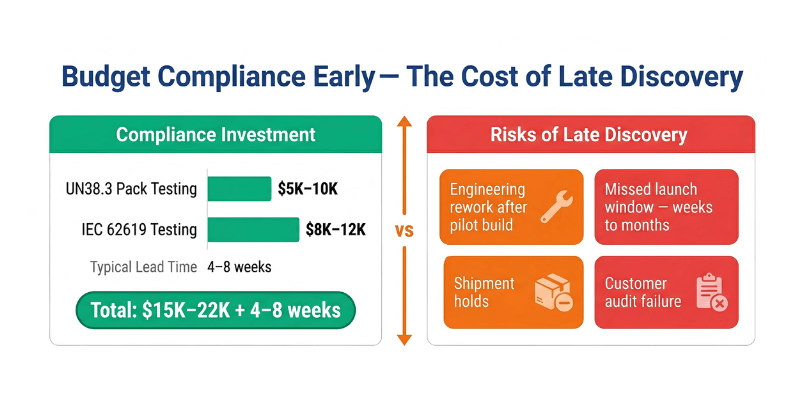
In our experience, a custom battery pack UN38.3 test program often falls around US$5,000–10,000, while IEC 62619 pack-level work may add roughly US$8,000–12,000 depending on scope and lab. Timing is often measured in weeks, not days.
| Artículo | Typical planning range | Notes |
|---|---|---|
| UN38.3 pack-level testing | US$5,000–10,000 | Varies by sample count, battery size, and lab |
| IEC 62619 testing | US$8,000–12,000 | Scope depends on application and pack design |
| Typical test lead time | 4–8 weeks | Can be longer if the lab queue is full or redesign is needed |
| Total project impact | Design-dependent | Delays increase sharply if compliance starts after design freeze |
The direct test cost is usually manageable. The bigger risk is late discovery:
- engineering changes after pilot build
- missed launch windows
- shipment holds
- requalification work
- customer approval delays
That is why the best time to discuss compliance is before final pack design is locked.
Sodium-ion Note for OEM Buyers
If you are evaluating sodium-ion for cost, supply-chain, or low-temperature reasons, treat compliance planning as a case-by-case exercise.
Transport classification, safety evaluation routes, and customer acceptance requirements for sodium-ion can evolve by market and timing. In many projects, buyers still pursue transport and product-safety testing through frameworks similar to those used for lithium batteries, but the exact path should be confirmed with the test lab, certification partner, and logistics provider for the target market.
In other words: do not assume sodium-ion paperwork is identical to lithium-ion paperwork without verification.
Preguntas frecuentes
Is UN38.3 required only for air freight?
No. UN38.3 is tied to transport of lithium batteries more broadly, not just air shipment. However, the full shipping requirements still depend on the mode of transport and the applicable rules for air, sea, road, or rail.
Does a custom battery pack always need its own UN38.3 testing?
Not every project is identical, but you should not assume cell-level documents automatically cover the final pack. If the finished battery differs in configuration, electronics, mechanical design, or other safety-relevant features, ask your accredited lab whether pack-level testing or additional evaluation is required.
Does IEC 62619 replace UL certification?
No. IEC 62619 and UL standards are different frameworks. Depending on your market and product category, you may need one, the other, or both.
Can we use test reports from a Chinese lab for EU or US business?
Often yes, provided the lab is properly accredited and the report is accepted by your customer, certification body, and logistics chain. Always verify the lab’s current accreditation status and scope first.
How long should we budget for compliance work?
For a custom pack, it is prudent to reserve at least several weeks for sample preparation, lab queue time, testing, and document issuance. If redesign is needed, the real schedule impact can be much longer.
What should procurement ask for first?
Start with:
- model-specific datasheet
- UN38.3 test summary
- relevant IEC report or certification evidence
- SDS if needed
- lab identity and accreditation scope
Final Advice for OEM Teams
The best battery compliance strategy is not “collect documents at the end.”
It is:
- define the target market and use case early
- select the right cell and pack architecture
- align transport and safety requirements before pilot build
- verify supplier documents before signing volume orders
That approach reduces surprises in shipping, customer audits, and product launch.
If your team is developing a custom battery pack for industrial equipment, Holo Battery can help review the application, align the pack architecture with likely compliance requirements, and plan test work before the project reaches the shipping stage.