

Most comparisons between LiFePO4 (LFP) and NMC stop at cell chemistry. Fleet operators need to know what each option actually costs per kilowatt-hour delivered over a 10-year service life.
Below, we run that math on a 40-unit warehouse fleet operating two shifts a day. Across 10 years, LFP delivers energy at $0.0346 per kWh compared with $0.1130 per kWh for NMC. We also show where NMC still takes the spec: tight battery bays and strict vehicle weight limits where an LFP pack cannot fit.
The TCO model
Operators still running lead-acid packs can start with our lithium vs. lead-acid comparison for the baseline payback math. Once a fleet commits to lithium, the total cost of ownership comes down to six variables divided by total delivered energy:
Cost per kWh delivered = (acquisition + replacements + energy losses + thermal management + maintenance and downtime − residual value) ÷ total kWh delivered over the fleet horizon.
What the model includes:
- Initial acquisition equals nameplate capacity (kWh) multiplied by pack price ($/kWh). Because the two chemistries have different depth-of-discharge (DoD) limits, each pack is sized around required usable energy (nameplate kWh = usable kWh ÷ allowed DoD).
- Replacements cover a full pack, thermal hardware, and installation labor whenever cumulative cycles pass the rated cycle life during the 10-year window, priced at current $/kWh.
- Energy losses account for charging inefficiency over the life of the fleet. Total energy drawn from the wall equals delivered kWh divided by system round-trip efficiency, billed at the depot’s industrial electricity rate.
- Thermal management adds a 10% hardware premium on NMC pack cost for active liquid cooling. Passive or forced-air cooling on LFP is included in the base pack price.
- Maintenance and downtime capture the workshop labor for each mid-life battery swap. Because both options are sealed lithium packs with BMS telemetry, routine daily maintenance is treated as equal.
- Residual value credits 20% of bare pack cost at year 10 if the installed pack still has at least half of its rated cycle life remaining. Spent packs carry $0 residual value.
What we leave out:
- Chargers and depot electrical infrastructure, which are identical for both chemistries at the same system voltage.
- Financing costs and discount rates. All figures are undiscounted cash totals so finance teams can apply their own hurdle rate to the cash-flow schedule.
- Vehicles, operator wages, and warehouse floor space, which do not change with battery chemistry.
- End-of-life scrap or recycling payouts beyond the remaining-life residual rule.
- Carbon and emissions accounting, which sits outside direct operating cost.
Sizing packs by usable energy matters more than most spec sheets admit. A vehicle that needs 30 kWh of usable energy per shift requires a larger nameplate NMC pack than LFP pack because NMC cannot be cycled as deeply without accelerating degradation. Comparing equal nameplate capacities overstates what NMC can deliver on the floor.
Inputs: LFP vs NMC
Bare cells and finished packs have very different energy densities and prices. All weight and cost calculations below use complete pack-level figures. Our guide to срок службы батареи covers how depth of discharge and temperature shape these ratings in detail.
| Input | ЛФП | NMC | Источник/условие |
|---|---|---|---|
| Cycle life to 80% retention | 6000 циклов | 2,000 cycles | LFP: EVE LF280K and LF90K datasheets at 25°C to 80% retention. NMC: CALB L148N58A prismatic cell spec, ≥2,000 cycles to 80% SOH at 25°C. NMC cycle life varies by formulation: balanced NMC532/NMC622 cells outlast high-nickel NMC811. |
| Плотность энергии, ячейка | 160–190 Wh/kg | 220–280 Wh/kg | IEA 2023, cell level. |
| Energy density, pack | 110–150 Wh/kg | 160–220 Wh/kg | IEA 2023, pack level. Model midpoints: LFP 130 Wh/kg, NMC 190 Wh/kg. |
| Acquisition, pack $/kWh | $81/kWh | $ 128/кВтч | BloombergNEF Battery Price Survey (December 2025) volume-weighted market averages. Custom industrial fleet packs cost more. The model depends on the roughly 58% gap between the two, not the absolute price levels; substitute your own quotes. |
| Round-trip efficiency, system | 88–94% (model: 91%) | 89–95% (model: 92%) | Pack-and-charger system efficiency range; cell-only efficiency runs higher. |
| Recommended usable DoD | 90–100% (model: 95%) | 80–90% (model: 85%) | Standard BMS operating window to preserve rated cycle life. |
| Calendar life | 12–15 years | 8–12 years | Typical service window at 25°C warehouse ambient. |
| Critical self-heating temp. | ~230–260°C | ~170–190°C | Critical self-heating temperature range for graphite-anode cells (Battery Design). |
| Thermal requirement | Passive / air cooling typical | Active (liquid) cooling typical in fleet duty | Standard pack engineering practice for multi-shift industrial duty. |
| Charge / discharge temperature | Charge 0–55°C, discharge −20–55°C | Charge −20–55°C, discharge −30–55°C | LFP: EVE datasheet. NMC: CALB L148N58A spec. |
System round-trip efficiency, usable depth of discharge, and calendar life depend heavily on BMS settings, charger selection, and ambient warehouse temperature, so the table lists standard engineering ranges along with the specific midpoints used in the calculation.
Cycle life drives the entire TCO gap because it dictates whether you buy a second set of batteries partway through the vehicle’s life. In practice, poor mechanical or electrical integration can shorten pack life well before the cells wear out, a problem we break down in our analysis of почему аккумуляторы AGV рано выходят из строя.
Thermal hardware is the second major cost divider. NMC reaches critical self-heating for термический побег around 170–190°C, which pushes multi-shift fleet designs toward active liquid cooling. LFP stays thermally stable up to 230–260°C and normally runs with passive conduction or simple forced air.
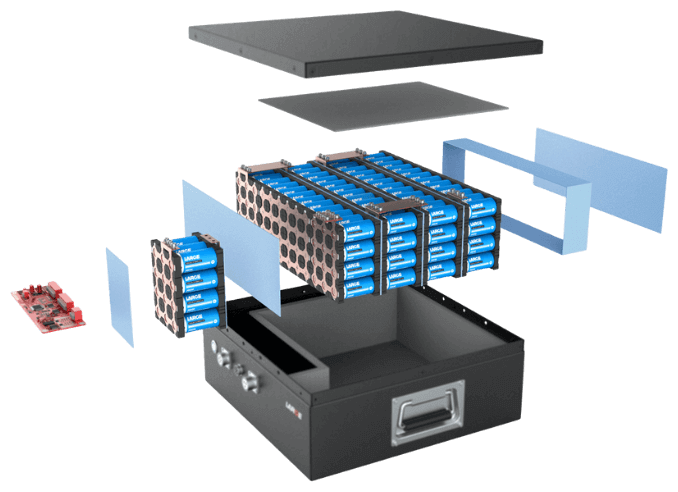
The model also uses these operating assumptions:
| Model parameter | Value | Basis and sensitivity |
|---|---|---|
| Electricity price | $0.12/kWh (industrial rate) | Scales charging losses only; varying electricity rates barely shifts the gap between chemistries. |
| NMC thermal adder | 10% of pack acquisition | Covers liquid-cooling plates, manifolds, and control hardware. Sensitivity testing below also runs this at 0%. |
| Swap labor / downtime per replacement | $200 per unit per event | Workshop labor to pull the spent pack and commission the replacement. |
| Residual credit rule | 20% of bare pack price if ≥50% rated cycle life remains at year 10; otherwise $0 | Conservative salvage estimate; thermal hardware is excluded from residual value. |
| Replacement pack pricing | Constant today’s $/kWh | Uses current pack pricing without speculating on future price curves. |
| Discounting | Undiscounted cash totals | Allows finance teams to apply their own internal discount rate to the cash flows. |
Worked example: a 40-unit depot fleet
Consider a 40-unit warehouse fleet running two shifts a day, 300 days a year, over a 10-year service life. Each vehicle uses 30 kWh of energy per day (one full cycle per operating day). That comes to 9,000 kWh and 300 cycles per unit each year, or 3,000 cycles and 3,600,000 kWh delivered across the fleet over 10 years. If you are sizing packs for material-handling equipment, our guide on как правильно выбрать аккумулятор для вилочного погрузчика walks through shift duty and amp-hour sizing.

1. To deliver 30 kWh of usable energy at 95% DoD, each LFP pack requires 31.58 kWh of nameplate capacity (30 ÷ 0.95). At 85% DoD, each NMC pack requires 35.29 kWh of nameplate capacity (30 ÷ 0.85).
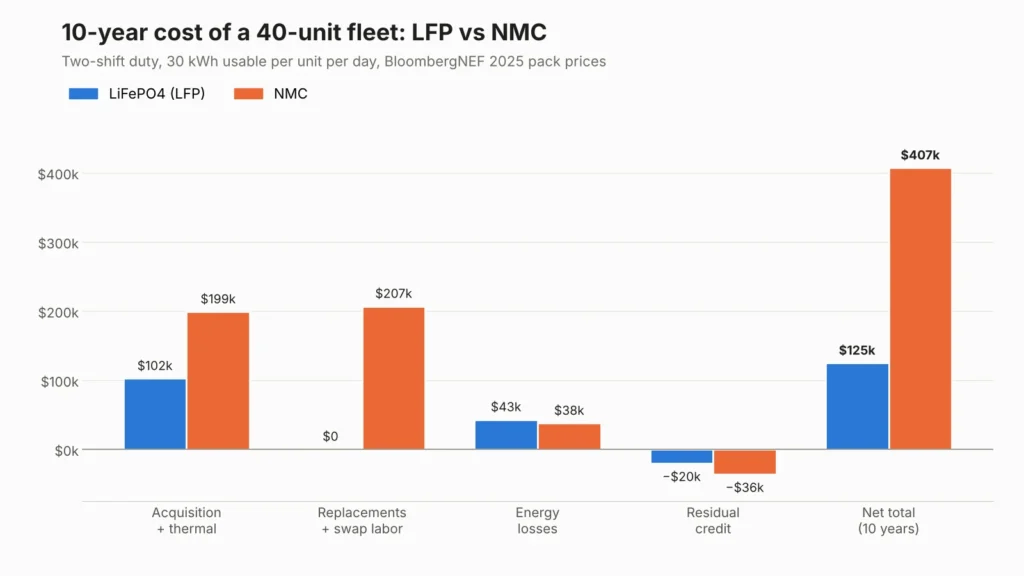
2. At $81/kWh, the 31.58 kWh LFP pack costs $2,558 per vehicle with passive cooling, or $102,316 across all 40 units. At $128/kWh, the 35.29 kWh NMC pack costs $4,518 per vehicle plus $452 for the 10% active-cooling adder ($4,970 per unit), totaling $198,776 for the fleet.
3. Using the pack-level density midpoints, the LFP pack weighs 243 kg (31.58 kWh ÷ 130 Wh/kg) and the NMC pack weighs 186 kg (35.29 kWh ÷ 190 Wh/kg), saving 57 kg per vehicle with NMC.
4. Three thousand cycles over 10 years uses half of LFP’s 6,000-cycle rating, so the original LFP packs run the full decade with zero replacements. NMC reaches its 2,000-cycle limit at year 6.7 (2,000 ÷ 300 cycles/yr). Replacing all 40 NMC packs adds another $198,776 in batteries and thermal hardware plus $8,000 in swap labor ($200 × 40 units), for a replacement bill of $206,776.
5. Delivering 3,600,000 kWh at 91% round-trip efficiency requires 3,956,044 kWh from the grid. LFP loses 356,044 kWh to heat and conversion, costing $42,725 at $0.12/kWh. At 92% efficiency, NMC draws 3,913,043 kWh and loses 313,043 kWh, costing $37,565. NMC’s 1% efficiency advantage saves $5,160 over 10 years, a small fraction of its $206,776 replacement cost.
6. At year 10, the original LFP packs still have 3,000 cycles (50% of rated life) remaining, qualifying for the 20% salvage credit of $20,463. The first set of NMC packs is scrapped at year 6.7 for $0, while the second set finishes year 10 with 1,000 cycles used and 1,000 cycles (50%) left, earning a 20% credit on bare pack cost of $36,141.
7. Combining all cost lines, LFP totals $124,578 across the fleet, or $0.0346 per kWh delivered. NMC totals $406,977, or $0.1130 per kWh delivered, roughly 3.3 times the cost of LFP.
| Cost component | ЛФП | NMC |
|---|---|---|
| Acquisition + thermal (fleet) | $102,316 | $198,776 |
| Replacements + swap (fleet) | $0 | $206,776 |
| Energy losses (fleet) | $42,725 | $37,565 |
| Residual credit (fleet) | −$20,463 | −$36,141 |
| Total (fleet, 10 yr) | $124,578 | $406,977 |
| Cost per kWh delivered | $0.0346/kWh | $0.1130/kWh |
Individual line items are rounded to the nearest dollar from unrounded intermediate calculations.
Sensitivity: where the verdict flips
Changing shift schedules, cell grades, and cooling costs shifts the gap between the two chemistries, though only physical vehicle limits reverse the outcome.
Shift utilization: 1, 2, or 3 shifts per day
Running one shift logs 150 cycles per year; two shifts log 300; three shifts log 450.
| Duty | Cycles/yr | Horizon cycles | LFP $/kWh | NMC $/kWh | NMC replacements |
|---|---|---|---|---|---|
| 1-shift | 150 | 1,500 | $0.0573 | $0.1209 | 0 |
| 2-shift (base) | 300 | 3,000 | $0.0346 | $0.1130 | 1 |
| 3-shift | 450 | 4,500 | $0.0308 | $0.1171 | 2 |

LFP gets cheaper per kilowatt-hour as utilization climbs because the upfront purchase spreads across more delivered energy, dropping from $0.0573/kWh on one shift to $0.0308/kWh on three shifts. NMC stays at about $0.11–0.12/kWh across all three schedules because heavier use triggers extra pack replacements.
On single-shift duty, watch calendar aging alongside cycle count. NMC calendar life runs 8 to 12 years, so a fleet kept in service for 10 to 12 years may still need a replacement NMC pack near the end of its service window even with only 1,500 cycles on the clock. LFP’s 12- to 15-year calendar life covers the full 10-year horizon.
Longer-life NMC cells and zero thermal premium
Some stationary and commercial NMC cells are rated for 3,000 cycles instead of 2,000. Using a 3,000-cycle NMC cell eliminates the mid-life replacement on a two-shift schedule and drops NMC to $0.0657/kWh, versus $0.0346/kWh for LFP. That cuts the cost ratio from 3.3x to 1.9x, though LFP still costs roughly half as much per kWh at 2025 pack prices. Similarly, removing the 10% active-cooling premium on NMC only lowers its base two-shift cost from $0.1130/kWh to $0.1030/kWh.
Weight and volume limits: where NMC takes the spec
Take an automated guided vehicle (AGV) with a maximum battery weight of 200 kg. The 31.58 kWh LFP pack weighs 243 kg and exceeds the chassis limit, while the 35.29 kWh NMC pack weighs 186 kg and fits with margin to spare. When a battery bay or axle rating cannot accept the extra mass, NMC is the only way to hit the runtime target without redesigning the vehicle.

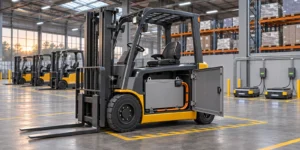
Compact mobile robots face the same trade-off on volume and payload: every extra kilogram of battery reduces carrying capacity. By contrast, counterbalance forklifts rely on the battery block as part of the truck’s rear counterweight, and the data plate specifies a minimum battery weight. Dropping 57 kg with an NMC pack often forces the integrator to bolt steel ballast plates into the compartment anyway, wiping out any weight advantage.
Which fleet specs which
Выбирайте LFP, когда:
- Your vehicles run two or three shifts a day (300+ cycles/year), where avoiding mid-life battery replacements saves more than the initial pack price.
- You plan to keep the equipment in service for 10 or more years without scheduled battery rebuilds.
- You operate counterbalance forklifts whose data plate requires a minimum counterweight mass, often using 48V LiFePO4 battery packs.
- You want simple passive or forced-air cooling with no pumps, chillers, or coolant lines to maintain.
Choose NMC when:
- Your AGVs or autonomous mobile robots have tight weight or volume limits where a 243 kg LFP pack exceeds the bay dimensions or floor-loading spec and a 186 kg NMC pack fits. Robots that also pull high peak currents during lifting or acceleration require careful busbar and cell selection, covered in our guide to high-discharge battery design for mobile robots.
- Your fleet turns vehicles over on 4- to 5-year leases (under 1,500–2,000 cycles), retiring the equipment before an NMC replacement comes due.
- Your vehicle platform already carries an active liquid-cooling loop, eliminating the standalone thermal hardware premium.
Upfront $/kWh rarely decides a fleet TCO calculation on its own. Even if a buyer negotiated NMC pack pricing down to match LFP at $81/kWh, cycling the fleet 300 times a year would still trigger a mid-life pack replacement and leave NMC far more expensive over 10 years.
To run this calculation for your own vehicles, you only need four numbers: daily usable kWh per unit, annual operating days, target fleet service life, and the maximum weight and dimensions of the battery compartment. Send those specs to our custom battery pack engineering team and we will model both options using actual production quotes for your volume.
Часто задаваемые вопросы
Does NMC’s higher energy density ever make it cheaper overall?
Within a 10-year warehouse fleet schedule, no. Even if you use 3,000-cycle ESS-grade NMC cells that need zero replacements over 10 years, NMC still comes out to $0.0657/kWh delivered compared with $0.0346/kWh for LFP at 2025 benchmark prices. Higher energy density pays off when it lets a smaller vehicle carry a larger payload or fit a tight battery bay.
How many cycles should I actually plan for?
Always calculate cycle life from the specific cell datasheet in your supplier’s quote. Prismatic LFP cells such as the EVE LF280K and LF90K are rated for 6,000 cycles to 80% capacity at 25°C, while the CALB L148N58A prismatic NMC cell used in our model is rated for 2,000 cycles. Ask your pack supplier for the written cycle-life curve at your actual depth of discharge and operating temperature.
My fleet runs one shift, not two. Does LFP still win?
Yes. At 150 cycles per year (1,500 cycles over 10 years), neither chemistry needs a cycle-driven replacement, and LFP costs $0.0573/kWh versus $0.1209/kWh for NMC based on upfront pack cost and residual value. Calendar aging also favors LFP on single-shift fleets: NMC’s 8- to 12-year calendar life can force a replacement around year 10 even when cycle counts are low.
Does battery weight matter for forklifts?
On a counterbalance forklift, the battery doubles as rear counterweight and the truck’s data plate specifies a minimum battery weight. Cutting 57 kg with an NMC pack usually means adding steel ballast to stay within safety specs, so LFP remains the practical choice. Weight savings matter much more on AGVs and autonomous mobile robots, where every kilogram removed from the battery reduces floor loading or adds payload capacity.
Can I run this model with my own fleet numbers?
Yes. Replace the benchmark figures in Steps 1 through 7 with your fleet count, daily usable kWh, operating days per year, local electricity tariff, and supplier pack quotes. The same formula applies to any shift schedule or vehicle class.