We build custom LiFePO4 and NMC battery packs for equipment manufacturers, from 12 V through 96 V systems, with CAN and RS485 BMS communication as standard.
This page is about us as a supplier: what we can actually build, what we will not claim, and how to check both before you commit anything. If what you want is the engineering detail of how a custom pack gets designed, that lives in our custom battery pack development guide.
Where we stand

That last point about cells is worth a sentence more. The most common failure in sourcing packs from China is not workmanship — it is cell substitution between batches, which shows up as premature imbalance a year later, long after the invoice is settled. Buying direct from the cell maker is what makes it possible to hold a specification across a repeat programme. We wrote up how Grade B cells get passed off as Grade A because it is the single most expensive thing that happens to buyers in this market.
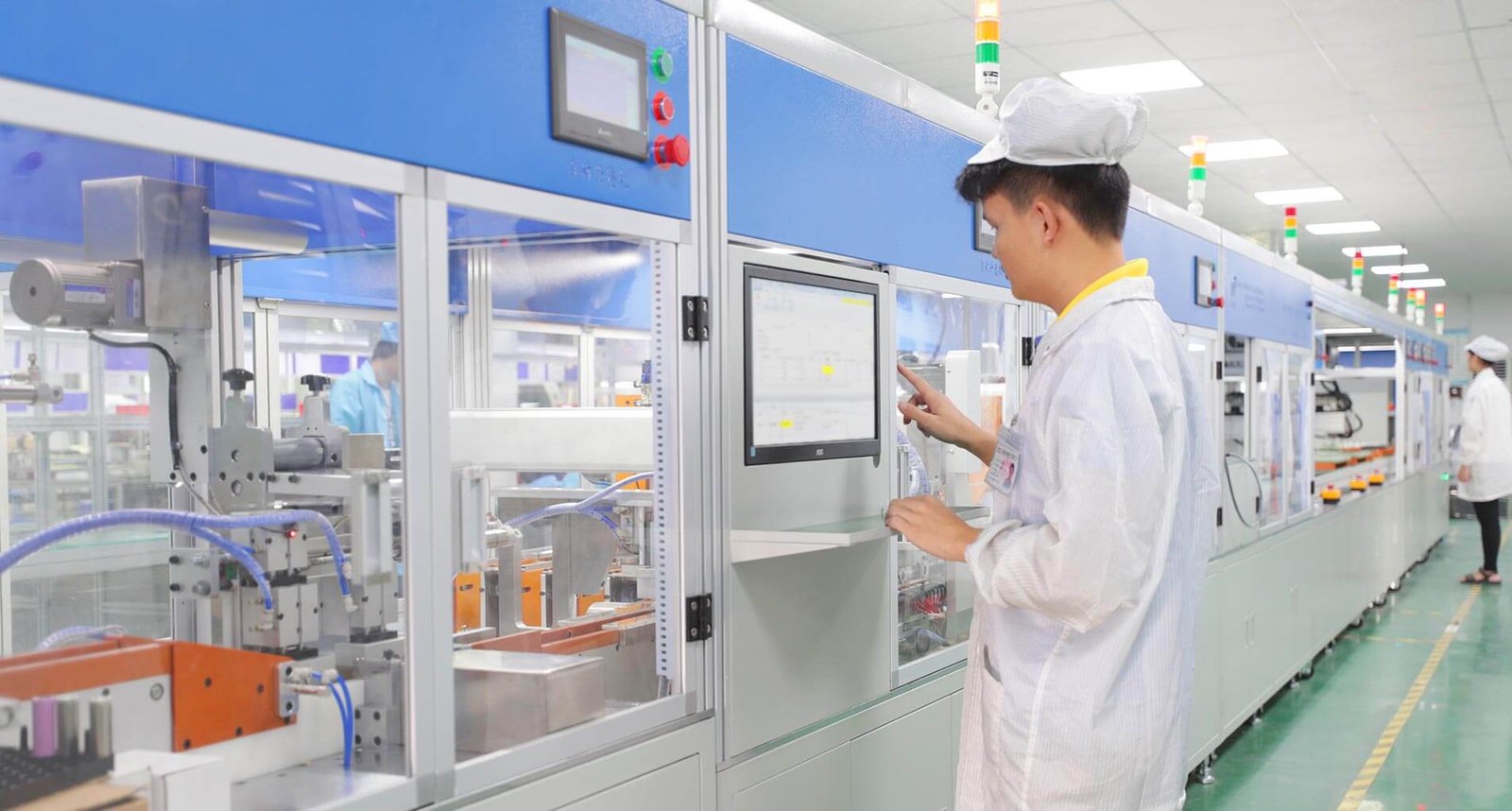
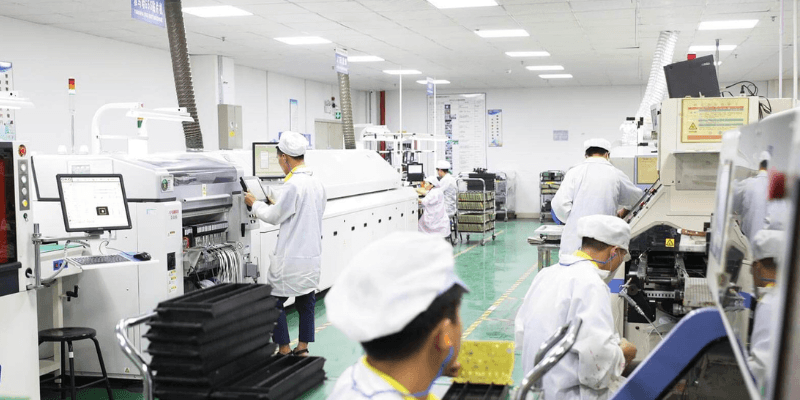
Inside the workshop
What we can build
| Artikel | Capability |
|---|---|
| Chemistries | LiFePO4 (LFP), NMC, and sodium-ion |
| Spannungsbereich | 12 V to 96 V systems; higher on request |
| Cell format | Prismatic, cylindrical and pouch, chosen from the mechanical envelope |
| BMS communication | CAN and RS485 standard; Bluetooth for local monitoring; WiFi optional; 4G and GPS on request |
| Cloud & software | Cloud monitoring and software customisation to your requirement |
| Gehege | Plastic, flame-retardant, aluminium and steel; IP-rated sealing |
| Zellen | Grade A, generally UL-recognised at cell level; silicon-anode cells up to ~450Wh/kg for weight-critical projects |
| Minimum order | No MOQ on builds without tooling or a custom BMS; 100+ where tooling or custom BMS firmware is needed; 300–500 for heavily customised certified packs |
| Sample lead time | 12–15 working days with cells in stock; 20–25 working days when cells must be procured |
| Production lead time | 30–35 working days, cell supply dependent |
| Dokumentation | UN38.3 test report and MSDS supplied with every pack |
| Garantie | NMC typically ~2 years, LiFePO4 typically 3–5 Jahre, kürzer bei hoher Dauerentladung |
Three things we won’t claim
Most of what makes sourcing a battery supplier difficult is that the marketing claims are unfalsifiable. Here is where we draw our lines, so you can hold us to them.
Our cells are UL-recognised. Our packs are not UL certified.
We use Grade A cells and generally select cells carrying UL recognition. That is cell-level recognition — a real quality signal and a genuine reason to prefer one cell source over another. It is not a UL certification of the finished pack, and you will not see us write “UL certified battery pack” anywhere on this site. The distinction becomes expensive at the moment your customer or your regulator asks to see the certificate. If your market needs pack-level certification we can run that programme — tell us in the first conversation, because it changes design, cost and timeline, and it cannot be retrofitted cheaply. Our guide to UN38.3, IEC 62133 and IEC 62619 explains which standard applies to what.
There is no one “Energiedichte” number for our packs.
Energy density is driven by cell selection, and cell selection is driven by your weight budget and your price tolerance. We build with Grade A LiFePO4 and NMC cells as standard. Where weight is the binding constraint — aerospace, racing, high-end drones — we can source silicon-anode cells that reach up to about 450 Wh/kg, and the premium they carry is significant. We will not quote one number for the whole catalogue, because that is how “up to” claims mislead: on standard cells we are in the 120–300 Wh/kg range, and it costs real money to go higher. Tell us the weight budget and we will tell you what it costs per kilogram saved. Sodium-ion is a third option, suited to cold-weather and cost-driven applications where its lower energy density is acceptable — we have products and a position on where it beats heated LFP.
We can’t promise a lead time until we’ve checked cell stock.
Lead times are ranges, not fixed numbers, because projects start from different places. From spec lock: assembly and testing take about 7 working days, and cell procurement sets the rest. A sample lands in 12–15 working days with cells in stock, or 20–25 working days when cells must be bought in. A production run is 30–35 working days.
From first design conversation to delivered production: a simple customization on a finalized design, standard cells and an off-the-shelf BMS runs about 4 weeks. A conventional custom project from requirements is 8–12 weeks. With full UL or IEC certification work, 14–18 weeks — that is the axis that includes certification, not the build itself.
Each figure is honest for its axis, and which one applies to you depends on your cell availability, whether the build needs new tooling or a custom BMS, and how much certification your market requires. Tell us your target date and your intended volume, and we check cell stock and confirm which end of which range you sit on before you commit. A supplier who quotes a single number without that conversation is quoting optimism, not a delivery.
Worked example — swappable jobsite power
A European manufacturer of battery-swappable power units for construction sites came to us with four constraints that had to be solved together, not one at a time.
The pack had to fit an existing rolling enclosure with no dimensional latitude, and stay light enough for one person to swap by hand. It had to deliver the pulse current that jobsite tools draw on startup — core drills, cutters and demolition hammers pull far above their continuous rating for the first few seconds, and a pack sized only for the average load trips on the first hole. It had to run in parallel with other packs and tolerate hot-swapping, so a depleted unit could come out mid-shift without dropping the load. And it had to survive dust, vibration and temperature swings on an open site.
Any one of those is routine. Together they constrain each other: the cell that handles the pulse is not the cell that fits the smallest volume, and parallel hot-swap puts requirements on the BMS that a single-pack design never sees. That is the kind of trade-off the engineering review exists to resolve — before tooling, not after.
The programme runs at 500 packs.
BMS and communication
The BMS is specified per project, not bolted on. We set continuous and peak discharge limits, charge current, cut-off thresholds, balancing behaviour and temperature protection windows against your actual duty cycle.
CAN and RS485 cover almost every integration we see — controllers, inverters, vehicle buses. Bluetooth handles local state-of-charge monitoring from a phone and is what most projects use. We can build 4G and GPS telemetry and we have the platform for it, but in practice the added cost rarely survives the business case, so we quote it only when remote fleet tracking is genuinely part of your product. If it is, ask and we will price it properly.

If your pack has to talk to a specific inverter or controller, send that device’s protocol document with your enquiry. It is the detail most often missing from first-round specs, and it decides whether the pack works on day one. Background reading: Optionen für das Batteriekommunikationsprotokoll Und what a BMS actually does.
Testing, before it ships
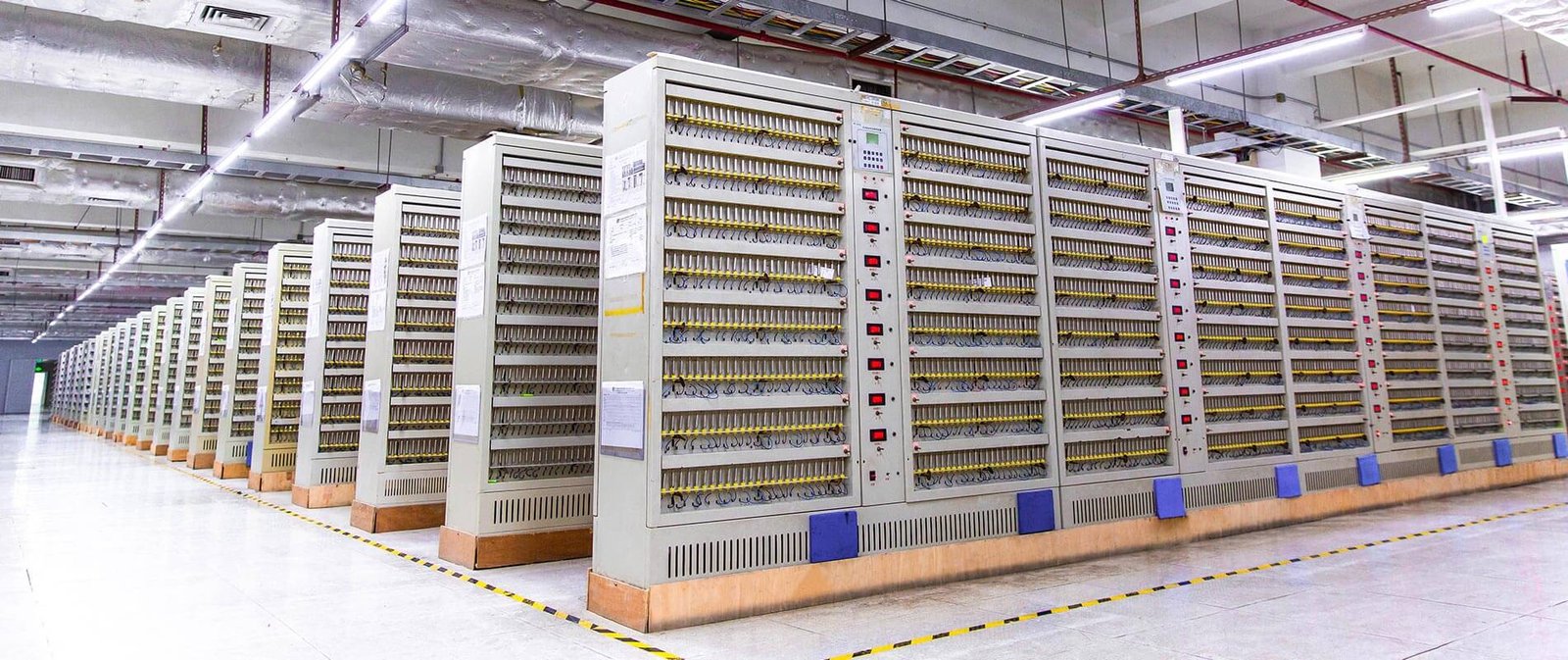
Every pack gets capacity, discharge, charge-cycle, cell-balance, insulation and protection-function testing before it leaves, and the records are kept against the pack so a field question years later has an answer. Rather than describe it, here it is:
How to check us — and any other supplier
You should not take the sections above on trust. These are the questions that separate suppliers who can build your pack from suppliers who will agree to try:
- Ask which cell supplier, and ask for the cell spec sheet. Then check capacity distribution and internal resistance data, not just headline capacity.
- Ask for the UN38.3 report on a pack, not a cell. Certified cells do not make a compliant pack, and the report follows the design — a changed pack needs changed documentation.
- Send a protocol document and see if they read it. A supplier who does not ask for it has not thought about your integration.
- State a peak current and its duration, then see what comes back. “30 A continuous, 80 A peak for 5 seconds” is a different pack from “80 A continuous”. A quote that ignores the distinction will trip on your first load peak.
- Ask what they won’t do. A supplier with no limits has not understood the requirement.
Our longer breakdown — nine criteria, and the six mistakes buyers make — is here: how to choose a lithium battery pack manufacturer. It is written to be useful whether or not you buy from us.
What we build for
Typical projects come from equipment manufacturers, system integrators and brand owners who need a pack that does not exist off the shelf.
| Anwendung | What drives the design | Example builds |
|---|---|---|
| AGV & industrial robotics | Charge frequency and duty cycle, not nameplate capacity. See why AGV batteries fail early. | 24V 90Ah AGV, 48V 50Ah AGV |
| Energiespeicher & solar | Inverter protocol, cycle life, rack or wall format | 48V 200Ah server rack |
| Forklifts & industrial vehicles | High continuous current, opportunity charging, weight as ballast | 48V 315Ah, 80V 460Ah |
| Marine & outboard | IP sealing, and the thermal problem sealing creates. See thermal trapping in potted packs. | 48V 100Ah waterproof, 96V 108Ah outboard |
| Drones & weight-critical | Wh/kg above everything; high discharge rate | 53.2V 30Ah drone, 44.4V 22Ah drone |
| Vehicle starter & auxiliary | Cold cranking, vibration, parasitic drain | 24V 280Ah truck starter, 12V sodium-ion start-stop |
Sourcing under your own brand? See OEM & Private-Label-Akkus for private labelling, your packaging and your documentation. Building on LiFePO4 specifically? See Konfigurationen des LiFePO4-Akkupacks.
Häufig gestellte Fragen
Is there a minimum order quantity?
It depends on the build. Where no tooling and no custom BMS firmware are needed, there is no MOQ requirement — a first order can be a single validation sample. Projects needing custom BMS firmware, enclosure tooling or specialised cells typically start at 100 units. Heavily customised packs with certifications sit at 300–500 units. Tell us your intended volume and we will tell you which tier you land in.
How long will my battery pack take?
Two figures, and the mismatch between them is the most common source of frustration in this industry. From spec lock: assembly and testing take about 7 working days, and a sample lands in 12–15 working days with cells in stock or 20–25 working days when cells must be procured; a production run is 30–35 working days. From first design conversation to delivered production: about 4 weeks for a simple customization on a finalized design, 8–12 weeks for a conventional custom project from requirements, and 14–18 weeks with full certification work.
Are your battery packs UL certified?
Our cells are generally UL-recognised at cell level. That is not a UL certification of the finished pack and we do not describe it as one. If your market requires pack-level certification we can run that programme — raise it at the start, because it affects design, cost and timeline.
Can the BMS talk to my controller or inverter?
Yes. CAN and RS485 are standard, which covers most controllers, inverters and vehicle buses. Bluetooth is available for local monitoring, WiFi as an option, and 4G or GPS where remote fleet tracking is part of your product. Send the protocol document for the device the pack must talk to.
Which cells do you use?
Grade A cells bought direct from EVE, REPT and Gotion, generally UL-recognised at cell level. Buying direct rather than through a broker is what lets us hold a specification across a repeat programme instead of substituting between batches. Ask for the cell spec sheet with your quotation.
What warranty do you offer?
It depends on the pack. NMC is typically around 2 years and LiFePO4 typically 3–5 years, with a shorter term where the application demands high continuous discharge. The applicable term is written into your quotation rather than left as a marketing claim.
Do you supply shipping documentation?
Yes. A UN38.3 test report and an MSDS come with every pack — the documents carriers and forwarders actually require.
Senden Sie uns eine Spezifikation
Get a buildable proposal, not a catalogue link
Voltage, capacity, continuous and peak discharge, physical envelope, what the pack has to communicate with, and your target date. Ballpark figures are fine; we will tell you what needs pinning down.