


Custom Battery Packs for AGVs and Mobile Robots
24V and 48V LiFePO4 and NMC packs for AGVs, AMRs and legged robots. Most robot batteries do not die of bad cells; they die of integration: heat trapped in the middle of the pack, resistance in the interconnects, charging in the cold and discharge limits set too deep. We design those out.

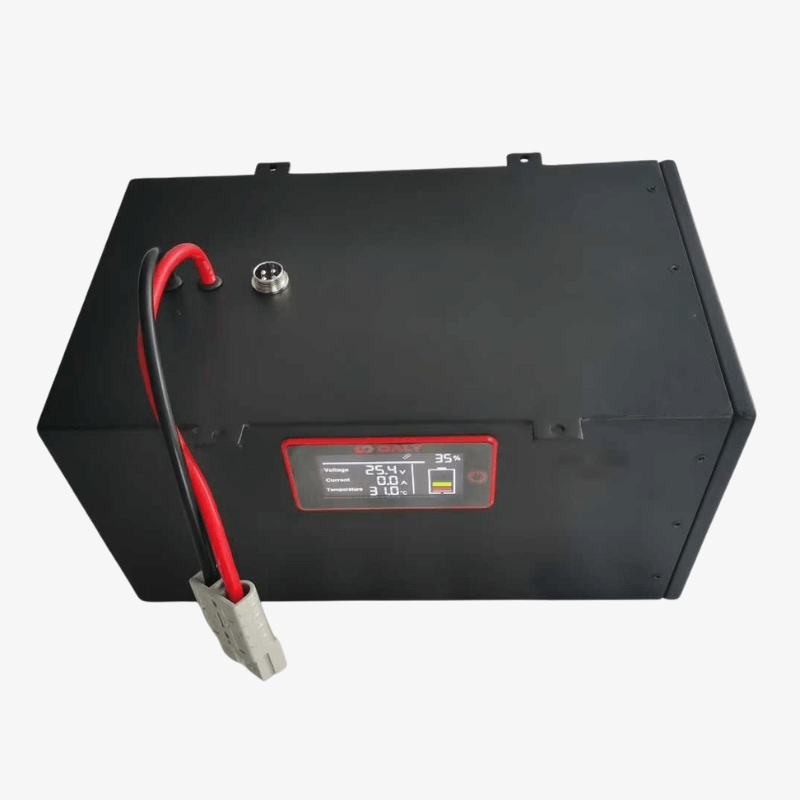

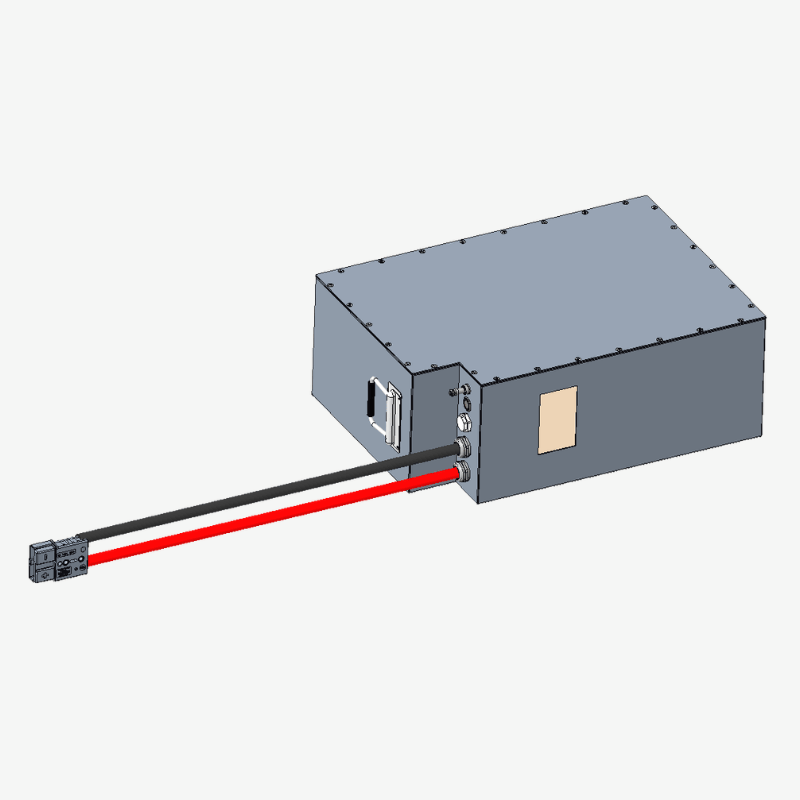
Robot platforms we build for
Reference packs are starting points. Envelope, connector, BMS protocol and current limits are normally adapted to your chassis and drive controller.
| Platform | Typical voltage | Ce qui motive la conception | Packs de référence |
|---|---|---|---|
| Warehouse AGVs and AMRs | 24V – 48V | Opportunity charging between tasks, lift-motor peaks, telemetry to the fleet manager | 51.2V 50Ah AGV (1C, CAN/RS485) AGV 24V 90Ah |
| Heavy-load AGVs, tuggers and stackers | 48 V | Long shifts, high continuous current, fit in an existing battery bay | 51.2V 315Ah |
| Outdoor UGVs and inspection robots | 48 V | Sealing, vibration, wide temperature range | 48V 100Ah étanche |
| Quadruped robots | Project-specific, often 48V | Pulse capability and safety outdoors; LFP usually preferred | Conception personnalisée |
| Humanoid robots | Spécifique au projet | Mass and volume budget; NMC 21700 usually preferred, with strong thermal control | Conception personnalisée |
Sizing an AGV pack for opportunity charging
An AGV battery does not need to last a full shift if the robot can charge between tasks. Sizing for the longest gap between charging opportunities, instead of the whole shift, often halves pack size and cost. What it cannot shrink is the peak current: lift motors and acceleration set the minimum power capability regardless of energy.
- Average power over a working period, logged from the robot:
500 W - Longest gap between charging opportunities:
2 h→ energy per gap1.0 kWh - Usable window: 10% SOC buffer at the bottom and 3.0V/cell cutoff, plus 20% ageing margin → rated
1.0 ÷ (0.9 × 0.8) ≈ 1.4 kWh - Peak power, lift motor plus drive:
4.5 kW→4,500 ÷ 51.2 V ≈ 88 A - Charge acceptance at a 15-minute dock stop at 0.5C on 50Ah:
25 A × 51.2 V × 0.25 h ≈ 0.32 kWh
Five integration errors that halve AGV battery life
Cell quality is rarely the root cause. These five integration mistakes can cut rated cycle life by 50 to 70 percent. Full analysis: Pourquoi les batteries AGV tombent en panne prématurément.
| Failure mode | Ce qui se passe | Typical integration | How we design it |
|---|---|---|---|
| Thermal gradient | Centre cells run 5–8°C hotter and age about 1.5× faster; the BMS cuts off while healthy cells still hold charge | > 8°C spread | Airflow channels and thermal pads to the chassis, < 3°C spread |
| Interconnect resistance | Under-torqued busbars add 80–150 mV of sag; false low-voltage shutdowns with 20–30% charge left | Hand-tightened | Torque-verified busbars (5 Nm), cables sized for peak current |
| Cold charging | Charging LFP below 10°C plates lithium on the anode and permanently loses capacity | Charge at any temperature | Heaters and BMS charge block until cells reach 15°C |
| Deep discharge | Cutoffs below 2.8V/cell grow internal resistance and can halve cycle life | 2.5V/cell, 100% DoD | 3.0V/cell cutoff, 10% SOC buffer |
| Vibration | Floor joints and uneven surfaces fatigue cell tabs; erratic voltage readings | Montage rigide | Damped tray, foam compression, flexible internal busbars |
Designing for peak loads, not average loads
Robots reset when bus voltage drops below the controller’s undervoltage lockout during a burst. The cause is DC resistance: at 200A, a pack with 10 mΩ of total loop resistance drops 2V and turns 400W into heat inside the enclosure. On a 24V robot with an 18V logic threshold, a cold start plus acceleration is enough to reboot it.
For systems above 100A peak we target total pack resistance below 2 mΩ at beginning of life, because cell resistance rises about 30% at 0°C and about 40% by end of life. That target drives the build: high-power cells where the duty cycle needs them, oxygen-free copper busbars instead of nickel strip, ultrasonic welds instead of spot welds, and parallel strings that share the current. Details: Conception de batterie à décharge élevée pour robots mobiles.
| Robot action | Peak power | Average power | Peak-to-average ratio |
|---|---|---|---|
| Humanoïde : marcher pour sprinter | 3,5 kW | 800 W | 4.4× |
| Humanoïde : récupération de chute | 4,2 kW | 600 W | 7.0× |
| Quadrupède : démarche liée | 2,8 kW | 600 W | 4.7× |
| Quadrupède : atterrissage sauté | 6,0 kW+ | 500 W | 12×+ |
Representative figures for legged robots. A pack sized only for average power will collapse during these transients. More: Batteries pour fortes charges transitoires destinées aux robots quadrupèdes et humanoïdes.
BMS and integration
- Communication
- CAN and RS485 as standard, so state of charge, temperature and fault flags reach the robot and the fleet manager. Having the interface is not the same as matching your protocol: send the protocol document and we confirm the registers before quoting. See options de protocole de communication de la batterie.
- Fast current sensing
- Motor stalls last 20–50 ms. For high-rate robots the BMS needs to sample fast enough to see them and tell the drive controller to reduce torque before a hard cutoff.
- Charging contacts
- Charge current, voltage and the handshake with your docking station agreed up front, including temperature-gated charging for cold stores and freezer aisles.
- Chemistry choice
- LiFePO4 for most AGVs and outdoor robots: safety, cycle life and low resistance. NMC for humanoids and mass-critical designs. Trade-offs: lithium-ion vs LiFePO4.
- Normes
- Industrial lithium packs are typically assessed against IEC 62619, with UN38.3 for transport. Which reports cover your exact design is confirmed at quotation.
Délai et quantité commandée
À partir d'une spécification verrouillée : échantillons sous 12 à 15 jours ouvrés lorsque les cellules sont en stock, 20 à 25 jours ouvrés lorsque les cellules doivent être sourcées ; production en 30 à 35 jours ouvrables. Dès la première conversation de conception : environ 4 semaines pour une conception finalisée sans nouvel outillage, 8 à 12 semaines pour un projet personnalisé typique, 14 à 18 semaines lorsque la certification est en cours. Comment fonctionne chaque phase : processus de développement de batteries personnalisées et nos capacités de fabrication.
AGV and robot battery questions
Why does my AGV’s battery percentage drop suddenly during lifts?
LiFePO4 or NMC for a mobile robot?
Does an AGV battery need active cooling?
Can the robot work in cold stores?
Can you build to our existing battery drawings?
Lectures complémentaires
Send your robot’s battery requirements
Un ingénieur répond avec des questions ou une proposition de configuration. Plus vous partagerez cette liste, plus vite nous pourrons citer :
- Robot type and payload
- Nominal voltage and drive controller model
- Logged current profile, or average and peak current
- Charging method and gap between charges
- Battery bay dimensions and weight limit
- Température de fonctionnement, y compris les chambres froides
- Protocole de communication
- Volume annuel et normes cibles