


Custom Marine Battery Packs for Electric Propulsion
LiFePO4 packs from 12V house banks to 96V outboard systems, built for eFoils, electric surfboards, outboards and electric boats. We design the enclosure, potting and BMS around your duty cycle, then validate against the failure modes we found inside 300+ failed IP68 packs, not just against an IP rating.


Marine programmes we build for
Each row links to a pack we have already built. Treat them as starting points: voltage, capacity, enclosure and connector are normally adjusted to your hull, motor controller and charger.
| Toepassing | Typical system voltage | Wat drijft het ontwerp | Referentiepakketten |
|---|---|---|---|
| eFoils and electric surfboards | 60V – 72V | Weight and volume inside the board, high continuous current, IP67 enclosure that survives impact and washdown | 60V 55Ah eFoil 72V 55Ah surfboard |
| Electric outboard motors | 60V – 96V | Controller voltage window, peak current at hole-shot, sealed enclosure on an open transom | 60V 110Ah 72V 95Ah 96V 108Ah (~10.4kWh) |
| Electric boats and inboard propulsion | 48V – 72V | Range per charge, installation space under deck, CAN integration with the drive | 72V 108Ah electric boat 48V 100Ah waterdicht |
| Trolling motors and house banks | 12V – 24V | Drop-in fit for existing battery boxes, charger compatibility with lead-acid systems | 12V 100Ah marine |
| Engine starting | 12V | Cold cranking amps in a small, light case | 12V 22Ah, 1800 CCA |
| Compact sealed packs (ROVs, diving scooters, instruments) | Project-specific | Sealing in a small metal enclosure, thermal path under continuous load | 51.2V 20Ah IP67 |
How to size a marine propulsion pack
Most undersized marine packs are sized from the motor’s rated power and a hoped-for runtime. Three numbers matter more: the average power at cruise, de peak power at hole-shot or take-off, and the energy you can actually use once you keep a reserve for getting home and protect the cells from deep discharge.
The voltage is usually fixed by the motor controller. A “72V” LiFePO4 system is 24 cells in series, 76.8V nominal; a “48 V” system is 16 cells, 51.2V nominal. Check the controller’s minimum and maximum input voltage against the pack’s full and empty voltage, not just the nominal figure.
- Average power at cruise, from motor data or a logged trial:
6 kW - Target runtime at cruise:
2.5 h→ energie nodig6 × 2.5 = 15 kWh - Usable fraction: limit discharge to about 90% to protect cycle life → rated energy
15 ÷ 0.9 ≈ 16.7 kWh - Capacity at 24S LiFePO4 (76.8V nominal):
16,700 Wh ÷ 76.8 V ≈ 217 Ah - Cruise current:
6,000 W ÷ 76.8 V ≈ 78 A; peak at 15 kW hole-shot:≈ 195 A
For eFoils the order of priorities flips: volume and weight inside the board are fixed first, then capacity is whatever fits at the current the motor needs. That is why board packs are almost always fully custom.
Why an IP68 label is not a marine specification
Between 2024 and 2025 our engineers tore down 300+ failed marine packs from multiple suppliers: electric surfboards, diving scooters and underwater vehicles. Every one of them carried an IP68 claim. Most survived their first year, then failed in a cluster around 14 to 18 months. This is what we found inside.
Share of failed packs in our teardown set and the time window in which each failure type clustered. Indicative observations from one dataset, not a statistical failure rate for the industry. Full method and microscopy notes: Analyse van defecten aan scheepsbatterijen: wat we hebben geleerd van 300 demontages.
What the failures had in common
- Voids trapped near terminal posts and harness exits grew into crack networks under thermal cycling.
- Smooth aluminium walls with little chemical bonding left a gap of tens of microns that wicked saltwater along the housing.
- Copper dendrites on BMS boards under visually intact potting: vapour got in long after the pack passed its immersion test.
- Brittle, burned resin where thick potting trapped heat during high-rate discharge.
What a static IP test does not reproduce
- Dynamic pressure cycling from waves, speed and depth changes
- Thermal shock from hot deck to cold water
- Salt crystal abrasion and pressure washdowns
- Heat built up inside a sealed block during sustained high current
What we engineer into a marine pack
- Cell chemistry and format
- LiFePO4 by default for thermal stability and cycle life. NMC is considered for weight-critical boards where every kilogram counts, with the extra thermal management it needs. Prismatic cells suit large outboard packs; cylindrical cells suit the curved, shallow spaces inside boards.
- Potting and encapsulation
- Potting chemistry chosen for your duty cycle, with controlled mixing and degassing to minimise voids, and thermally conductive grades where high continuous current would otherwise trap heat. How we design potting for high-rate discharge
- Enclosure and sealing
- Metal or moulded enclosures with gaskets, stainless hardware and surface preparation at bond lines, designed for washdown and long-term seal integrity rather than a single immersion test.
- GBS en communicatie
- CAN and RS485 as standard, Bluetooth for local monitoring. Protection thresholds and current limits set to your motor controller, so the pack and the drive agree on what happens at low charge or high temperature.
- Connectors and wiring
- High-current connectors and harnesses specified to your installation, for example the 350A Anderson connector on our 48V 100Ah waterproof pack, with reinforced cable protection where wiring passes through the enclosure.
- Opladen
- Charge voltage and current agreed with your charger, including onboard and shore chargers carried over from lead-acid systems. See the marine battery charging guide.
- Standards and shipping
- Designs prepared against the requirements your programme names, such as ABYC E-13 for marine lithium installations, and UN38.3 testing for transport. Which documents cover your exact design is confirmed at quotation.
Real example: electric outboard pack
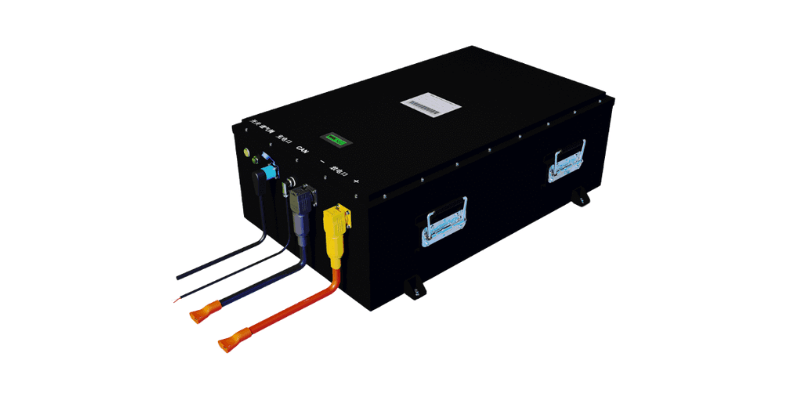
72V outboard pack with IP68 sealing and ABYC E-13
- Vereiste
- 72V 100Ah for an electric outboard motor, IP68 waterproofing and ABYC E-13. No standard pack fitted.
- Delivered
- 72V 108Ah, 24S4P LiFePO4, sized about 6% above the request to keep margin against voltage sag under load.
- Timeline
- 14 weeks from the first design conversation to delivery, including ABYC work.
Five things to ask any marine battery supplier
Use this list when you compare quotes, including ours. A supplier who cannot answer these early will be harder to hold to account after a field failure.
- 1. The full IP test report
- The complete multi-page laboratory report, not a one-page summary, with the cell model and pack configuration matching your order.
- 2. Potting material data
- Datasheets for every potting compound, and why that material suits your thermal cycling, vibration and discharge rate.
- 3. Degassing and process traceability
- How voids are controlled during mixing and pouring, and batch records that show the process is repeatable from unit to unit.
- 4. Moisture protection beyond potting
- Which steps protect the BMS and interfaces from vapour permeation, and the documented process flow for them.
- 5. Cure monitoring
- Whether cure temperature is logged for your batch geometry, since exothermic cure can stress cells before the pack ever ships.
The longer version, with what a weak answer looks like: 5 waarschuwingssignalen Uw leverancier van IP68-scheepsbatterijen bezuinigt.
Levertijd en bestelhoeveelheid
Op basis van een vergrendelde specificatie: monsters binnen 12-15 werkdagen als de cellen op voorraad zijn, 20-25 als de cellen moeten worden ingekocht; productie in 30-35 werkdagen. Vanaf het eerste ontwerpgesprek: ongeveer 4 weken voor een definitief ontwerp zonder nieuwe tooling, 8 tot 12 weken voor een typisch maatwerkproject, 14 tot 18 weken wanneer certificering in aanmerking komt. Hoe elke fase werkt: ontwikkelingsproces voor aangepaste accu's En onze productiemogelijkheden.
Marine battery questions
Is IP67 or IP68 enough for an eFoil or outboard battery?
Why LiFePO4 rather than NMC for marine propulsion?
Can the pack talk to my motor controller?
Can you replace the lead-acid batteries in an existing boat?
Do you supply the motor and controller too?
How do you ship large marine packs?
Verder lezen
Send your marine battery requirements
Een engineer antwoordt met vragen of een voorgestelde configuratie. Hoe meer van deze lijst je deelt, hoe sneller we kunnen citeren:
- Vessel or product type and duty cycle
- Nominal voltage and motor controller model
- Cruise power and peak power, with peak duration
- Target runtime or range per charge
- Available space and weight limit
- Immersion depth, washdown and operating temperature
- Charger and communication protocol
- Standards required (e.g. ABYC E-13) and annual volume