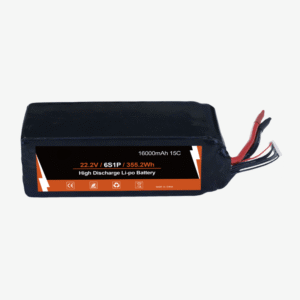
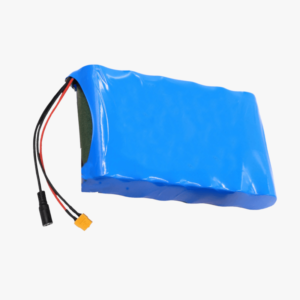
This 13.6V battery features cutting-edge cells with a 360Wh/kg energy density, surpassing LiPo’s 200Wh/kg and general Lithium Ion’s 230Wh/kg. It offers up to 80% more flight time than a LiPo and 57% more than a regular Lithium Ion battery.
| Weight | 0.424 kg |
|---|---|
| Nominal Voltage | 13.6V |
| Capacity | 11.1Ah |
| Energy | 151 Wh |
| Battery Type | pouch cell |
| Max Continuous Discharge Current | 54A / 5C (86A / 8C for less than 30 seconds) |
| Charging Current | 2.16A |
| Dimensions | 150*29*52mm |
| Charging Temperature | 0~60°C |
| Discharging Temperature | -20~60°C |
| Storage Temperature | -20~45°C |
A compact 13.6V 11.1Ah lithium-ion pack in PVC wrap, sized for OEM device integration where internal volume is the binding constraint. Nominal energy is approximately 151 Wh (calculated from nominal voltage and rated capacity; delivered usable energy depends on discharge current, operating temperature, cutoff voltage, and application duty cycle). The pack delivers 54A / 5C continuous discharge current, with peak discharge capability up to 86A / 8C for less than 30 seconds (short-duration pulse, subject to thermal and BMS limits), rated at a full 4.86C draw, with headroom for the surge loads motive duty demands.
Charging at 2.16A brings it to full in roughly 6 hours. The operating window is -20~60°C on discharge and 0~60°C on charge. The pack measures 150*29*52mm and weighs 0.424 kg.
This is the entry point of our 13.6V range. The next step up is 22.1Ah, which is where most projects land once the duty cycle is modelled properly.
Cell count and arrangement, connector type, wire gauge and length, NTC placement, wrap printing and protection thresholds are all set per project. Packs this size often use a simple protection board; where the device needs it we add a full BMS with Bluetooth, CAN or RS485.
How long does a design revision add?
Each revision restarts the 20–25 working day sample clock. Locking the envelope and current profile early is the biggest time saver.
Why PVC wrap instead of a plastic case?
Wrap saves volume and weight and costs less at low volumes. A moulded case makes sense when you need ingress sealing or the volumes justify tooling.
Grade A ternary cells, generally specified with UL recognition at cell level. Every pack ships with a UN38.3 test summary and MSDS prepared for air, sea and road transport. Assembly and testing take around 7 working days. Cell supply is what sets the overall schedule: when the cells your design needs are in stock, samples ship in 10–15 working days; when they have to be sourced, allow 20–25. Tell us your target date early and we will confirm cell availability before you commit to it. Production runs 20–25 working days. There is no minimum order quantity — this is a custom design business and we quote single units, with pricing improving noticeably from 100 packs upward. Ternary lithium warranty typically runs 2 years.
Our engineering division designs bespoke battery packs with CANBUS, RS485, custom aluminum enclosures, and matched chargers.

China Premier Custom Battery Pack Manufacturer. Serving industrial, telecom, marine, and robotics OEM/ODM partners across 40+ countries.
Send the application details and we will confirm whether this configuration fits your voltage, current, enclosure, and communication requirements. We will reply within 8 business hours; please watch for an email from “@holobattery.com”.