

A 10 kWh daily load doesn’t mean a 10 kWh battery bank.
Once you factor in inverter losses, two days of cloudy weather, and an 80% discharge limit for LiFePO4, that same 10 kWh load actually needs a 25 to 30 kWh bank to keep your inverter from cutting out.
Use the calculator below to turn your daily consumption and system voltage into the exact Ah, kWh, and series-parallel pack layout you need. If you’re planning the complete installation, explore our engineering breakdown of off-grid solar system components or consult our LiFePO4 voltage chart for resting state-of-charge thresholds.
The calculator
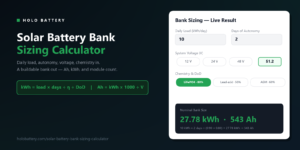
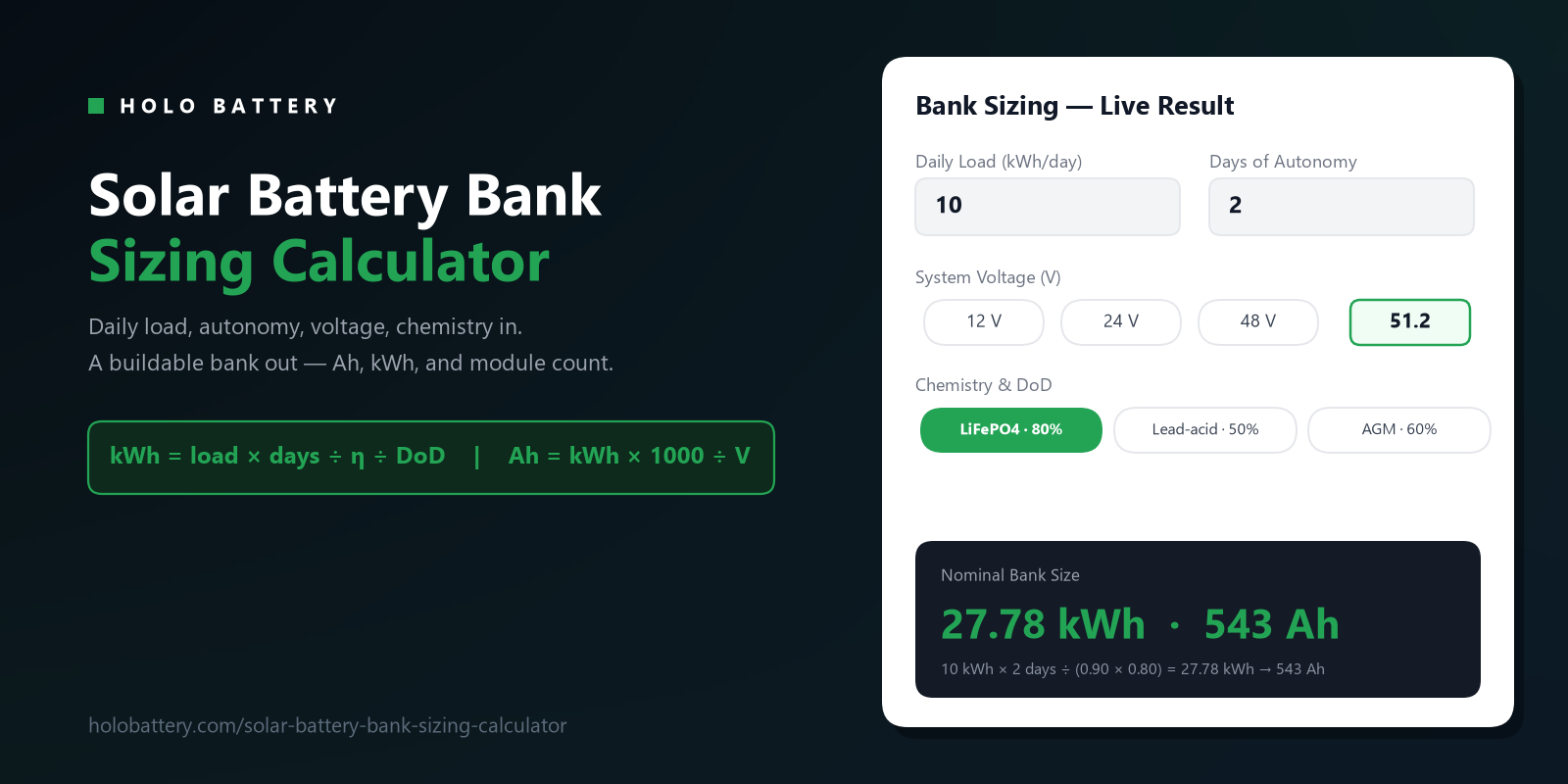
Adjust daily energy demand, autonomy requirements, system voltage, and battery chemistry below to generate your nominal bank rating and modular string layout. Enter an optional peak load to run a continuous discharge current check.
How the math works
If you prefer calculating by hand or validating your bill of materials, the sizing formula breaks down into four practical steps:
Voltage note: “48V-class” LiFePO4 banks are 51.2V nominal (16S cells); “24V” is 25.6V (8S) and “12V” is 12.8V (4S). We size LiFePO4 at those nominal voltages, while lead-acid banks are true 12/24/48V.
- Total Autonomy Energy: Daily Load (kWh) × Days of Autonomy. This represents the gross energy you must pull from storage during consecutive sunless days.
- Inverter-Compensated Energy: Autonomy Energy ÷ Inverter Efficiency (η). Inverters aren’t 100% efficient; a typical 90% efficiency rating means pulling about 11.1 kWh from the battery bank to deliver 10 kWh of AC power to your loads.
- Nominal Battery Bank (kWh): Compensated Energy ÷ Depth of Discharge (DoD). Because you shouldn’t drain batteries to zero, this step sizes the gross nameplate capacity so your everyday discharge stays within safe chemistry boundaries.
- Capacity in Amp-Hours (Ah) & Modular Layout: Nominal kWh × 1000 ÷ System Voltage. Once you have target Ah, divide by your individual pack rating (such as a standard 100Ah or 200Ah battery) and round up to the nearest whole module to determine your parallel string count.
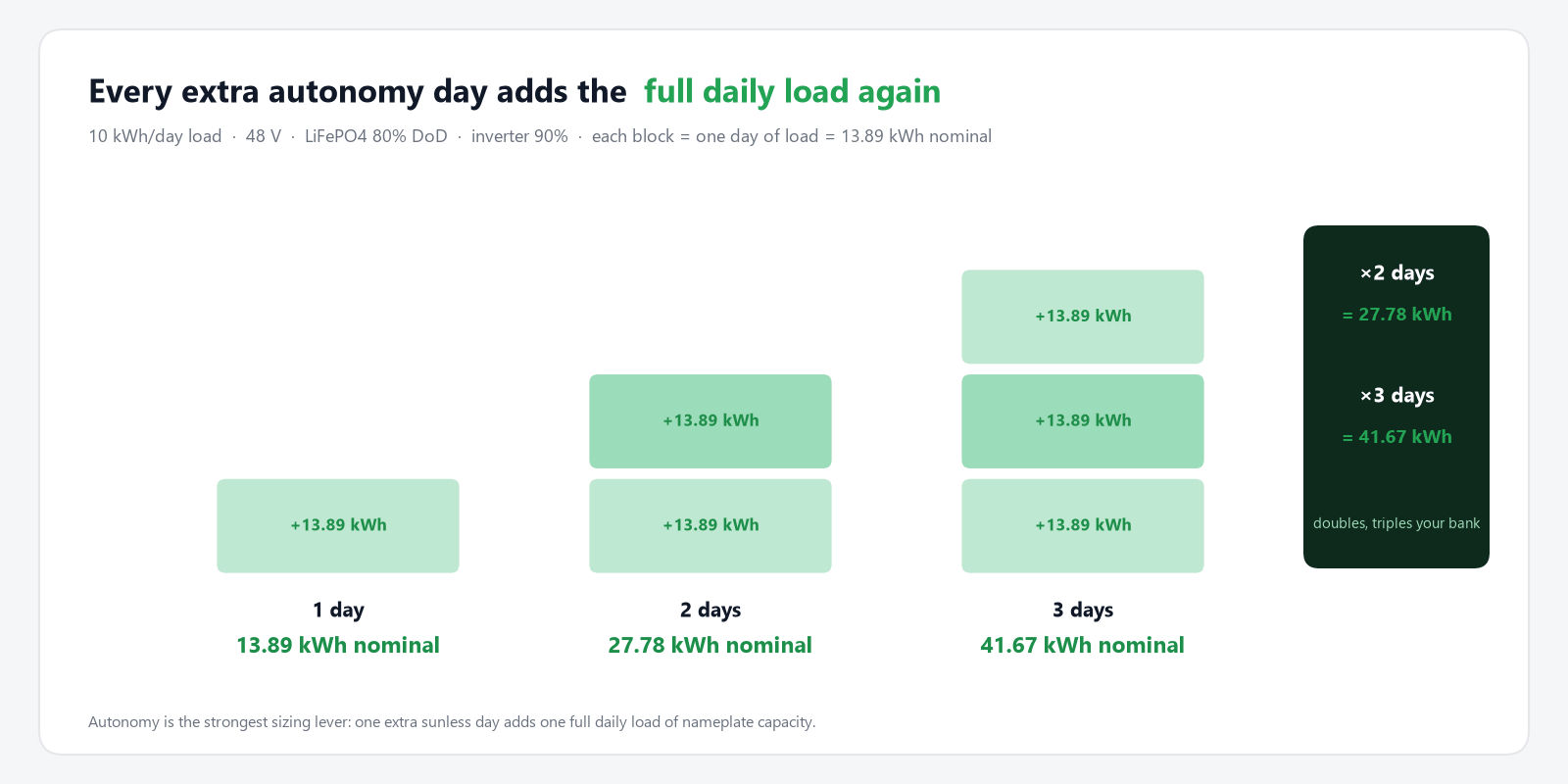
Field Example: For a system drawing 10 kWh per day, needing 2 days of backup at 48V using LiFePO4 (80% DoD) and a 90% efficient inverter:
10 kWh × 2 days = 20 kWh → 20 ÷ 0.90 = 22.22 kWh usable → 22.22 ÷ 0.80 = 27.78 kWh nominal → 27,780 Wh ÷ 51.2V = 543 Ah.
Building this with standard 51.2V 100Ah server-rack or wall-mount packs requires rounding 543 Ah up to six 100Ah modules (1S × 6P), giving you an as-built capacity of 30.7 kWh (600 Ah). That slight margin protects the cells from reaching their absolute low-voltage cutoff during deep winter stretches.
Real-world sizing scenarios
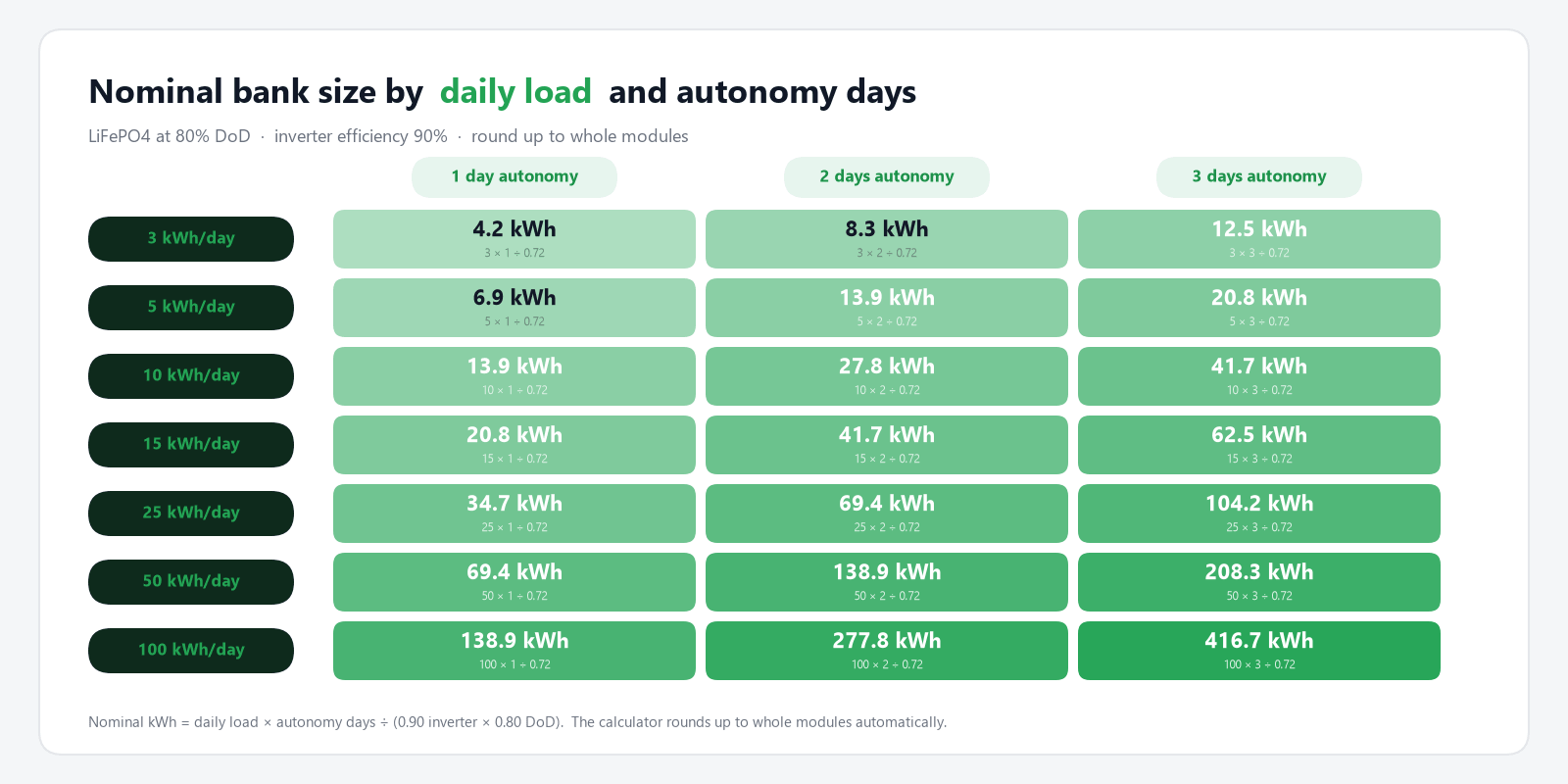
Every solar project has different physical and electrical constraints. Here is how three common installations shape out using real equipment specs:
1. Off-grid cabin (3 kWh / day @ 24V)
A typical hunting cabin or remote retreat running LED lighting, a 12V/24V DC fridge, water pump, and Starlink internet draws roughly 3 kWh per day. Factoring in two days of autonomy, 90% inverter efficiency, and an 80% LiFePO4 DoD:
3 kWh × 2 ÷ 0.90 ÷ 0.80 = 8.33 kWh nominal (326 Ah @ 25.6V nominal).
Using standard 24V-class (25.6V nominal) 100Ah modules, four packs wired in parallel (1S × 4P) yield 10.24 kWh (400 Ah). That gives you plenty of buffer without running heavy, expensive 4/0 AWG cabling.
2. Residential emergency backup (15 kWh / day @ 48V)
A grid-tied home preparing for severe weather and storm outages generally prioritizes critical circuits: refrigeration, heating blowers, lighting, and electronics. At 15 kWh per day with one full day of backup:
15 kWh × 1 ÷ 0.90 ÷ 0.80 = 20.83 kWh nominal (407 Ah @ 51.2V).
Five 51.2V 100Ah (5.12 kWh) rack modules provide 25.6 kWh (500 Ah). The 48V-class bus keeps continuous current around 100A to 150A, comfortably within standard 2/0 battery interconnect cable ratings.
3. Commercial & industrial peak-shaving (100 kWh / day @ 48V)
Commercial workshops or agricultural pumps drawing 100 kWh per day need substantial energy throughput. At 100 kWh with one day of autonomy, nominal storage hits roughly 138.9 kWh (2,713 Ah @ 51.2V).
For high-capacity C&I projects, paralleling dozens of 100Ah low-voltage boxes creates messy wiring and busbar imbalances. Instead, system integrators typically specify industrial 280Ah or 314Ah high-voltage rack clusters. At these power levels, always run a discharge current verification: a 25 kW peak surge draws over 540A from the battery bank at 51.2V once inverter losses are included, requiring your battery strings and DC disconnects to handle high continuous discharge rates. Size your capacity for energy first, then verify that your battery string can deliver the required continuous amp draw without exceeding its rated C-rate and discharge current.
Series vs. parallel: physical layout rules
Once you know your total kWh and Ah targets, you have to wire individual modules into an actual bank. The electrical rules are straightforward, but physical assembly trips up many installers:
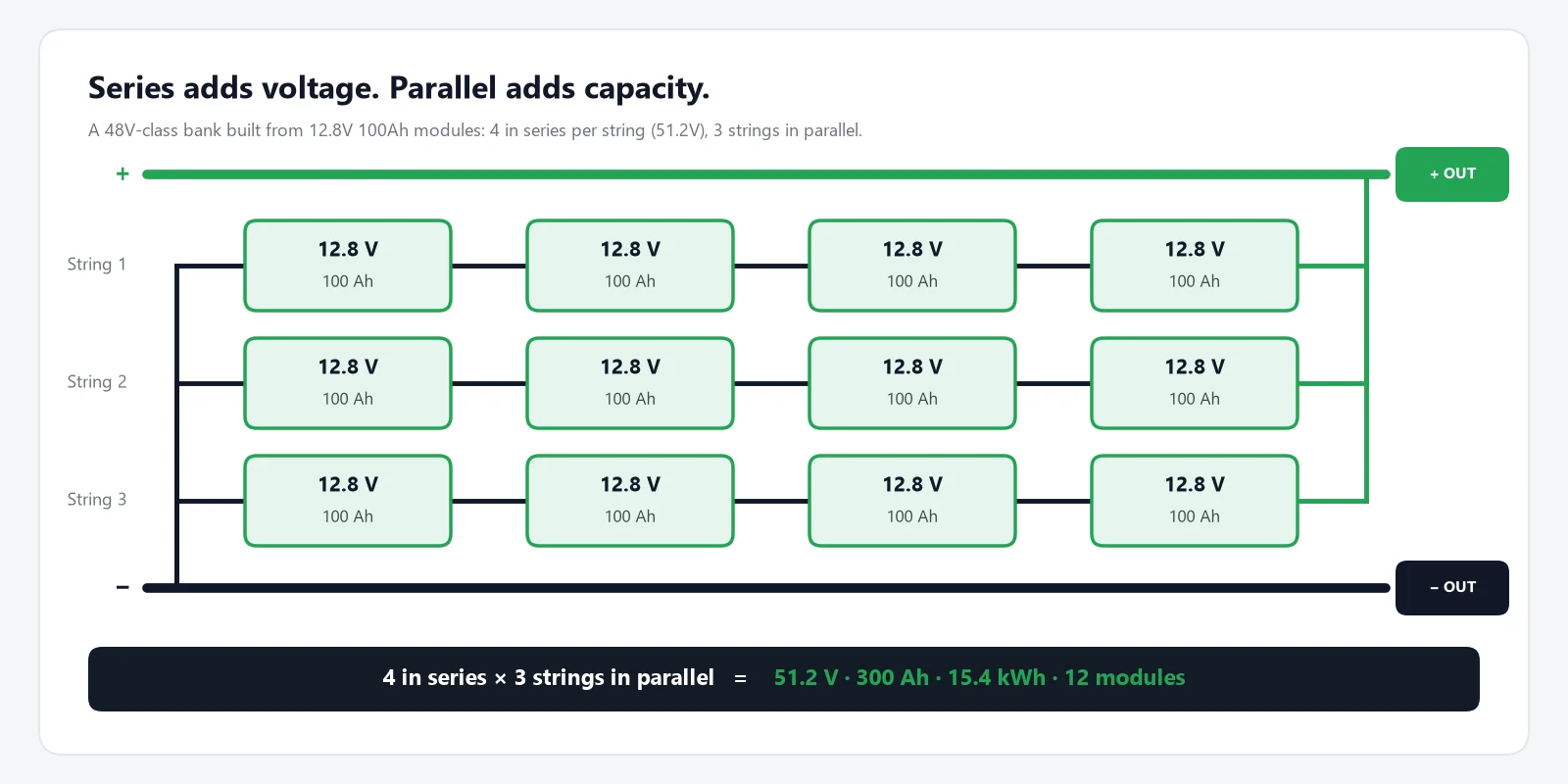
Series strings raise voltage: Wiring battery terminals in series (positive to negative) adds module voltages together while keeping capacity the same. If you are building a 48V-class system with 12V-class (12.8V nominal) 100Ah batteries, you wire four modules in series per string (4S = 51.2V 100Ah).
Parallel strings expand capacity: Wiring strings together (positive to positive, negative to negative) sums up amp-hours while keeping voltage constant. Three strings in parallel (3P) give you 300 Ah at 51.2V (15.4 kWh total across 12 modules).
Two hard rules from job-site experience:
- Never mix chemistries, ages, or module capacities. Paralleling a brand-new battery with a three-year-old pack forces the new battery to drag down to the internal resistance of the worn one. The weakest cell in the bank always bottlenecks the entire system.
- Don’t build massive 12V banks. Once an off-grid setup exceeds 3 kW of inverter capacity or 400 Ah of storage, running at 12V becomes a fire and voltage-drop hazard. A 5 kW continuous load pulls over 415 Amps at 12V, demanding welder-sized 4/0 copper cables and massive fuses. Step up to 24V or 48V to cut current down to manageable levels.
If your enclosure dimensions or electrical requirements fall outside standard modular footprints, we engineer custom battery packs built to exact voltage, form factor, and BMS communication specifications.
Why chemistry drastically changes bank size
Nameplate kWh is deceptive because usable energy depends entirely on battery chemistry. Discharging lead-acid past 50% causes rapid plate sulfation and permanently ruins cycle life. By comparison, Lithium Iron Phosphate (LiFePO4) easily cycles to 80% or even 90% Depth of Discharge without voltage sag or cell damage.
Here is what happens when you size the exact same 10 kWh/day, 2-day autonomy project across different chemistries at 48V:
- LiFePO4 (80% DoD): 27.78 kWh nominal (543 Ah @ 51.2V) → roughly six 100Ah modules.
- AGM / Gel (60% DoD): 37.04 kWh nominal (772 Ah) → 33% more physical storage required.
- Flooded Lead-Acid (50% DoD): 44.44 kWh nominal (926 Ah) → 60% larger bank, taking up massive floor space and structural weight.
While lead-acid carries a lower sticker price per gross kWh, you have to buy nearly double the physical capacity just to get the same usable power. When you factor in replacement cycles every 3 to 4 years versus 10 to 15 years for lithium, LiFePO4 is almost always cheaper per lifetime kilowatt-hour delivered.
While this guide focuses strictly on capacity sizing, you can explore lifecycle and thermal comparisons in our detailed guide to lithium vs lead-acid. To ensure your inverter and charge controller settings match your new storage bank, follow our technical walkthrough on how to charge LiFePO4 batteries.
5 common mistakes that leave systems undersized
Most battery bank failures aren’t caused by defective hardware; they come from oversights on paper during initial system design. Watch out for these five traps:
- Underestimating autonomy. Sizing for a single day of autonomy in an area that regularly gets three consecutive days of winter storms means your inverter shuts down on day two. Always check your local peak sun hours and historical cloud cover before choosing autonomy days.
- Ignoring inverter conversion losses. Inverters and charge controllers are not 100% efficient. If you forget to divide by inverter efficiency (η ≈ 90%), your bank will consistently run 10% shorter than modeled.
- Paralleling mismatched packs. Wiring a brand-new battery into an existing two-year-old bank causes high circulating currents and forces the new pack to age prematurely. Always expand storage in identical, matched module batches.
- Pushing high amps through low voltage. Running large inverters (5 kW+) on a 12V battery bank pulls massive currents (>400A), causing severe voltage drop across cables and triggering inverter low-voltage alarms under load. Switch to 24V or 48V.
- Neglecting winter temperature drops. Lithium capacity temporarily drops in freezing weather. If your storage sits in an unheated garage or outdoor shed, enable the cold-climate buffer (+15%) in the calculator or specify modules with internal heating pads. Review our engineering guidelines on charging at extreme temperatures before commissioning in sub-zero environments.
Frequently asked questions
How many days of autonomy should I design for?
Plan for 1 day if you have a reliable grid or generator backup. For off-grid residences, 2 to 3 days is standard practice to prevent power loss during extended cloudy weather.
Can I add more batteries to an existing bank later?
Yes, ideally within the first year using identical modules. Adding new batteries to an aged bank causes internal resistance mismatches that bottleneck charging performance.
How do I choose between 12V, 24V, and 48V?
Base it on your inverter capacity: under 1.5 kW works well at 12V, 1.5 kW to 3 kW fits 24V, and anything 3 kW or higher should run at 48V to prevent high current draw and heavy cabling.
Do cold temperatures permanently damage lithium batteries?
Cold temperatures temporarily lower usable capacity, but charging below 0 °C (32 °F) permanently ruins LiFePO4 cells. For freezing spaces, choose packs with built-in heating elements; see our guide on charging at extreme temperatures.
How do surge loads affect battery bank sizing?
Motor startup surges demand high peak amps. While kWh covers daily runtime, ensure your bank’s continuous BMS discharge rating can handle these spikes; verify your pack’s rated C-rate and discharge current.