

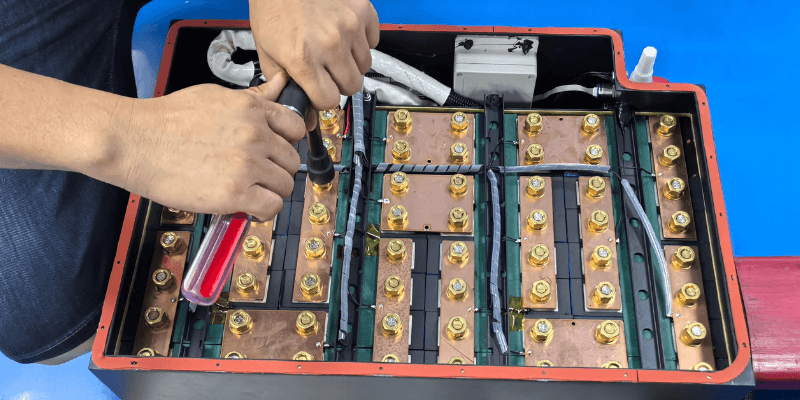
When budgeting a custom lithium battery pack for commercial equipment in 2027, two numbers determine whether a project makes financial sense: the recurring unit price (seller EXW quotation) and the non-recurring engineering (NRE), tooling, and compliance budget. Early estimates often drift because teams extrapolate from bulk EV cell $/kWh headlines and overlook BMS customization, enclosure engineering, third-party testing, and Class 9 dangerous-goods logistics.
As illustrative budgeting ranges for mid-volume OEM programs (100 to 500 packs per year, EXW excluding freight, import duties, tooling, and third-party lab fees), unit quotes can sit around $0.22 to $0.45 per Wh for standard-enclosure LiFePO4 packs, and $0.35 to $0.85 per Wh for compact, lower-energy (sub-1 kWh), high-discharge, or irregular-shape NMC packs. These are illustrative planning ranges rather than global market averages (which reflect gigawatt-scale EV contracts). Actual EXW pricing depends on cell brand, pack energy, discharge rate, per-batch order quantity, enclosure construction, and quotation date. One-time engineering and tooling costs can start at 0 $ when reusing an existing standard configuration with minimal setup, around $1,000+ when fixtures or custom parameter configuration are needed, and rise substantially for a custom battery pack requiring dedicated molds and UL certification.
Below is the cost framework we walk U.S. and European hardware teams through before quoting a build.
1. Recurring Manufacturing Cost Split: Where Each Dollar Goes
The table below shows an illustrative cost split (totaling 100%) of recurring manufacturing cost per pack for one mid-size project example: a 51.2V 50Ah (2.56 kWh, 16S LiFePO4) pack in a custom sheet-metal housing. This denominator covers direct materials, direct assembly and EOL testing labor, and UN transport packaging, and excludes factory overhead allocation, warranty reserves, one-time BMS firmware development (counted in Section 2 NRE), and external lab fees.
| Recurring Manufacturing Component | Illustrative Split: 51.2V 50Ah Sheet-Metal Example (Total = 100%) | Primary Cost Drivers Across Projects |
|---|---|---|
| Battery Cells (Grade A) | 56% | Chemistry (LiFePO4, NMC, or sodium-ion), cell supplier (EVE, REPT, Samsung, CATL), discharge C-rate, and incoming capacity/IR matching yield. |
| BMS Hardware, Flashing & Configuration | 16% | Series count (4S to 30S), continuous current MOSFET or contactor rating, balancing hardware, and per-unit firmware flashing and parameter setup. |
| Enclosure, Harness, Connectors & Attaches | 15% | PVC wrap vs. ABS/PC plastic vs. sheet metal or cast aluminum, IP67/IP68 sealing gaskets, potting compound, wire harnesses, terminals, and industrial connectors. |
| Assembly, Welding & EOL Testing | 9% | Laser busbar welding, mechanical assembly labor, cycle aging time, and per-unit serialized end-of-line (EOL) verification. |
| UN Transport Packaging & Étiquetage | 4% | UN-certified dangerous-goods cartons, internal fire-retardant dividers, and serialized traceability labels. |
Cost shares shift significantly with pack energy and mechanical complexity. In higher-energy assemblies using standard BMS hardware and off-the-shelf enclosures, battery cells can represent roughly 70 % à 80 % of recurring manufacturing cost per pack, while the remaining four components together account for 20% to 30%. Exact splits are always determined from the project’s internal BOM.
2. Illustrative One-Time Costs (NRE, Tooling & Prototypes)
Before serial production begins, one-time engineering design, custom BMS firmware development, assembly fixtures, prototype builds, and any dedicated molds must be funded. The table below shows illustrative Holo Battery project budgeting tiers (excluding third-party certification lab fees and destructive test samples; prototype unit prices are quoted separately based on sample quantity and CNC or soft-tooling needs).
| Customization Tier | Illustrative NRE / Tooling Budget (Excl. Lab Fees) | Typical Holo Production MOQ | What Is Typically Included |
|---|---|---|---|
| Tier 1: Existing Enclosure + Configured BMS | $0 to $1,500 | 50 to 100 units | $0 when reusing an existing standard build with no fixture changes; up to $1,500 when adjusting series/parallel layout, BMS parameter configuration, or custom output leads. |
| Tier 2: Custom Sheet Metal + Custom BMS Protocol | $1,500 to $6,000 | 100 to 300 units | Laser-cut aluminum or steel housing (no injection mold), one-time CANbus/RS485 firmware development, assembly fixtures, thermal pads, or IP67 sealing. |
| Tier 3: Dedicated Mold + Pack Designed for Third-Party Certification | $8,000 to $25,000+ (excl. lab fees) | 300 to 500+ units | Dedicated ABS/PC injection mold or die-cast housing, bespoke PCB layout, pre-compliance engineering, and fixture setup (third-party lab fees and destructive samples budgeted separately). |
Engineering prototypes carry a higher per-unit price than serial production because cells, custom harnesses, and CNC-machined housings are procured in small quantities without volume breaks. You can review how we structure sample and serial builds on our OEM and Private Label Battery Packs page.
3. Certification, Testing & Compliance Scope (US & European Markets)
Compliance scope is the most common source of late-stage budget surprises. A cell certificate such as UL 1642 does not certify a finished custom battery pack. Under UNECE Manual of Tests and Criteria guidelines, design changes that create a new battery type or could cause a test failure may require retesting, so enclosure, cell, or protection-circuit changes should always be evaluated before freezing a budget.
Actual lab fees and lead times vary widely by test house, pack energy, sample count, whether retesting is needed, and whether ongoing factory surveillance applies. Confirm a formal quote with an accredited lab rather than relying on generic estimates; timelines are typically measured from the date complete test samples arrive at the lab.
| Standard / Compliance Item | Target Region & Application | Budget & Planning Notes |
|---|---|---|
| UN 38.3 Testing & Test Summary | Global lithium battery transport (design-type test) | Required for production transport of new battery types. Specific regulatory exemptions and carrier approvals exist for qualifying low-volume production runs and prototypes (including dedicated air-freight approval rules). Budget for lab testing plus destructive test samples. |
| SDS & Shipment Documentation | Carrier & customs documentation by transport mode | Separate from UN 38.3 design testing. Whether an SDS or another permitted emergency-response format applies is governed by the relevant transport regulations, and individual carriers or freight forwarders may request additional documentation. |
| UL2054 | United States & Canada (commercial portable battery packs) | Third-party lab quote required; budget must include test samples, potential retesting, and ongoing UL follow-up factory inspection and listing maintenance fees. |
| UL 2271 | North America (light electric vehicles and mobility packs) | Confirm the exact mechanical, electrical, and abuse test scope under UL 2271 with an accredited lab; plan for lab fees, destructive samples, and ongoing UL maintenance charges. |
| UL1973 | North America (stationary storage, vehicle auxiliary power, and light electric rail) | Confirm exact safety and fault-tolerance evaluation scope with an accredited lab; factor in lab fees, engineering pre-compliance checks, test units, and annual surveillance costs. |
| CEI 62133-2 & CEI 62619 | European Union, UK & CB Scheme (portable vs. industrial/motive) | IEC 62133-2 covers portable sealed packs; IEC 62619 covers industrial stationary and motive equipment such as forklifts and AGVs (not on-road passenger vehicles). Budget covers CB lab testing and destructive samples. |
| EU Battery Regulation (2023/1542) | European Union (all placed-on-market industrial & portable batteries) | Separate from IEC lab testing. Budget for conformity assessment, EU Declaration of Conformity, technical documentation file, substance compliance, labeling, and traceability setup with your EU importer. |
For a detailed view of which files come from the cell maker versus what requires project-specific lab testing, see our Battery Testing and Compliance Support page.
4. Worked Amortization Example: How Year-1 Volume Changes Buyer Unit Budget
To see how fixed upfront costs affect buyer unit budgets, look at an illustrative example of a 51.2V 50Ah (2.56 kWh, 16S LiFePO4) industrial pack with a custom sheet-metal enclosure, CANbus BMS setup, and pack-level UN 38.3 testing. In the table below, all three columns represent Year 1 total volume, et $8,000 in fixed engineering, fixture, and testing costs is amortized completely across Year 1 (illustrative EXW unit prices plus amortized NRE, excluding freight and import duties).
| Cost Item (Illustrative Model) | 10 Packs (Year 1 Total) | 100 Packs (Year 1 Total) | 500 Packs (Year 1 Total) |
|---|---|---|---|
| Recurring Unit Price (EXW Quote) | $820 / pack | $640 / pack | $560 / pack |
| Engineering + BMS Setup + Fixtures ($3,000 amortized) | +$300 / pack | +$30 / pack | +$6 / pack |
| Pack-Level UN 38.3 Testing + Samples ($5,000 amortized) | +$500 / pack | +$50 / pack | +$10 / pack |
| First-Year Cost per Pack (Incl. NRE & Testing, Excl. Freight & Import Charges) | $1,620 / pack | $720 / pack | $576 / pack |
This example does not mean 100 units is a rigid threshold for every project, since standard-enclosure builds carry lower NRE while UL-listed molded packs carry much higher fixed costs. It illustrates the underlying math: at 10 packs in Year 1, fixed engineering and testing costs nearly double the effective cost of each battery ($1,620 vs. $820). If total program volume is very small, adapting equipment to an off-the-shelf battery is usually more economical than commissioning a custom build.
5. Why Quotes for the Same Voltage and Ah Can Differ Widely
When comparing factory quotes for the same nominal voltage and capacity, align the technical specification, warranty terms, and Incoterms first. Large price gaps usually trace back to four concrete differences:
- Cell origin, lot consistency, and matching discipline: Cell source, batch consistency, and incoming matching directly affect long-term capacity retention and pack balance. Buyers should verify incoming OCV/IR sorting tolerances and factory QR traceability records rather than relying on verbal claims.
- Continuous vs. short-duration BMS current rating: A BMS rated for 100A for a few seconds is very different from a BMS engineered to sustain 100A continuous discharge inside a sealed enclosure without overheating or tripping. Confirm continuous thermal derating, not just peak cutout numbers.
- Different Incoterms and dangerous-goods scope: Comparing an EXW factory price against CIF or DDP quotes creates an apples-to-oranges gap. Under EXW (Incoterms 2020), the seller is responsible for appropriate packaging and marking for transport, while the buyer arranges pickup, export and import clearance, and main freight. Always confirm in the quote whether UN-certified dangerous-goods packaging for air or sea mode is included. Under CIF, the seller covers ocean freight and basic marine insurance to the destination port while the buyer handles import customs and duties. Under DDP, the seller assumes freight, customs clearance, and import duty obligations to the named destination.
- End-of-line testing depth: Skipping per-unit load testing and serialized EOL logging lowers factory labor cost, but shifts defect discovery from the test bench to your customer’s equipment.
6. Four Practical Ways to Control Custom Pack Cost Without Cutting Safety
- Use widely stocked cell formats: Selecting common 21700 cylindrical cells or standard prismatic LFP footprints (such as 100Ah, 230Ah, or 280Ah) can reduce sourcing constraints and shorten lead times, though supplier order minimums may still apply.
- Start with sheet metal before injection molding: For pilot runs and early production batches, powder-coated aluminum or steel enclosures avoid high plastic mold investments and let you refine mounting brackets after field testing.
- Share your real duty cycle instead of a padded worst case: Oversizing continuous current requirements forces heavier busbars, larger contactors, and higher-rate cells that add cost and weight without extending service life.
- Align voltage with standard controller cutoffs: Sticking to proven 4S (12.8V), 8S (25.6V), 16S (51.2V), or 24S (76.8V) platforms lets you leverage validated BMS hardware and off-the-shelf chargers.