

Compared with two years ago, the U.S. lithium-ion battery industry has changed a lot. After the federal EV tax credit ended in September 2025, several cell plants slowed EV output and shifted lines to LFP cells for energy storage, while defense and industrial buyers began asking harder questions about where their cells come from.
This guide lists 12 lithium-ion battery manufacturers in the USA, split into two groups that buyers often confuse: battery cell manufacturers (the gigafactories that make the cells themselves) and battery pack and system manufacturers (the companies that design and assemble finished battery packs for OEMs). Knowing which group you need saves weeks of emailing the wrong suppliers.
Quick Comparison: 12 Lithium-Ion Battery Manufacturers in the USA
| Company | U.S. location | Type | Main focus |
|---|---|---|---|
| Tesla | Sparks, Nevada | Battery cells and systems | EV cells; LFP cells for Megapack and Powerwall |
| Panasonic Energy | Sparks, NV & De Soto, KS | Battery cells | Cylindrical EV cells; planning energy storage lines |
| LG Energy Solution | Holland & Lansing, Michigan | Battery cells and energy storage | LFP cells for energy storage; EV cells |
| Ultium Cells | Warren, OH & Spring Hill, TN | Battery cells | GM and LGES joint venture; LFP cells for energy storage |
| SK Battery America | Commerce, Georgia | Battery cells | EV and energy storage cells |
| EnerSys | Reading, Pennsylvania | Battery packs and systems | Motive power, telecom, defense |
| Ultralife | Newark, New York | Battery cells and packs | Military and specialty batteries |
| East Penn (Deka) | Lyon Station, Pennsylvania | Battery packs | Lithium forklift and pallet jack batteries |
| Inventus Power | Woodridge, Illinois | Custom battery packs | Medical, defense and industrial OEM battery packs |
| Epec | New Bedford, Massachusetts | Custom battery packs | Low-to-mid volume custom battery packs |
| Dragonfly Energy | Reno, Nevada | Battery packs | LiFePO4 batteries for RV, trucking and marine |
| ProTechnologies (PTI) | Pilot Mountain, North Carolina | Custom battery packs | Industrial OEM battery pack assembly |
U.S. Lithium-Ion Battery Cell Manufacturers
These companies produce cells at gigawatt-hour scale. They mostly sell to automakers and large energy storage integrators under long-term contracts, so a typical OEM ordering a few thousand battery packs a year will not buy cells from them directly. They matter for understanding where U.S. supply is heading.
1. Tesla
- Location: Sparks, Nevada (Gigafactory Nevada)
- Company type: Battery cell, battery pack and system manufacturer
- Website: www.tesla.com
Gigafactory Nevada is one of the largest lithium-ion battery plants in the world and the original home of Tesla’s partnership with Panasonic, which still produces cells on site.
In 2025 Tesla built its first North American LFP cell factory at the Nevada site to supply Megapack and Powerwall, cells it previously imported. In July 2026 Tesla began shipping the first Megapacks with American-made LFP cells.
2. Panasonic Energy
- Locations: Sparks, Nevada / De Soto, Kansas
- Company type: Battery cell manufacturer
- Website: energy.panasonic.com

Panasonic produces cylindrical lithium-ion cells inside Gigafactory Nevada and opened a second U.S. plant in De Soto, Kansas, in July 2025. The De Soto site covers nearly 5 million square feet; by mid-2026 it was running four production lines, about half of its planned eight.
With EV demand slowing, Panasonic said in June 2026 that it will convert part of its Kansas plant to make batteries for data center energy storage, with that production expected to begin in 2029.
3. LG Energy Solution
- Locations: Holland, Michigan / Lansing, Michigan
- Company type: Battery cell and energy storage manufacturer
- Website: www.lgensol.com
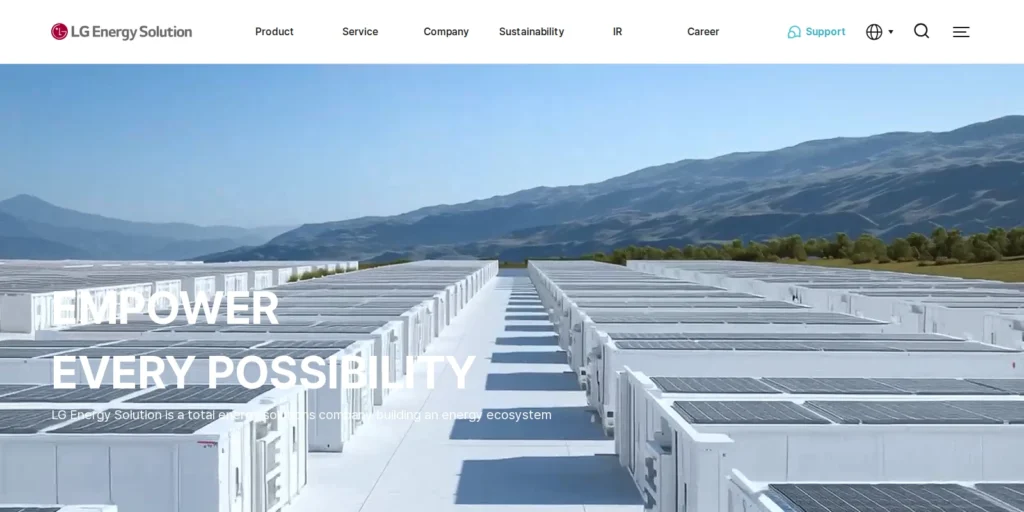
LG Energy Solution runs a wholly owned LFP cell plant in Holland, Michigan, and in August 2026 started production at its Lansing plant, which it took over from GM in 2025. Lansing targets more than 35 GWh a year and will make LFP cells for energy storage and NMC cells for Toyota.
LGES plans more than 50 GWh of North American LFP capacity by the end of 2026, making it the largest domestic source of LFP cells for stationary storage.
4. Ultium Cells
- Locations: Warren, Ohio / Spring Hill, Tennessee
- Company type: Battery cell manufacturer (GM and LG Energy Solution joint venture)
- Website: www.ultiumcell.com

Ultium Cells was formed to supply cells for General Motors electric vehicles. After the federal tax credit ended, the Warren plant stopped production in January 2026. It restarted in August 2026 after a seven-month shutdown, with about 1,400 employees back on site.
At Spring Hill, part of the plant was converted, at a cost of about $70 million, to produce LFP cells for energy storage systems. Production started in mid-2026, and about 700 laid-off workers were recalled. These cells go to the U.S. energy storage business of LG Energy Solution.
5. SK Battery America
- Location: Commerce, Georgia
- Company type: Battery cell manufacturer (subsidiary of SK On)
- Website: www.skbatteryamerica.com

SK On’s Georgia complex represents about $2.6 billion of investment and roughly 22 GWh of planned annual capacity. It has supplied cells for the Volkswagen ID.4, the Ford F-150 Lightning and Hyundai and Kia models, and it also makes cells for stationary energy storage.
In March 2026 the company cut 958 jobs at the site, citing weak U.S. EV demand. SK On also took full control of the former BlueOval SK plant in Tennessee after ending its joint venture with Ford.
U.S. Battery Pack and System Manufacturers
If you need a finished battery for a product such as a forklift, robot, medical device or vehicle, these are the companies you would actually talk to. They buy cells, design the BMS and enclosure, and handle certification.
6. EnerSys
- Location: Reading, Pennsylvania
- Company type: Industrial battery and system manufacturer
- Website: www.enersys.com
EnerSys is one of the world’s largest industrial battery companies, serving motive power (forklifts and material handling), energy systems (telecom and data centers) and specialty markets, including aerospace and defense.
In July 2026 it narrowed its planned Greenville, South Carolina, lithium cell plant to an initial 1 GWh of defense-focused production. In October 2026 EnerSys agreed to acquire Ultralife for about $320 million, with closing expected in early 2027.
7. Ultralife
- Location: Newark, New York
- Company type: Battery cell and battery pack manufacturer
- Website: www.ultralifecorporation.com

Ultralife makes rechargeable and non-rechargeable batteries, battery systems and communications equipment, mainly for military and specialty customers. It reported about $191 million in fiscal 2025 revenue and has more than 700 employees across the U.S., Canada, the UK and China.
Its pending acquisition by EnerSys (see above) is expected to close in the first quarter of 2027.
8. East Penn Manufacturing (Deka)
- Location: Lyon Station, Pennsylvania
- Company type: Battery manufacturer
- Website: www.eastpennmanufacturing.com

East Penn is a family-owned company best known as the world’s largest single-site lead-acid battery maker, sold under the Deka brand.
Its Deka Ready Power lithium-ion line covers forklifts and pallet jacks, giving warehouse fleets a maintenance-free alternative to flooded lead-acid batteries from a supplier they may already use.
9. Inventus Power
- Location: Woodridge, Illinois
- Company type: Custom battery pack manufacturer
- Website: www.inventuspower.com

Inventus Power designs custom and standard lithium-ion battery packs, chargers and power supplies for OEMs in medical, aerospace and defense, fleet and industrial markets.
It manufactures in the U.S., Mexico, China and Brazil. Private equity firm H.I.G. Capital acquired the company in April 2026.
10. Epec Engineered Technologies
- Location: New Bedford, Massachusetts
- Company type: Custom battery pack manufacturer
- Website: www.epectec.com

Epec designs and builds custom battery packs in a 55,000-square-foot (about 5,100 m²) facility in New Bedford that houses engineering, a prototype lab and production. It uses name-brand cells from suppliers such as Panasonic, Samsung, LG and Molicel.
Like many U.S. battery pack makers, Epec pairs U.S. engineering with production partners in Asia for higher volumes, a model worth understanding before you compare quotes.
11. Dragonfly Energy
- Location: Reno, Nevada
- Company type: LiFePO4 battery and system manufacturer
- Website: www.dragonflyenergy.com

Dragonfly Energy sells LiFePO4 batteries under the Battle Born brand, best known in the RV market, and supplies integrated power systems for heavy-duty trucking and industrial customers.
In July 2026 it bought the Dakota Lithium brand assets to expand into marine, powersports and golf cart batteries. It is also developing a dry electrode process aimed at solid-state cell manufacturing.
12. ProTechnologies (PTI)
- Location: Pilot Mountain, North Carolina
- Company type: Custom battery pack manufacturer
- Website: protechnologies.com
PTI designs and assembles custom industrial battery packs for OEMs and offers a lifetime warranty on its workmanship.
It is a subsidiary of Universal Power Group, a distributor of batteries, power products and wire and cable.
Made in the USA vs. Designed in the USA
Before comparing quotes, ask each supplier where the cells are made and where the battery pack is assembled. Most lithium-ion cells used in U.S. battery packs are still imported, and several well-known U.S. battery pack companies run part of their production in Mexico or Asia. That is not a problem in itself, but it affects price, lead time and whether a battery pack meets domestic-content rules.
- Defense and government programs: These may require FEOC-compliant or domestically sourced cells. Ask for the cell origin in writing.
- Commercial OEMs: They usually care more about cell grade, BMS quality, certifications and total delivered cost than about the country on the label.
- Low volumes: Prototypes and orders of a few hundred units are often easiest with a U.S. assembler. At higher volumes, production in Asia usually saves the most.
How to Choose a Lithium-Ion Battery Manufacturer
- Cells: Which brand and grade? Can they show UN 38.3, IEC 62133 or UL 1642 reports for the exact cell?
- Battery pack certification: Do they have experience with UL 2054, UL 1973 or UL 2271, depending on your application?
- BMS: Is the battery management system designed in-house, and can they adjust protection limits and communication (CAN, RS485, SMBus) for your device?
- Volume fit: What are the MOQ and NRE costs? A gigafactory will not take a 500-unit order; a small assembler may struggle at 50,000.
- Lead time: Ask for separate sample and production lead times, and what happens if a cell supply changes.
- Total delivered cost: For imported battery packs, compare DDP quotes that include freight, duties and dangerous-goods shipping, not just ex-works prices.
For a deeper checklist, see these guides:
Sourcing Custom Battery Packs from Overseas
Holo Battery is not a U.S. manufacturer, and we don’t claim to be. We are a custom lithium battery pack manufacturer that builds LiFePO4 and lithium-ion battery packs for OEMs in the United States and Europe.
- Samples in 10–15 working days; production runs in 25–30 working days
- DDP delivery to the United States by air or sea, so the quote includes freight and duties
- Grade-A cells certified to UN 38.3, IEC 62133 and UL 1642; battery pack UL or IEC certification arranged per project
- Custom BMS, enclosure and connector design, plus OEM and private label options
Typical applications:
- AGV and mobile robot batteries
- Forklift batteries
- Golf cart and LSV batteries
- Energy storage batteries
- Marine battery packs
- OEM and private label battery packs
If a U.S. assembler’s quote or lead time doesn’t fit your project, send us your specifications. We will reply with a configuration and a DDP price.
Contact Holo Battery for a quote | Our battery pack manufacturing services
FAQ
Who is the largest lithium-ion battery manufacturer in the USA?
By cell output, the largest U.S. producers are the gigafactories run by Tesla and Panasonic in Nevada, LG Energy Solution in Michigan and SK On in Georgia. For industrial batteries and systems, EnerSys is one of the largest U.S.-headquartered companies.
Are LiFePO4 cells made in the USA?
Yes, and production is growing. Tesla makes LFP cells in Nevada for its storage products, LG Energy Solution makes LFP cells in Holland and Lansing, Michigan, and Ultium Cells now makes LFP cells for energy storage at its Spring Hill, Tennessee, plant. Most of this output goes to large storage systems rather than to small OEMs.
Can a small company buy cells directly from a U.S. gigafactory?
Usually not. Gigafactories sell their cells under large, long-term contracts. Smaller OEMs normally work with a battery pack manufacturer that buys cells from these producers or from cell makers abroad.
How long does it take to make a custom lithium battery pack?
It depends on the design and certification needs. A typical schedule is a few weeks for engineering and samples, then testing, then production. At Holo Battery, samples take 10–15 working days and production runs take 25–30 working days once the design is approved.
Related Articles: