

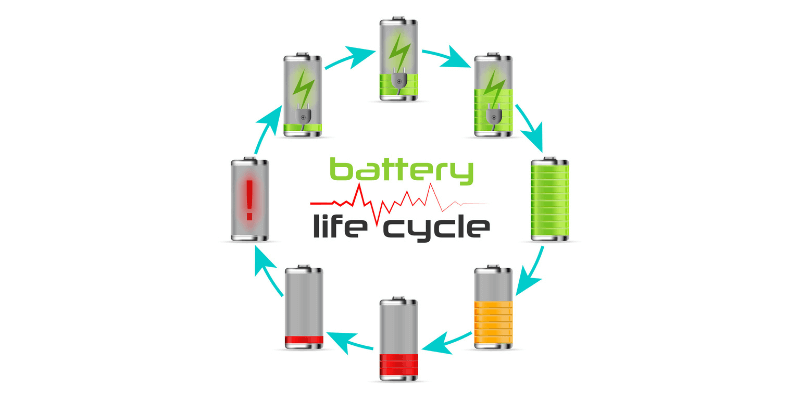
Battery cycle life is the number of charge and discharge cycles a battery delivers before its capacity fades to 80 percent of the original rating.
The numbers vary widely by chemistry. A lead-acid battery typically lasts 300 to 500 cycles. A LiFePO4 battery can reach 3500 to 6000 cycles under the same conditions.
Why the gap? Depth of discharge, temperature, and charging habits all play a role. This guide breaks down each factor.
Understanding Battery Cycle Life and Depth of Discharge (DOD)
One complete battery cycle represents cumulative energy discharge equal to 100 percent of rated capacity, followed by a complete recharge.
Discharging a battery to 50 percent capacity, recharging it fully, and repeating the process next day constitutes exactly one full operational cycle.
Battery longevity depends fundamentally upon depth of discharge (DoD), which measures the percentage of stored capacity withdrawn during discharge relative to total capacity.
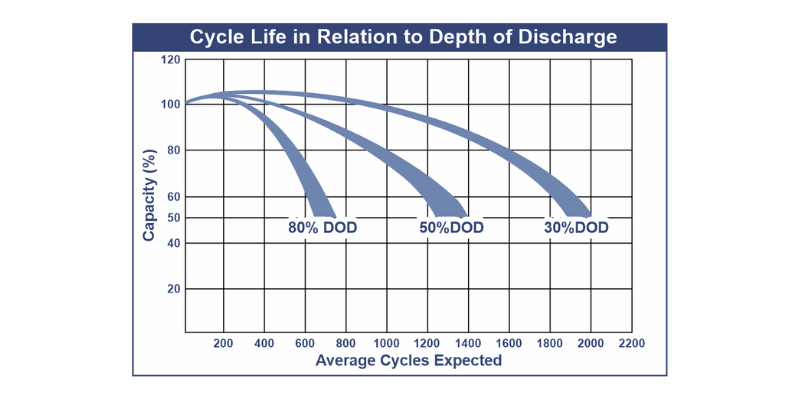
In industrial battery management, state of charge (SoC) and discharge depth are tracked using precision shunt monitors such as the Victron BMV-700. Restricting discharge cycles to shallower levels multiplies total deliverable cycles exponentially, as illustrated below:
Battery Cycle Life Benchmarks Across Chemistries
To compare theoretical and operational cycle endurance across different battery chemistries, review the following engineering benchmarks based on eighty percent remaining capacity:
| Battery Chemistry | Nominal Voltage | Cycle Life (80% EOL) | Optimal DOD | Thermal Sensitivity |
|---|---|---|---|---|
| LiFePO4 (Lithium Iron Phosphate) | 3.2V | 3,500 to 6,000 cycles | 80% to 90% | Very Low (Robust) |
| NMC (Nickel Manganese Cobalt) | 3.6V to 3.7V | 1,000 to 2,000 cycles | 70% to 80% | Moderate |
| LTO (Lithium Titanate) | 2.3V to 2.4V | 15,000 to 25,000 cycles | 90% to 100% | Extremely Low |
| LiCoO2 (LCO) | 3.7V | 500 to 800 cycles | 60% to 70% | High |
| Absorbent Glass Mat (AGM) | 12V system | 400 to 600 cycles | 50% maximum | High |
Lithium Iron Phosphate (LiFePO4) vs. NMC Lithium-Ion
Lithium iron phosphate chemistry provides exceptional mechanical stability in its crystal olivine lattice. Because strong covalent phosphorus-oxygen bonds withstand high cycling stress without structural collapse, LiFePO4 cells deliver between 3500 and 6000 cycles at 80 percent DOD.
For applications requiring long service life in solar energy storage, marine propulsion, or automated guided vehicles, specifying customized LiFePO4 solutions eliminates frequent battery replacement cycles.
Advanced Lithium Chemistries vs. Deep-Cycle Lead-Acid
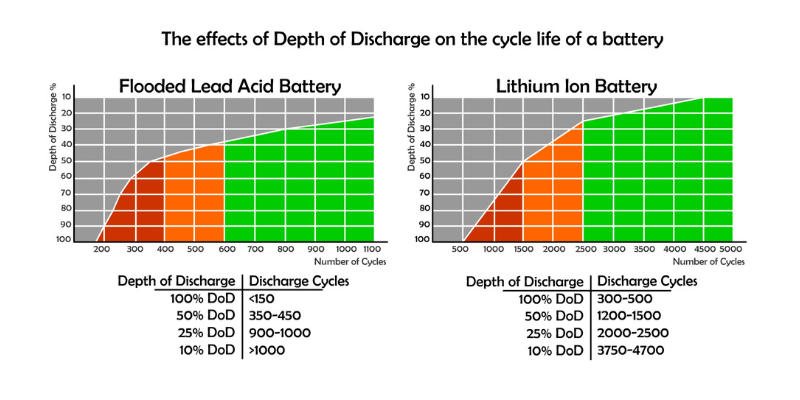
Conventional lead-acid batteries, including flooded and sealed AGM variants, suffer severe degradation when discharged deeply. Deep discharge causes coarse lead sulfate crystal formation on the plates, restricting cycle life to 300 to 500 cycles under heavy duty cycles. By contrast, lithium-based systems tolerate deep discharge cycles with minimal degradation, providing 5 to 10 times higher cycle endurance:
Primary Degradation Mechanisms and Lifecycle Optimization Protocols
Thermal Stress and Operating Temperature Management
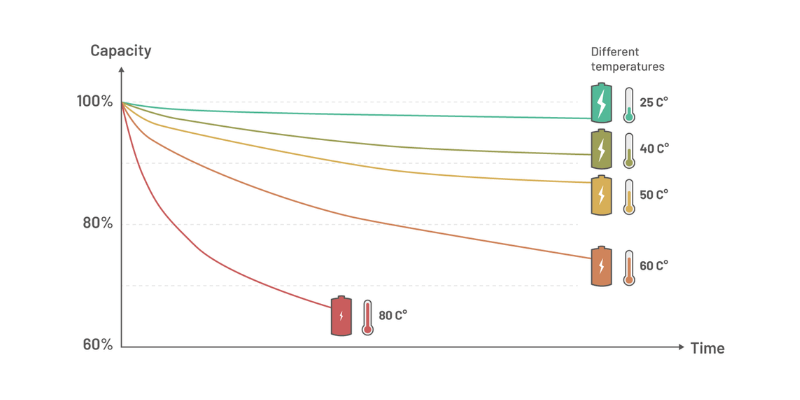
Operating temperature profoundly dictates chemical reaction rates and aging velocity. While elevated temperatures lower internal resistance temporarily, they accelerate parasitic side reactions and SEI layer growth.
Laboratory testing confirms that lithium battery performance dropped about 3. 3% at 77°F and 6. 7% at 113°F over the first 200 cycles. For lead-acid configurations, battery lifespan halves with every 15-degree increase above 77°F.
Depth of Discharge Limits and Cycle Multiplication
Restricting maximum discharge depth preserves the host crystal lattice of positive and negative electrodes. For lead-acid systems, limiting discharge to 50 percent DOD instead of 80 percent doubles operating life. For lithium systems, programming battery management system cutoffs to operate between 15 percent and 85 percent state-of-charge significantly multiplies total cycle life compared to full 100 percent swings.
Charge Current Rates, C-Rate Impacts, and SEI Growth
Subjecting cells to rapid charging above 1C generates high localized Joule heating and concentration polarization. In lithium-ion cells, excessive charging rates force lithium ions to deposit as metallic lithium plating onto the graphite anode rather than intercalating smoothly. Maintaining charging rates at or below 0.5C minimizes structural cracking in cathode particles and slows solid electrolyte interphase (SEI) impedance growth.
Electrolyte Stability, Sulfation, and Dendrite Mitigation
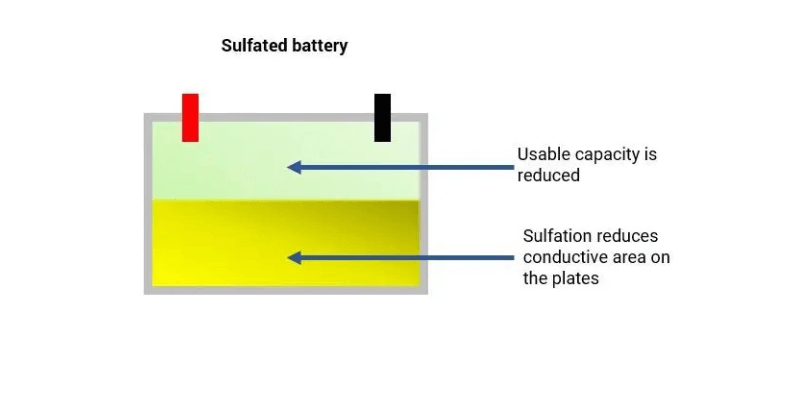
Deep-cycle batteries depend upon an electrolyte solution to conduct ions between electrodes. In flooded lead-acid batteries, chronic undercharging causes severe plate sulfation, where amorphous lead sulfate recrystallizes into dense, insoluble barriers:
To mitigate these degradation pathways, automated multi-stage charging profiles must include conditioning absorption phases for lead-acid systems, while lithium battery packs mandate calibrated cell balance circuits to avoid overcharging individual series elements.
Frequently Asked Questions on Battery Longevity
Can a lithium battery operate effectively once capacity drops below eighty percent?
Yes. Reaching eighty percent capacity marks the standard end of primary service life for critical applications such as electric vehicles or high-drain tools. However, these retired cells remain highly effective for secondary, stationary solar energy storage where space and weight constraints are secondary.
What is the technical difference between calendar life and operational cycle life?
Cycle life measures degradation caused by active charge and discharge actions. Calendar life tracks chemical decomposition over elapsed time, which occurs even when batteries sit idle in climate-controlled storage under resting open-circuit conditions.
Does rapid charging permanently reduce total cycle life?
Charging continuously above 1C generates high localized Joule heating and concentration polarization. Over repeated sessions, this elevated current promotes solid electrolyte interface growth, reducing total lifetime cycles compared to standard 0.5C charging protocols.