

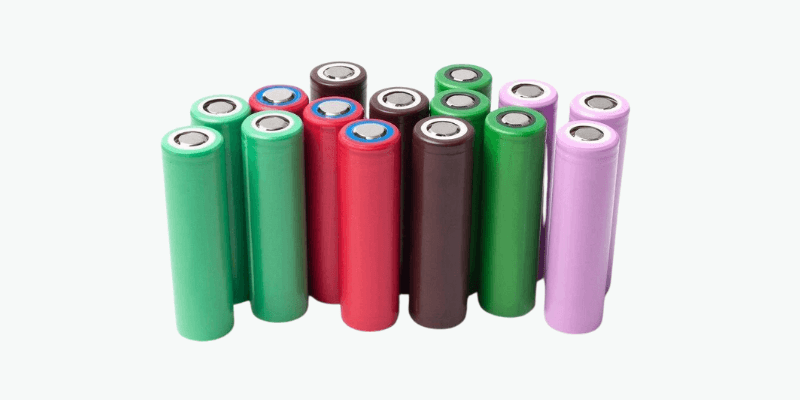
IMR, ICR, INR, and IFR are not marketing labels. Each acronym names the cathode chemistry inside an 18650 cell, and that chemistry decides voltage, discharge current, safety, and lifespan.
The letters decode simply: M is manganese, C is cobalt, N is nickel, and F is iron. The R means rechargeable.
Picking the wrong chemistry for a high-drain application can mean overheating or early failure. Here is what each type does best.
Decoding 18650 Chemistry Acronyms: The Cathode Classification System
In standard battery industry nomenclature, the first letter I designates Lithium-Ion technology. The second letter defines the core cathode chemical element: M for Manganese, C for Cobalt, N for Nickel, and F for Iron (Ferro).
The third letter R identifies cylindrical rechargeable cells. The standard numbers 18650 signify an 18 mm diameter and a 65 mm length, with capacities ranging from 1200 mAh to 3600 mAh depending on chemistry.
Selecting the appropriate lithium-ion batteries chemistry dictates pack safety, operational current limits, and thermal management hardware.
Comparison Chart
While qualitative comparisons note general trade-offs, industrial pack design requires precise electrical and thermal ratings. The following engineering matrix details operational thresholds across all four chemistries:
| Code | Cathode Chemistry | Nominal / Peak Voltage | Continuous Discharge Rate | Thermal Runaway Threshold | Primary Application |
|---|---|---|---|---|---|
| IMR | LiMn2O4 (Lithium Manganese Oxide) | 3.7V / 4.2V | High (15A to 30A) | 250 degrees Celsius | High-drain power tools, medical aspirators |
| ICR | LiCoO2 (Lithium Cobalt Oxide) | 3.7V / 4.2V | Low to Moderate (1C to 2C) | 150 degrees Celsius | Laptops, low-drain utility packs (Protection circuit required) |
| INR | LiNiMnCoO2 (Nickel Manganese Cobalt) | 3.6V / 4.2V | High to Very High (10A to 35A) | 210 degrees Celsius | Electric mobility, robotics, heavy industrial equipment |
| IFR | LiFePO4 (Lithium Iron Phosphate) | 3.2V / 3.65V | High (3C to 10C) | 270 degrees Celsius | Solar energy storage, marine electronics, telecommunications |
IMR 18650 Battery
IMR cells use Lithium Manganese Oxide (LiMn2O4) arranged in a three-dimensional spinel crystal structure. This open crystalline lattice enables rapid three-dimensional lithium-ion diffusion, resulting in low internal resistance and outstanding high-drain discharge capabilities.
IMR cells sustain continuous discharge loads between 15A and 30A without excessive heating. Furthermore, the manganese spinel framework exhibits strong structural stability, withstanding temperatures up to 250 degrees Celsius before risking thermal runaway.
While volumetric capacity is slightly reduced (typically 1500 mAh to 2500 mAh), IMR cells power equipment requiring immediate pulse currents.

ICR 18650 Battery
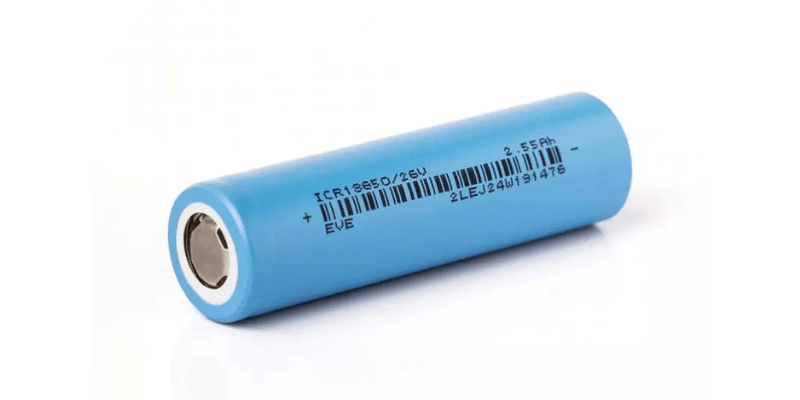
ICR cells incorporate Lithium Cobalt Oxide (LiCoO2) in a layered cathode structure, delivering the highest specific energy density among early lithium formulations (reaching up to 2800 mAh to 3500 mAh).
However, the cobalt oxide lattice possesses lower thermal stability, decomposing at approximately 150 degrees Celsius and releasing oxygen gas into volatile electrolytes. Due to elevated internal impedance, continuous discharge is typically restricted to 1C to 2C.
ICR cells must never be operated without dedicated protection circuit modules (PCMs) monitoring overcharge, overdischarge, and short-circuit conditions.
INR 18650 Battery
INR cells use Lithium Nickel Manganese Cobalt Oxide (LiNiMnCoO2, or NMC), representing the dominant chemistry in modern industrial battery design.
This ternary formulation combines the high energy density of nickel, the structural stability and low impedance of manganese, and the stabilizing properties of cobalt.
INR cells achieve high capacities (3000 mAh to 3500 mAh) while sustaining continuous discharge currents of 20A to 35A.
With thermal runaway thresholds around 210 degrees Celsius, INR cells serve as the core power source for electric motorcycles, power tools, and autonomous robotics.

IFR 18650 Battery
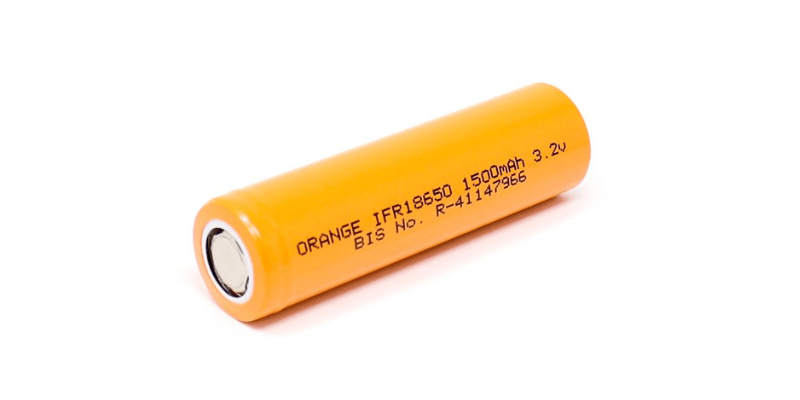
IFR cells employ Lithium Iron Phosphate (LiFePO4) as cathode material.
Due to reliable covalent phosphorus-oxygen bonds in the olivine crystal structure, IFR chemistry delivers the highest intrinsic safety profile across the battery industry, remaining completely stable up to 270 degrees Celsius without releasing combustible oxygen.
While nominal operating voltage is lower at 3.2V (compared to 3.6V to 3.7V for other chemistries) and capacity is moderate (1100 mAh to 1800 mAh), IFR cells deliver over 2000 to 4000 full discharge cycles, making them ideal for stationary solar systems, marine telemetry, and emergency backup power.
FAQs
What Are The Specs Of The 18650 Battery?
Standard 18650 cells feature an 18 mm diameter and 65 mm cylinder length. Depending on cathode chemistry, nominal voltage ranges from 3.2V (IFR) to 3.6V-3.7V (IMR, ICR, INR), with maximum charge voltage reaching 4.20V (3.65V for IFR) and usable capacities between 1200 mAh and 3600 mAh.
Can you mix IMR and INR 18650 cells in the same pack?
Never mix different chemical formulations in one multi-cell assembly. Discrepancies in internal resistance, voltage curves, and discharge rates cause accelerated cell degradation and severe pack imbalance.
Which 18650 chemistry provides the highest intrinsic thermal safety?
IFR (LiFePO4) exhibits the highest thermal runaway resistance, remaining stable up to 270 degrees Celsius due to strong covalent phosphorus-oxygen bonds in the cathode crystal lattice.
Why do IFR batteries have a lower nominal voltage (3.2V) than other 18650 cells?
Nominal cell voltage is dictated by the chemical reduction-oxidation potential between cathode active materials and the lithium metal reference. The Fe3+/Fe2+ redox couple in LiFePO4 operates at 3.45V versus Li/Li+, producing a flat 3.2V discharge plateau compared to the higher 3.7V potential of cobalt and nickel couples.
Why are ICR 18650 cells rarely used without integrated protection circuit boards (PCBs)?
Because LiCoO2 decomposes exothermically at roughly 150 degrees Celsius, overcharging past 4.25V rapidly induces thermal runaway. An integrated protection board is mandatory to cut off charging current during accidental overvoltage or dead-short scenarios.